

Novel Bioreactors for Culturing Marine Organisms 12.5 Immobilized-Cell Bioreactors 355
Part B | 12.5
R2
V
P
OHT
Shrimp
maturation
tank
CT
FB
R1
R4
V
R3
AS
R6
V
V
R5
V
V
V
AT
PB
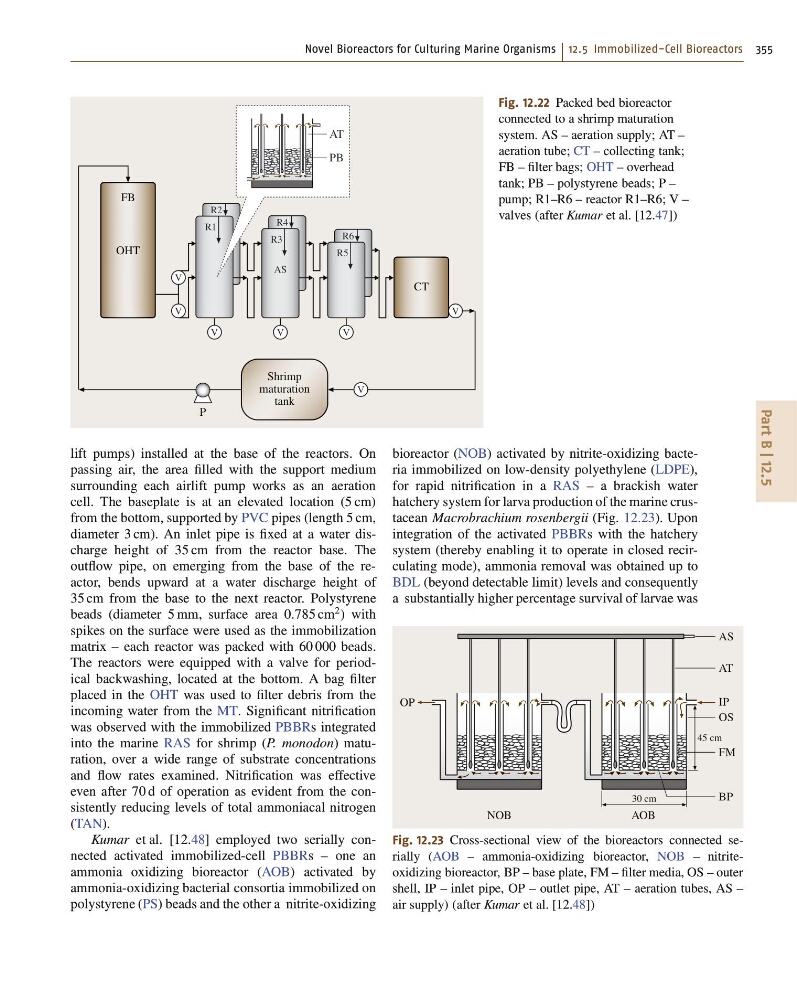
Fig. 12.22 Packed bed bioreactor
connected to a shrimp maturation
system. AS – aeration supply; AT –
aeration tube; CT – collecting tank;
FB – filter bags; OHT – overhead
tank; PB – polystyrene beads; P –
pump; R1–R6 – reactor R1–R6; V –
valves (after Kumar et al. [12.47])
lift pumps) installed at the base of the reactors. On
passing air, the area filled with the support medium
surrounding each airlift pump works as an aeration
cell. The baseplate is at an elevated location (5 cm)
from the bottom, supported by PVC pipes (length 5 cm,
diameter 3 cm). An inlet pipe is fixed at a water discharge height of 35 cm from the reactor base. The
outflow pipe, on emerging from the base of the reactor, bends upward at a water discharge height of
35 cm from the base to the next reactor. Polystyrene
beads (diameter 5 mm, surface area 0:785 cm
2 ) with
spikes on the surface were used as the immobilization
matrix – each reactor was packed with 60 000 beads.
The reactors were equipped with a valve for periodical backwashing, located at the bottom. A bag filter
placed in the OHT was used to filter debris from the
incoming water from the MT. Significant nitrification
was observed with the immobilized PBBRs integrated
into the marine RAS for shrimp (P. monodon) maturation, over a wide range of substrate concentrations
and flow rates examined. Nitrification was effective
even after 70 d of operation as evident from the consistently reducing levels of total ammoniacal nitrogen
(TAN).
Kumar et al. [12.48] employed two serially connected activated immobilized-cell PBBRs – one an
ammonia oxidizing bioreactor (AOB) activated by
ammonia-oxidizing bacterial consortia immobilized on
polystyrene (PS) beads and the other a nitrite-oxidizing
bioreactor (NOB) activated by nitrite-oxidizing bacteria immobilized on low-density polyethylene (LDPE),
for rapid nitrification in a RAS – a brackish water
hatchery system for larva production of the marine crustacean Macrobrachium rosenbergii (Fig. 12.23). Upon
integration of the activated PBBRs with the hatchery
system (thereby enabling it to operate in closed recirculating mode), ammonia removal was obtained up to
BDL (beyond detectable limit) levels and consequently
a substantially higher percentage survival of larvae was
AS
IP
AT
OS
OP
FM
BP
AOB
NOB
30 cm
45 cm
Fig. 12.23 Cross-sectional view of the bioreactors connected serially (AOB – ammonia-oxidizing bioreactor, NOB – nitriteoxidizing bioreactor, BP – base plate, FM – filter media, OS – outer
shell, IP – inlet pipe, OP – outlet pipe, AT – aeration tubes, AS –
air supply) (after Kumar et al. [12.48])
Part B | 12.5
R2
V
P
OHT
Shrimp
maturation
tank
CT
FB
R1
R4
V
R3
AS
R6
V
V
R5
V
V
V
AT
PB
Fig. 12.22 Packed bed bioreactor
connected to a shrimp maturation
system. AS – aeration supply; AT –
aeration tube; CT – collecting tank;
FB – filter bags; OHT – overhead
tank; PB – polystyrene beads; P –
pump; R1–R6 – reactor R1–R6; V –
valves (after Kumar et al. [12.47])
lift pumps) installed at the base of the reactors. On
passing air, the area filled with the support medium
surrounding each airlift pump works as an aeration
cell. The baseplate is at an elevated location (5 cm)
from the bottom, supported by PVC pipes (length 5 cm,
diameter 3 cm). An inlet pipe is fixed at a water discharge height of 35 cm from the reactor base. The
outflow pipe, on emerging from the base of the reactor, bends upward at a water discharge height of
35 cm from the base to the next reactor. Polystyrene
beads (diameter 5 mm, surface area 0:785 cm
2 ) with
spikes on the surface were used as the immobilization
matrix – each reactor was packed with 60 000 beads.
The reactors were equipped with a valve for periodical backwashing, located at the bottom. A bag filter
placed in the OHT was used to filter debris from the
incoming water from the MT. Significant nitrification
was observed with the immobilized PBBRs integrated
into the marine RAS for shrimp (P. monodon) maturation, over a wide range of substrate concentrations
and flow rates examined. Nitrification was effective
even after 70 d of operation as evident from the consistently reducing levels of total ammoniacal nitrogen
(TAN).
Kumar et al. [12.48] employed two serially connected activated immobilized-cell PBBRs – one an
ammonia oxidizing bioreactor (AOB) activated by
ammonia-oxidizing bacterial consortia immobilized on
polystyrene (PS) beads and the other a nitrite-oxidizing
bioreactor (NOB) activated by nitrite-oxidizing bacteria immobilized on low-density polyethylene (LDPE),
for rapid nitrification in a RAS – a brackish water
hatchery system for larva production of the marine crustacean Macrobrachium rosenbergii (Fig. 12.23). Upon
integration of the activated PBBRs with the hatchery
system (thereby enabling it to operate in closed recirculating mode), ammonia removal was obtained up to
BDL (beyond detectable limit) levels and consequently
a substantially higher percentage survival of larvae was
AS
IP
AT
OS
OP
FM
BP
AOB
NOB
30 cm
45 cm
Fig. 12.23 Cross-sectional view of the bioreactors connected serially (AOB – ammonia-oxidizing bioreactor, NOB – nitriteoxidizing bioreactor, BP – base plate, FM – filter media, OS – outer
shell, IP – inlet pipe, OP – outlet pipe, AT – aeration tubes, AS –
air supply) (after Kumar et al. [12.48])