

Part B | 12.3
348 Part B Tools and Methods in Marine Biotechnology
150 ml
sample
Sampling port
Fluorescent
lamp
b)
a)
60 µm
sparger
Air inlett
Draft tube
15 Watt
fluorescent lamps
(4× array)
Circulating
water bath
CO 2
Air
12 mm sample line
Air outlet
Spent medium
(125 µm outlet
filter)
Air humidifier
Air humidifier
Air pump
Air
rotameter
Fresh
medium
reservoir
Peristaltic
pump
pH
8.2
D.O.
100 %
Air filter
Sparger
assembly
Illumination stage
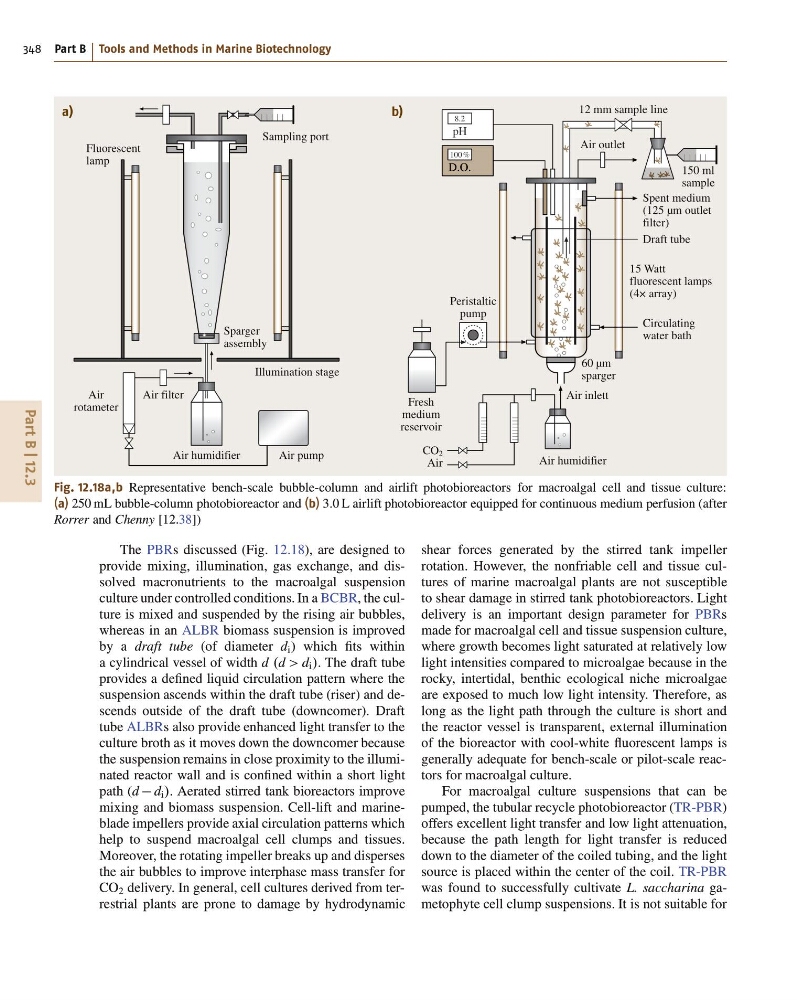
Fig. 12.18a,b Representative bench-scale bubble-column and airlift photobioreactors for macroalgal cell and tissue culture:
(a) 250 mL bubble-column photobioreactor and (b) 3:0 L airlift photobioreactor equipped for continuous medium perfusion (after
Rorrer and Chenny [12.38])
The PBRs discussed (Fig. 12.18), are designed to
provide mixing, illumination, gas exchange, and dissolved macronutrients to the macroalgal suspension
culture under controlled conditions. In a BCBR, the culture is mixed and suspended by the rising air bubbles,
whereas in an ALBR biomass suspension is improved
by a draft tube (of diameter d i ) which fits within
a cylindrical vessel of width d .d > d i /. The draft tube
provides a defined liquid circulation pattern where the
suspension ascends within the draft tube (riser) and descends outside of the draft tube (downcomer). Draft
tube ALBRs also provide enhanced light transfer to the
culture broth as it moves down the downcomer because
the suspension remains in close proximity to the illuminated reactor wall and is confined within a short light
path (d d i /. Aerated stirred tank bioreactors improve
mixing and biomass suspension. Cell-lift and marineblade impellers provide axial circulation patterns which
help to suspend macroalgal cell clumps and tissues.
Moreover, the rotating impeller breaks up and disperses
the air bubbles to improve interphase mass transfer for
CO 2 delivery. In general, cell cultures derived from terrestrial plants are prone to damage by hydrodynamic
shear forces generated by the stirred tank impeller
rotation. However, the nonfriable cell and tissue cultures of marine macroalgal plants are not susceptible
to shear damage in stirred tank photobioreactors. Light
delivery is an important design parameter for PBRs
made for macroalgal cell and tissue suspension culture,
where growth becomes light saturated at relatively low
light intensities compared to microalgae because in the
rocky, intertidal, benthic ecological niche microalgae
are exposed to much low light intensity. Therefore, as
long as the light path through the culture is short and
the reactor vessel is transparent, external illumination
of the bioreactor with cool-white fluorescent lamps is
generally adequate for bench-scale or pilot-scale reactors for macroalgal culture.
For macroalgal culture suspensions that can be
pumped, the tubular recycle photobioreactor (TR-PBR)
offers excellent light transfer and low light attenuation,
because the path length for light transfer is reduced
down to the diameter of the coiled tubing, and the light
source is placed within the center of the coil. TR-PBR
was found to successfully cultivate L. saccharina gametophyte cell clump suspensions. It is not suitable for
348 Part B Tools and Methods in Marine Biotechnology
150 ml
sample
Sampling port
Fluorescent
lamp
b)
a)
60 µm
sparger
Air inlett
Draft tube
15 Watt
fluorescent lamps
(4× array)
Circulating
water bath
CO 2
Air
12 mm sample line
Air outlet
Spent medium
(125 µm outlet
filter)
Air humidifier
Air humidifier
Air pump
Air
rotameter
Fresh
medium
reservoir
Peristaltic
pump
pH
8.2
D.O.
100 %
Air filter
Sparger
assembly
Illumination stage
Fig. 12.18a,b Representative bench-scale bubble-column and airlift photobioreactors for macroalgal cell and tissue culture:
(a) 250 mL bubble-column photobioreactor and (b) 3:0 L airlift photobioreactor equipped for continuous medium perfusion (after
Rorrer and Chenny [12.38])
The PBRs discussed (Fig. 12.18), are designed to
provide mixing, illumination, gas exchange, and dissolved macronutrients to the macroalgal suspension
culture under controlled conditions. In a BCBR, the culture is mixed and suspended by the rising air bubbles,
whereas in an ALBR biomass suspension is improved
by a draft tube (of diameter d i ) which fits within
a cylindrical vessel of width d .d > d i /. The draft tube
provides a defined liquid circulation pattern where the
suspension ascends within the draft tube (riser) and descends outside of the draft tube (downcomer). Draft
tube ALBRs also provide enhanced light transfer to the
culture broth as it moves down the downcomer because
the suspension remains in close proximity to the illuminated reactor wall and is confined within a short light
path (d d i /. Aerated stirred tank bioreactors improve
mixing and biomass suspension. Cell-lift and marineblade impellers provide axial circulation patterns which
help to suspend macroalgal cell clumps and tissues.
Moreover, the rotating impeller breaks up and disperses
the air bubbles to improve interphase mass transfer for
CO 2 delivery. In general, cell cultures derived from terrestrial plants are prone to damage by hydrodynamic
shear forces generated by the stirred tank impeller
rotation. However, the nonfriable cell and tissue cultures of marine macroalgal plants are not susceptible
to shear damage in stirred tank photobioreactors. Light
delivery is an important design parameter for PBRs
made for macroalgal cell and tissue suspension culture,
where growth becomes light saturated at relatively low
light intensities compared to microalgae because in the
rocky, intertidal, benthic ecological niche microalgae
are exposed to much low light intensity. Therefore, as
long as the light path through the culture is short and
the reactor vessel is transparent, external illumination
of the bioreactor with cool-white fluorescent lamps is
generally adequate for bench-scale or pilot-scale reactors for macroalgal culture.
For macroalgal culture suspensions that can be
pumped, the tubular recycle photobioreactor (TR-PBR)
offers excellent light transfer and low light attenuation,
because the path length for light transfer is reduced
down to the diameter of the coiled tubing, and the light
source is placed within the center of the coil. TR-PBR
was found to successfully cultivate L. saccharina gametophyte cell clump suspensions. It is not suitable for