

Part B | 12.3
346 Part B Tools and Methods in Marine Biotechnology
a)
b)
160
193
140
110
9
110
110
9
9
110
9
9
455
330 from
base (all
reactors)
DO/pH
probe
location (all
reactors)
10
17 Holes
(Ø = 1 mm)
Bubble column
Baffle
143
2306
2032
1816
193
144
198
190
91
336
345
339
339
8
Draft tube airlift
Bubble column
Draft tube airlift
Manometer
tabs
2306
2032
1881
Riser
Downcomer
Riser
Downcomer
Riser
Riser
193
92
92
Split cylinder
Split cylinder
airlift
1850
2306
2032
92
19
10
13 Holes
(Ø = 1 mm)
79
10
23
13 Holes
(Ø = 1 mm)
Riser
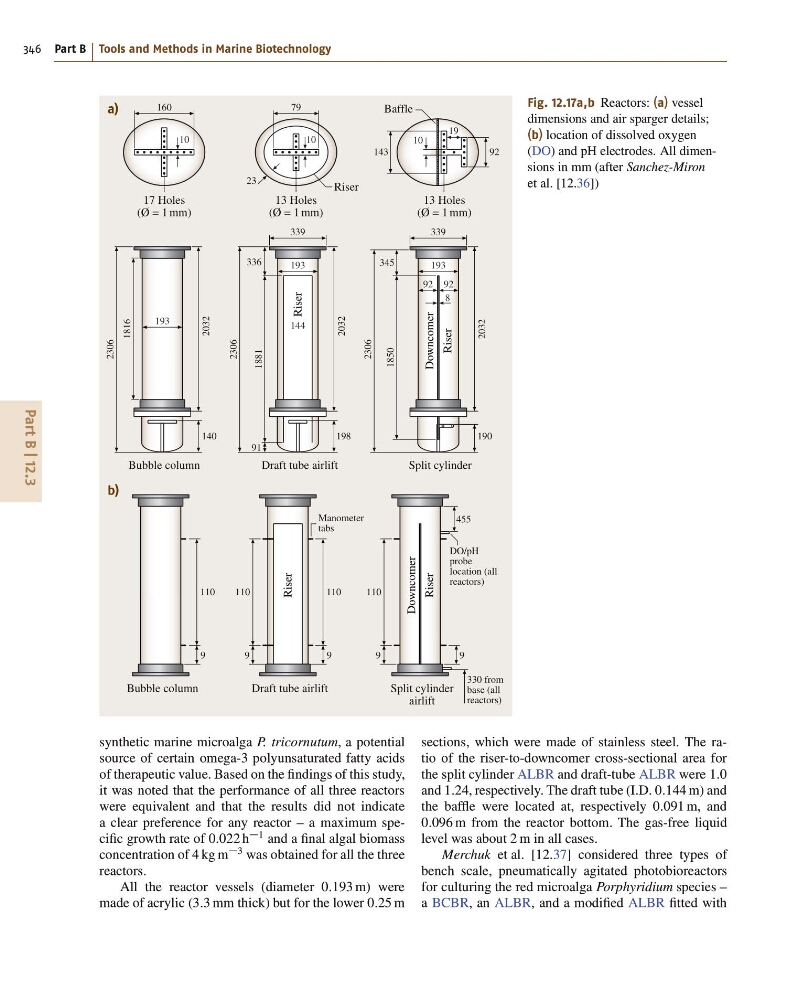
Fig. 12.17a,b Reactors: (a) vessel
dimensions and air sparger details;
(b) location of dissolved oxygen
(DO) and pH electrodes. All dimensions in mm (after Sanchez-Miron
et al. [12.36])
synthetic marine microalga P. tricornutum, a potential
source of certain omega-3 polyunsaturated fatty acids
of therapeutic value. Based on the findings of this study,
it was noted that the performance of all three reactors
were equivalent and that the results did not indicate
a clear preference for any reactor – a maximum specific growth rate of 0:022 h
1 and a final algal biomass
concentration of 4 kg m
3 was obtained for all the three
reactors.
All the reactor vessels (diameter 0:193 m) were
made of acrylic (3:3 mm thick) but for the lower 0:25 m
sections, which were made of stainless steel. The ratio of the riser-to-downcomer cross-sectional area for
the split cylinder ALBR and draft-tube ALBR were 1:0
and 1:24, respectively. The draft tube (I.D. 0:144 m) and
the baffle were located at, respectively 0:091 m, and
0:096 m from the reactor bottom. The gas-free liquid
level was about 2 m in all cases.
Merchuk et al. [12.37] considered three types of
bench scale, pneumatically agitated photobioreactors
for culturing the red microalga Porphyridium species –
a BCBR, an ALBR, and a modified ALBR fitted with
346 Part B Tools and Methods in Marine Biotechnology
a)
b)
160
193
140
110
9
110
110
9
9
110
9
9
455
330 from
base (all
reactors)
DO/pH
probe
location (all
reactors)
10
17 Holes
(Ø = 1 mm)
Bubble column
Baffle
143
2306
2032
1816
193
144
198
190
91
336
345
339
339
8
Draft tube airlift
Bubble column
Draft tube airlift
Manometer
tabs
2306
2032
1881
Riser
Downcomer
Riser
Downcomer
Riser
Riser
193
92
92
Split cylinder
Split cylinder
airlift
1850
2306
2032
92
19
10
13 Holes
(Ø = 1 mm)
79
10
23
13 Holes
(Ø = 1 mm)
Riser
Fig. 12.17a,b Reactors: (a) vessel
dimensions and air sparger details;
(b) location of dissolved oxygen
(DO) and pH electrodes. All dimensions in mm (after Sanchez-Miron
et al. [12.36])
synthetic marine microalga P. tricornutum, a potential
source of certain omega-3 polyunsaturated fatty acids
of therapeutic value. Based on the findings of this study,
it was noted that the performance of all three reactors
were equivalent and that the results did not indicate
a clear preference for any reactor – a maximum specific growth rate of 0:022 h
1 and a final algal biomass
concentration of 4 kg m
3 was obtained for all the three
reactors.
All the reactor vessels (diameter 0:193 m) were
made of acrylic (3:3 mm thick) but for the lower 0:25 m
sections, which were made of stainless steel. The ratio of the riser-to-downcomer cross-sectional area for
the split cylinder ALBR and draft-tube ALBR were 1:0
and 1:24, respectively. The draft tube (I.D. 0:144 m) and
the baffle were located at, respectively 0:091 m, and
0:096 m from the reactor bottom. The gas-free liquid
level was about 2 m in all cases.
Merchuk et al. [12.37] considered three types of
bench scale, pneumatically agitated photobioreactors
for culturing the red microalga Porphyridium species –
a BCBR, an ALBR, and a modified ALBR fitted with