

Part B | 9.4
282 Part B Tools and Methods in Marine Biotechnology
L = 10 cm
L = 5 cm
Continuous photobioreactor growth kinetics
effects of dilution rate and light path length
0
20
40
60
80
100
120
140
160
Biomass production rate DC x (mg cells L
–1 h
–1
)
Dilution rate D (h
–1 )
a)
b)
0
0.02
0.04
0.06
0.08
0.10
0.12
0
0.02
0.04
0.06
0.08
0.10
0.12
L = 10 cm
L = 5 cm
L = 10 cm
L = 5 cm
C x
I m
0
30
60
90
120
0
500
1000
1500
2000
Mean light intensity I m
(µmol photons m
–2 s
–1
)
Cell density C x (mg cells L
–1
)
Dilution rate D (h
–1 )
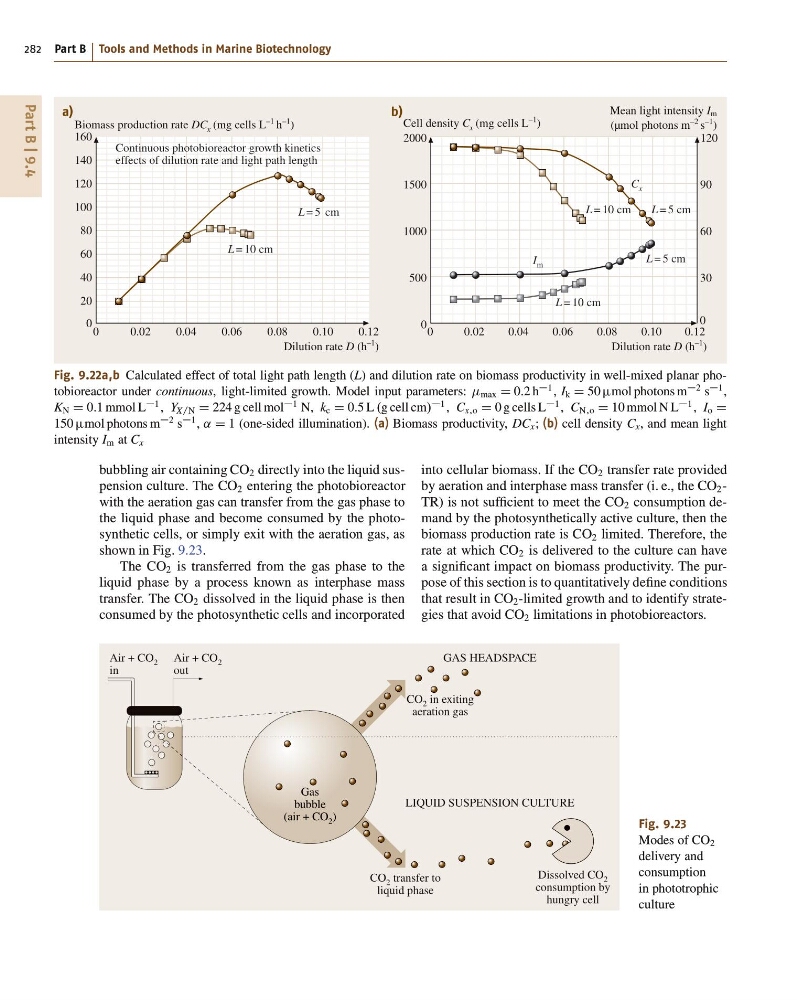
Fig. 9.22a,b Calculated effect of total light path length (L) and dilution rate on biomass productivity in well-mixed planar photobioreactor under continuous, light-limited growth. Model input parameters: max D 0:2 h
1 , I k D 50 mol photons m
2 s
1 ,
K N D 0:1 mmol L
1 , Y X=N D 224 g cell mol
1 N, k c D 0:5 L .g cell cm/
1 , C x;o D 0 g cells L
1 , C N;o D 10 mmol N L
1 , I o D
150 mol photons m
2 s
1 , ˛ D 1 (one-sided illumination). (a) Biomass productivity, DC x ; (b) cell density C x , and mean light
intensity I m at C x
bubbling air containing CO 2 directly into the liquid suspension culture. The CO 2 entering the photobioreactor
with the aeration gas can transfer from the gas phase to
the liquid phase and become consumed by the photosynthetic cells, or simply exit with the aeration gas, as
shown in Fig. 9.23.
The CO 2 is transferred from the gas phase to the
liquid phase by a process known as interphase mass
transfer. The CO 2 dissolved in the liquid phase is then
consumed by the photosynthetic cells and incorporated
Dissolved CO 2
consumption by
hungry cell
GAS HEADSPACE
CO 2 in exiting
aeration gas
CO 2 transfer to
liquid phase
LIQUID SUSPENSION CULTURE
Air + CO 2
in
Gas
bubble
(air + CO 2 )
Air + CO 2
out
Fig. 9.23
Modes of CO 2
delivery and
consumption
in phototrophic
culture
into cellular biomass. If the CO 2 transfer rate provided
by aeration and interphase mass transfer (i. e., the CO 2 -
TR) is not sufficient to meet the CO 2 consumption demand by the photosynthetically active culture, then the
biomass production rate is CO 2 limited. Therefore, the
rate at which CO 2 is delivered to the culture can have
a significant impact on biomass productivity. The purpose of this section is to quantitatively define conditions
that result in CO 2 -limited growth and to identify strategies that avoid CO 2 limitations in photobioreactors.
282 Part B Tools and Methods in Marine Biotechnology
L = 10 cm
L = 5 cm
Continuous photobioreactor growth kinetics
effects of dilution rate and light path length
0
20
40
60
80
100
120
140
160
Biomass production rate DC x (mg cells L
–1 h
–1
)
Dilution rate D (h
–1 )
a)
b)
0
0.02
0.04
0.06
0.08
0.10
0.12
0
0.02
0.04
0.06
0.08
0.10
0.12
L = 10 cm
L = 5 cm
L = 10 cm
L = 5 cm
C x
I m
0
30
60
90
120
0
500
1000
1500
2000
Mean light intensity I m
(µmol photons m
–2 s
–1
)
Cell density C x (mg cells L
–1
)
Dilution rate D (h
–1 )
Fig. 9.22a,b Calculated effect of total light path length (L) and dilution rate on biomass productivity in well-mixed planar photobioreactor under continuous, light-limited growth. Model input parameters: max D 0:2 h
1 , I k D 50 mol photons m
2 s
1 ,
K N D 0:1 mmol L
1 , Y X=N D 224 g cell mol
1 N, k c D 0:5 L .g cell cm/
1 , C x;o D 0 g cells L
1 , C N;o D 10 mmol N L
1 , I o D
150 mol photons m
2 s
1 , ˛ D 1 (one-sided illumination). (a) Biomass productivity, DC x ; (b) cell density C x , and mean light
intensity I m at C x
bubbling air containing CO 2 directly into the liquid suspension culture. The CO 2 entering the photobioreactor
with the aeration gas can transfer from the gas phase to
the liquid phase and become consumed by the photosynthetic cells, or simply exit with the aeration gas, as
shown in Fig. 9.23.
The CO 2 is transferred from the gas phase to the
liquid phase by a process known as interphase mass
transfer. The CO 2 dissolved in the liquid phase is then
consumed by the photosynthetic cells and incorporated
Dissolved CO 2
consumption by
hungry cell
GAS HEADSPACE
CO 2 in exiting
aeration gas
CO 2 transfer to
liquid phase
LIQUID SUSPENSION CULTURE
Air + CO 2
in
Gas
bubble
(air + CO 2 )
Air + CO 2
out
Fig. 9.23
Modes of CO 2
delivery and
consumption
in phototrophic
culture
into cellular biomass. If the CO 2 transfer rate provided
by aeration and interphase mass transfer (i. e., the CO 2 -
TR) is not sufficient to meet the CO 2 consumption demand by the photosynthetically active culture, then the
biomass production rate is CO 2 limited. Therefore, the
rate at which CO 2 is delivered to the culture can have
a significant impact on biomass productivity. The purpose of this section is to quantitatively define conditions
that result in CO 2 -limited growth and to identify strategies that avoid CO 2 limitations in photobioreactors.