

Marine Sponges – Molecular Biology and Biotechnology 8.6 Metagenomic Strategies for Natural Product Discovery 237
Part A | 8.6
aprR
attP
phiC31 intergrease
IoxP
COS
parC
parB
parA
repE
ChIR
oriT
EcoRI (10614)
EcoRI (816)
pCCERI
12297 bp
Bst Z17I (1442)
XbaI (2790)
oriV
oriS
EcoRI (7759)
HindIII (10073)
HindIII (9104)
HindIII (7787)
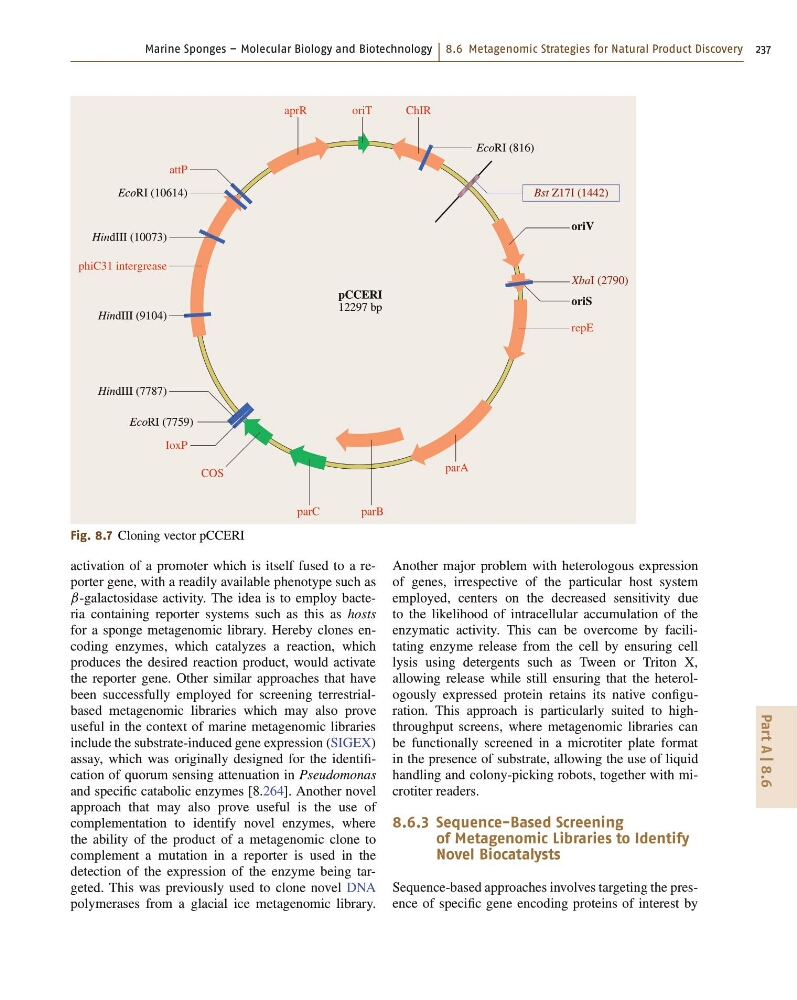
Fig. 8.7 Cloning vector pCCERI
activation of a promoter which is itself fused to a reporter gene, with a readily available phenotype such as
ˇ-galactosidase activity. The idea is to employ bacteria containing reporter systems such as this as hosts
for a sponge metagenomic library. Hereby clones encoding enzymes, which catalyzes a reaction, which
produces the desired reaction product, would activate
the reporter gene. Other similar approaches that have
been successfully employed for screening terrestrialbased metagenomic libraries which may also prove
useful in the context of marine metagenomic libraries
include the substrate-induced gene expression (SIGEX)
assay, which was originally designed for the identification of quorum sensing attenuation in Pseudomonas
and specific catabolic enzymes [8.264]. Another novel
approach that may also prove useful is the use of
complementation to identify novel enzymes, where
the ability of the product of a metagenomic clone to
complement a mutation in a reporter is used in the
detection of the expression of the enzyme being targeted. This was previously used to clone novel DNA
polymerases from a glacial ice metagenomic library.
Another major problem with heterologous expression
of genes, irrespective of the particular host system
employed, centers on the decreased sensitivity due
to the likelihood of intracellular accumulation of the
enzymatic activity. This can be overcome by facilitating enzyme release from the cell by ensuring cell
lysis using detergents such as Tween or Triton X,
allowing release while still ensuring that the heterologously expressed protein retains its native configuration. This approach is particularly suited to highthroughput screens, where metagenomic libraries can
be functionally screened in a microtiter plate format
in the presence of substrate, allowing the use of liquid
handling and colony-picking robots, together with microtiter readers.
8.6.3 Sequence-Based Screening
of Metagenomic Libraries to Identify
Novel Biocatalysts
Sequence-based approaches involves targeting the presence of specific gene encoding proteins of interest by
Part A | 8.6
aprR
attP
phiC31 intergrease
IoxP
COS
parC
parB
parA
repE
ChIR
oriT
EcoRI (10614)
EcoRI (816)
pCCERI
12297 bp
Bst Z17I (1442)
XbaI (2790)
oriV
oriS
EcoRI (7759)
HindIII (10073)
HindIII (9104)
HindIII (7787)
Fig. 8.7 Cloning vector pCCERI
activation of a promoter which is itself fused to a reporter gene, with a readily available phenotype such as
ˇ-galactosidase activity. The idea is to employ bacteria containing reporter systems such as this as hosts
for a sponge metagenomic library. Hereby clones encoding enzymes, which catalyzes a reaction, which
produces the desired reaction product, would activate
the reporter gene. Other similar approaches that have
been successfully employed for screening terrestrialbased metagenomic libraries which may also prove
useful in the context of marine metagenomic libraries
include the substrate-induced gene expression (SIGEX)
assay, which was originally designed for the identification of quorum sensing attenuation in Pseudomonas
and specific catabolic enzymes [8.264]. Another novel
approach that may also prove useful is the use of
complementation to identify novel enzymes, where
the ability of the product of a metagenomic clone to
complement a mutation in a reporter is used in the
detection of the expression of the enzyme being targeted. This was previously used to clone novel DNA
polymerases from a glacial ice metagenomic library.
Another major problem with heterologous expression
of genes, irrespective of the particular host system
employed, centers on the decreased sensitivity due
to the likelihood of intracellular accumulation of the
enzymatic activity. This can be overcome by facilitating enzyme release from the cell by ensuring cell
lysis using detergents such as Tween or Triton X,
allowing release while still ensuring that the heterologously expressed protein retains its native configuration. This approach is particularly suited to highthroughput screens, where metagenomic libraries can
be functionally screened in a microtiter plate format
in the presence of substrate, allowing the use of liquid
handling and colony-picking robots, together with microtiter readers.
8.6.3 Sequence-Based Screening
of Metagenomic Libraries to Identify
Novel Biocatalysts
Sequence-based approaches involves targeting the presence of specific gene encoding proteins of interest by