

Seaweed Flora of the European North Atlantic and Mediterranean 6.3 Seaweeds Biodiversity and Potential 139
Part A | 6.3
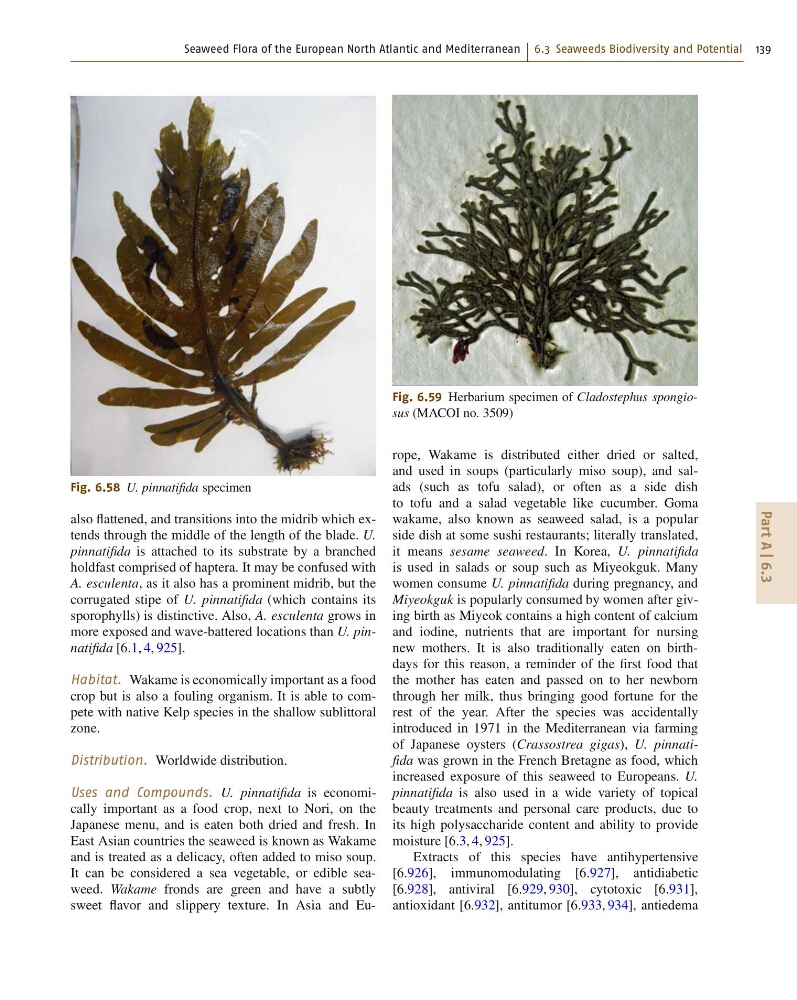
Fig. 6.58 U. pinnatifida specimen
also flattened, and transitions into the midrib which extends through the middle of the length of the blade. U.
pinnatifida is attached to its substrate by a branched
holdfast comprised of haptera. It may be confused with
A. esculenta, as it also has a prominent midrib, but the
corrugated stipe of U. pinnatifida (which contains its
sporophylls) is distinctive. Also, A. esculenta grows in
more exposed and wave-battered locations than U. pinnatifida [6.1, 4, 925].
Habitat. Wakame is economically important as a food
crop but is also a fouling organism. It is able to compete with native Kelp species in the shallow sublittoral
zone.
Distribution. Worldwide distribution.
Uses and Compounds. U. pinnatifida is economically important as a food crop, next to Nori, on the
Japanese menu, and is eaten both dried and fresh. In
East Asian countries the seaweed is known as Wakame
and is treated as a delicacy, often added to miso soup.
It can be considered a sea vegetable, or edible seaweed. Wakame fronds are green and have a subtly
sweet flavor and slippery texture. In Asia and EuFig. 6.59 Herbarium specimen of Cladostephus spongiosus (MACOI no. 3509)
rope, Wakame is distributed either dried or salted,
and used in soups (particularly miso soup), and salads (such as tofu salad), or often as a side dish
to tofu and a salad vegetable like cucumber. Goma
wakame, also known as seaweed salad, is a popular
side dish at some sushi restaurants; literally translated,
it means sesame seaweed. In Korea, U. pinnatifida
is used in salads or soup such as Miyeokguk. Many
women consume U. pinnatifida during pregnancy, and
Miyeokguk is popularly consumed by women after giving birth as Miyeok contains a high content of calcium
and iodine, nutrients that are important for nursing
new mothers. It is also traditionally eaten on birthdays for this reason, a reminder of the first food that
the mother has eaten and passed on to her newborn
through her milk, thus bringing good fortune for the
rest of the year. After the species was accidentally
introduced in 1971 in the Mediterranean via farming
of Japanese oysters (Crassostrea gigas), U. pinnatifida was grown in the French Bretagne as food, which
increased exposure of this seaweed to Europeans. U.
pinnatifida is also used in a wide variety of topical
beauty treatments and personal care products, due to
its high polysaccharide content and ability to provide
moisture [6.3, 4, 925].
Extracts of this species have antihypertensive
[6.926], immunomodulating [6.927], antidiabetic
[6.928], antiviral [6.929, 930], cytotoxic [6.931],
antioxidant [6.932], antitumor [6.933, 934], antiedema
Part A | 6.3
Fig. 6.58 U. pinnatifida specimen
also flattened, and transitions into the midrib which extends through the middle of the length of the blade. U.
pinnatifida is attached to its substrate by a branched
holdfast comprised of haptera. It may be confused with
A. esculenta, as it also has a prominent midrib, but the
corrugated stipe of U. pinnatifida (which contains its
sporophylls) is distinctive. Also, A. esculenta grows in
more exposed and wave-battered locations than U. pinnatifida [6.1, 4, 925].
Habitat. Wakame is economically important as a food
crop but is also a fouling organism. It is able to compete with native Kelp species in the shallow sublittoral
zone.
Distribution. Worldwide distribution.
Uses and Compounds. U. pinnatifida is economically important as a food crop, next to Nori, on the
Japanese menu, and is eaten both dried and fresh. In
East Asian countries the seaweed is known as Wakame
and is treated as a delicacy, often added to miso soup.
It can be considered a sea vegetable, or edible seaweed. Wakame fronds are green and have a subtly
sweet flavor and slippery texture. In Asia and EuFig. 6.59 Herbarium specimen of Cladostephus spongiosus (MACOI no. 3509)
rope, Wakame is distributed either dried or salted,
and used in soups (particularly miso soup), and salads (such as tofu salad), or often as a side dish
to tofu and a salad vegetable like cucumber. Goma
wakame, also known as seaweed salad, is a popular
side dish at some sushi restaurants; literally translated,
it means sesame seaweed. In Korea, U. pinnatifida
is used in salads or soup such as Miyeokguk. Many
women consume U. pinnatifida during pregnancy, and
Miyeokguk is popularly consumed by women after giving birth as Miyeok contains a high content of calcium
and iodine, nutrients that are important for nursing
new mothers. It is also traditionally eaten on birthdays for this reason, a reminder of the first food that
the mother has eaten and passed on to her newborn
through her milk, thus bringing good fortune for the
rest of the year. After the species was accidentally
introduced in 1971 in the Mediterranean via farming
of Japanese oysters (Crassostrea gigas), U. pinnatifida was grown in the French Bretagne as food, which
increased exposure of this seaweed to Europeans. U.
pinnatifida is also used in a wide variety of topical
beauty treatments and personal care products, due to
its high polysaccharide content and ability to provide
moisture [6.3, 4, 925].
Extracts of this species have antihypertensive
[6.926], immunomodulating [6.927], antidiabetic
[6.928], antiviral [6.929, 930], cytotoxic [6.931],
antioxidant [6.932], antitumor [6.933, 934], antiedema