

Seaweed Flora of the European North Atlantic and Mediterranean 6.3 Seaweeds Biodiversity and Potential 127
Part A | 6.3
Uses and Compounds. Extracts have antifungal and
antimicrobial activity [6.62, 804].
Cystoseira tamariscifolia (Hudson) Papenfuss
Common Name. Rainbow wrack
Description. C. tamariscifolia is a bushy seaweed, up
to 60 cm in length but usually 3045 cm. It has a cylindrical frond and branches irregularly (Fig. 6.49). The
reproductive bodies on the end of branches are long,
oval and spiny. Small air bladders are usually found below the reproductive bodies. C. tamariscifolia is olive
green in color, almost black when dry. When the plant is
seen underwater it has a blue-green iridescence [6.805].
Habitat. Found in rock pools and on the lower shore;
grows on both rocky shores and gravelly flats.
Distribution. NE Atlantic (United Kingdom to Mauritania); Mediterranean (France to Turkey).
Uses and Compounds. Extracts have antibacterial
and antifungal [6.269, 438, 806–808], antioxidant and
antitumor [6.731], and cytotoxic [6.317] activity.
Cystoseira usneoides (Linnaeus) M. Roberts
Description. Large sized thallus, formed by a central
axis and lateral branches with secondary branches – the
ones which are closer from basis are flattened and have
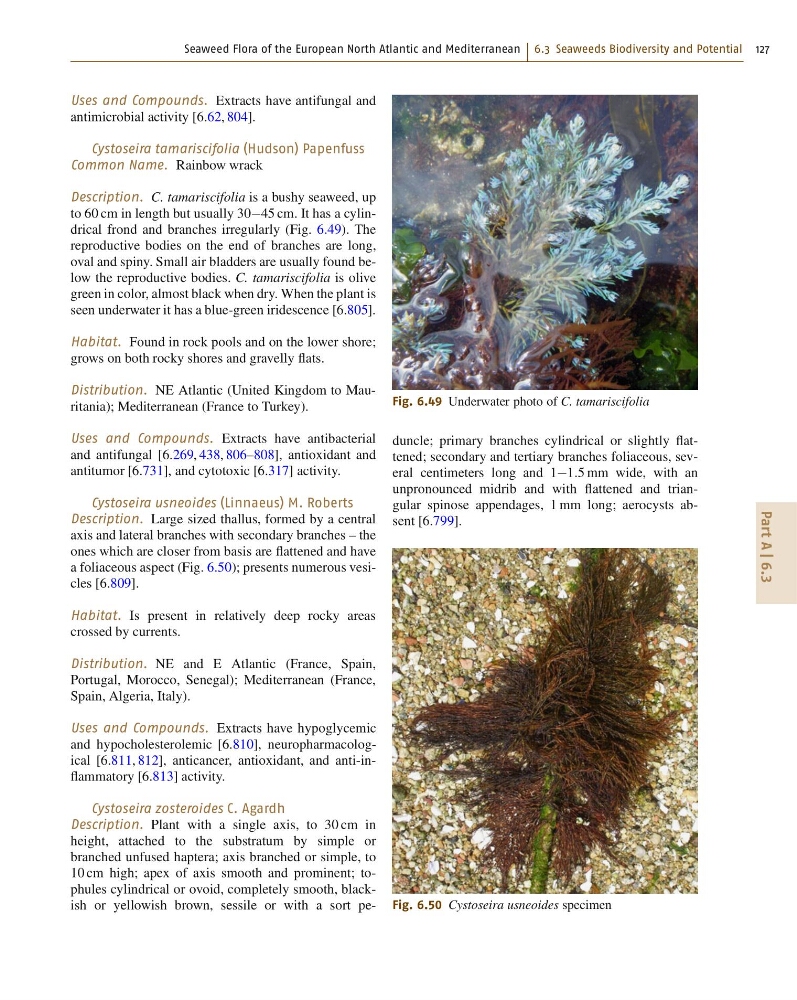
a foliaceous aspect (Fig. 6.50); presents numerous vesicles [6.809].
Habitat. Is present in relatively deep rocky areas
crossed by currents.
Distribution. NE and E Atlantic (France, Spain,
Portugal, Morocco, Senegal); Mediterranean (France,
Spain, Algeria, Italy).
Uses and Compounds. Extracts have hypoglycemic
and hypocholesterolemic [6.810], neuropharmacological [6.811, 812], anticancer, antioxidant, and anti-inflammatory [6.813] activity.
Cystoseira zosteroides C. Agardh
Description. Plant with a single axis, to 30 cm in
height, attached to the substratum by simple or
branched unfused haptera; axis branched or simple, to
10 cm high; apex of axis smooth and prominent; tophules cylindrical or ovoid, completely smooth, blackish or yellowish brown, sessile or with a sort peFig. 6.49 Underwater photo of C. tamariscifolia
duncle; primary branches cylindrical or slightly flattened; secondary and tertiary branches foliaceous, several centimeters long and 11:5 mm wide, with an
unpronounced midrib and with flattened and triangular spinose appendages, 1 mm long; aerocysts absent [6.799].
Fig. 6.50 Cystoseira usneoides specimen
Part A | 6.3
Uses and Compounds. Extracts have antifungal and
antimicrobial activity [6.62, 804].
Cystoseira tamariscifolia (Hudson) Papenfuss
Common Name. Rainbow wrack
Description. C. tamariscifolia is a bushy seaweed, up
to 60 cm in length but usually 3045 cm. It has a cylindrical frond and branches irregularly (Fig. 6.49). The
reproductive bodies on the end of branches are long,
oval and spiny. Small air bladders are usually found below the reproductive bodies. C. tamariscifolia is olive
green in color, almost black when dry. When the plant is
seen underwater it has a blue-green iridescence [6.805].
Habitat. Found in rock pools and on the lower shore;
grows on both rocky shores and gravelly flats.
Distribution. NE Atlantic (United Kingdom to Mauritania); Mediterranean (France to Turkey).
Uses and Compounds. Extracts have antibacterial
and antifungal [6.269, 438, 806–808], antioxidant and
antitumor [6.731], and cytotoxic [6.317] activity.
Cystoseira usneoides (Linnaeus) M. Roberts
Description. Large sized thallus, formed by a central
axis and lateral branches with secondary branches – the
ones which are closer from basis are flattened and have
a foliaceous aspect (Fig. 6.50); presents numerous vesicles [6.809].
Habitat. Is present in relatively deep rocky areas
crossed by currents.
Distribution. NE and E Atlantic (France, Spain,
Portugal, Morocco, Senegal); Mediterranean (France,
Spain, Algeria, Italy).
Uses and Compounds. Extracts have hypoglycemic
and hypocholesterolemic [6.810], neuropharmacological [6.811, 812], anticancer, antioxidant, and anti-inflammatory [6.813] activity.
Cystoseira zosteroides C. Agardh
Description. Plant with a single axis, to 30 cm in
height, attached to the substratum by simple or
branched unfused haptera; axis branched or simple, to
10 cm high; apex of axis smooth and prominent; tophules cylindrical or ovoid, completely smooth, blackish or yellowish brown, sessile or with a sort peFig. 6.49 Underwater photo of C. tamariscifolia
duncle; primary branches cylindrical or slightly flattened; secondary and tertiary branches foliaceous, several centimeters long and 11:5 mm wide, with an
unpronounced midrib and with flattened and triangular spinose appendages, 1 mm long; aerocysts absent [6.799].
Fig. 6.50 Cystoseira usneoides specimen