

Part A | 6.3
124 Part A Marine Flora and Fauna
cell lines. Extracts have also antifouling [6.771, 772],
antibacterial [6.96, 269, 773], antiprotozoal [6.525],
antioxidant [6.429, 731], and antitumoral [6.774]
activity.
Cystoseira abies-marina (S.G. Gmelin)
Description. At the base a branching, gnarled stem
with teeth-like appendages. Upper thallus tufted, forking or lateral branching at more or less the same length,
single branches thin, covered with scattered dark dots,
and conspicuous bilateral saw-teeth-like; conceptacles
as wart-like swellings in the upper parts of the thallus;
without swim bladders [6.32].
Habitat. It is mostly present in the Macronesian islands. Widely spread out in the sublittoral zone, in
places subject to wave action.
Distribution. E Atlantic (Azores, Madeira, Canary
Islands, Cap Verde Islands); Mediterranean (Spain, Sardinia, Libya, Italy).
Uses and Compounds. This species is used directly
for food and as fertilizer [6.775]. Extracts have antioxidant [6.225, 776, 777], antimicrobial [6.778], and
cytotoxic [6.225] activity.
Cystoseira baccata (S.G. Gmelin) P.C. Silva
Common Name. Bushy berry wrack
Description. Fronds usually solitary, 1 m or more
in length, attached by a thick, conical attaching
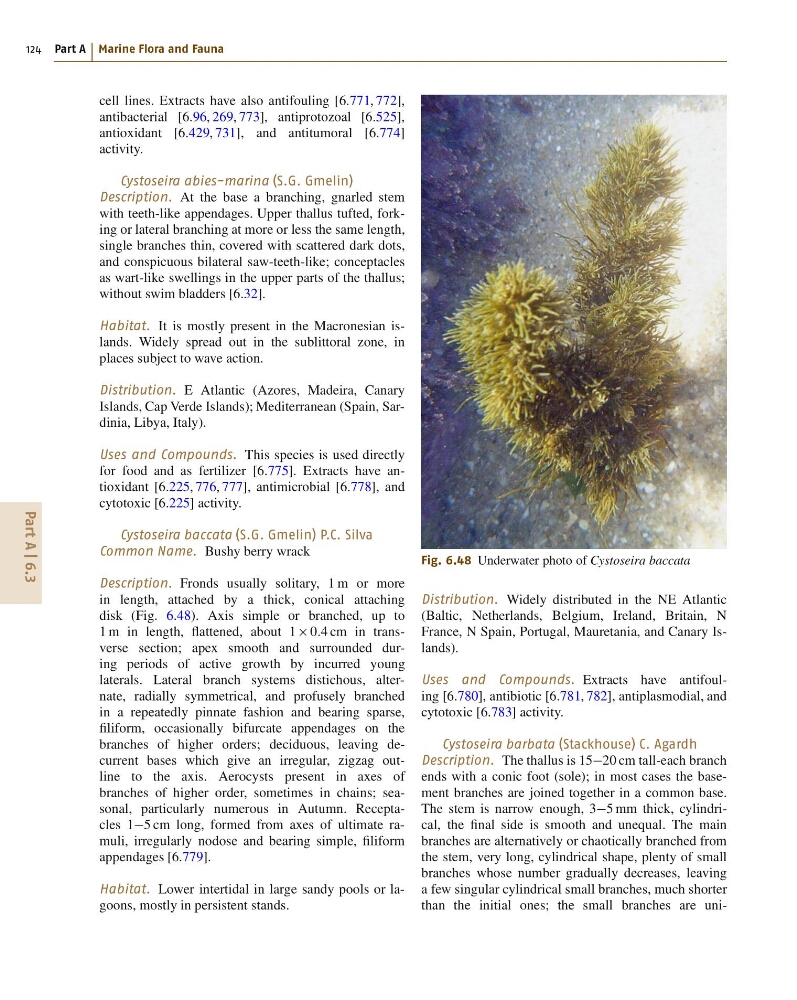
disk (Fig. 6.48). Axis simple or branched, up to
1 m in length, flattened, about 1 0:4 cm in transverse section; apex smooth and surrounded during periods of active growth by incurred young
laterals. Lateral branch systems distichous, alternate, radially symmetrical, and profusely branched
in a repeatedly pinnate fashion and bearing sparse,
filiform, occasionally bifurcate appendages on the
branches of higher orders; deciduous, leaving decurrent bases which give an irregular, zigzag outline to the axis. Aerocysts present in axes of
branches of higher order, sometimes in chains; seasonal, particularly numerous in Autumn. Receptacles 15 cm long, formed from axes of ultimate ramuli, irregularly nodose and bearing simple, filiform
appendages [6.779].
Habitat. Lower intertidal in large sandy pools or lagoons, mostly in persistent stands.
Fig. 6.48 Underwater photo of Cystoseira baccata
Distribution. Widely distributed in the NE Atlantic
(Baltic, Netherlands, Belgium, Ireland, Britain, N
France, N Spain, Portugal, Mauretania, and Canary Islands).
Uses and Compounds. Extracts have antifouling [6.780], antibiotic [6.781, 782], antiplasmodial, and
cytotoxic [6.783] activity.
Cystoseira barbata (Stackhouse) C. Agardh
Description. The thallus is 1520 cm tall-each branch
ends with a conic foot (sole); in most cases the basement branches are joined together in a common base.
The stem is narrow enough, 35 mm thick, cylindrical, the final side is smooth and unequal. The main
branches are alternatively or chaotically branched from
the stem, very long, cylindrical shape, plenty of small
branches whose number gradually decreases, leaving
a few singular cylindrical small branches, much shorter
than the initial ones; the small branches are uni-
124 Part A Marine Flora and Fauna
cell lines. Extracts have also antifouling [6.771, 772],
antibacterial [6.96, 269, 773], antiprotozoal [6.525],
antioxidant [6.429, 731], and antitumoral [6.774]
activity.
Cystoseira abies-marina (S.G. Gmelin)
Description. At the base a branching, gnarled stem
with teeth-like appendages. Upper thallus tufted, forking or lateral branching at more or less the same length,
single branches thin, covered with scattered dark dots,
and conspicuous bilateral saw-teeth-like; conceptacles
as wart-like swellings in the upper parts of the thallus;
without swim bladders [6.32].
Habitat. It is mostly present in the Macronesian islands. Widely spread out in the sublittoral zone, in
places subject to wave action.
Distribution. E Atlantic (Azores, Madeira, Canary
Islands, Cap Verde Islands); Mediterranean (Spain, Sardinia, Libya, Italy).
Uses and Compounds. This species is used directly
for food and as fertilizer [6.775]. Extracts have antioxidant [6.225, 776, 777], antimicrobial [6.778], and
cytotoxic [6.225] activity.
Cystoseira baccata (S.G. Gmelin) P.C. Silva
Common Name. Bushy berry wrack
Description. Fronds usually solitary, 1 m or more
in length, attached by a thick, conical attaching
disk (Fig. 6.48). Axis simple or branched, up to
1 m in length, flattened, about 1 0:4 cm in transverse section; apex smooth and surrounded during periods of active growth by incurred young
laterals. Lateral branch systems distichous, alternate, radially symmetrical, and profusely branched
in a repeatedly pinnate fashion and bearing sparse,
filiform, occasionally bifurcate appendages on the
branches of higher orders; deciduous, leaving decurrent bases which give an irregular, zigzag outline to the axis. Aerocysts present in axes of
branches of higher order, sometimes in chains; seasonal, particularly numerous in Autumn. Receptacles 15 cm long, formed from axes of ultimate ramuli, irregularly nodose and bearing simple, filiform
appendages [6.779].
Habitat. Lower intertidal in large sandy pools or lagoons, mostly in persistent stands.
Fig. 6.48 Underwater photo of Cystoseira baccata
Distribution. Widely distributed in the NE Atlantic
(Baltic, Netherlands, Belgium, Ireland, Britain, N
France, N Spain, Portugal, Mauretania, and Canary Islands).
Uses and Compounds. Extracts have antifouling [6.780], antibiotic [6.781, 782], antiplasmodial, and
cytotoxic [6.783] activity.
Cystoseira barbata (Stackhouse) C. Agardh
Description. The thallus is 1520 cm tall-each branch
ends with a conic foot (sole); in most cases the basement branches are joined together in a common base.
The stem is narrow enough, 35 mm thick, cylindrical, the final side is smooth and unequal. The main
branches are alternatively or chaotically branched from
the stem, very long, cylindrical shape, plenty of small
branches whose number gradually decreases, leaving
a few singular cylindrical small branches, much shorter
than the initial ones; the small branches are uni-