

Part A | 6.3
94 Part A Marine Flora and Fauna
Habitat. Common in shallow water, especially in seagrass meadows and rock hollows; to 10 m depth.
Distribution. Widely distributed in tropical and subtropical seas.
Uses and Compounds. Used on functional
foods [6.109], and the extracts have antiviral [6.237],
antibacterial [6.40], cytotoxic and antioxidant [6.459],
oxytocic and espamogenic [6.460] activity.
Amphiroa rigida J.V. Lamouroux
Common Name. Twig algae.
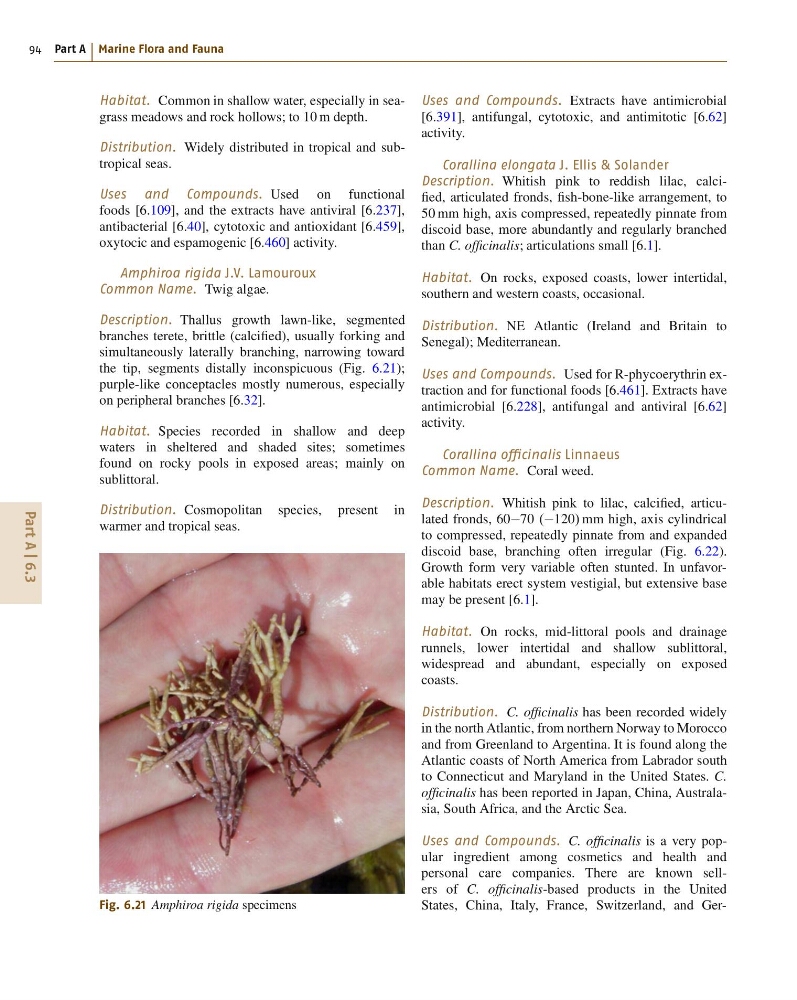
Description. Thallus growth lawn-like, segmented
branches terete, brittle (calcified), usually forking and
simultaneously laterally branching, narrowing toward
the tip, segments distally inconspicuous (Fig. 6.21);
purple-like conceptacles mostly numerous, especially
on peripheral branches [6.32].
Habitat. Species recorded in shallow and deep
waters in sheltered and shaded sites; sometimes
found on rocky pools in exposed areas; mainly on
sublittoral.
Distribution. Cosmopolitan species, present in
warmer and tropical seas.
Fig. 6.21 Amphiroa rigida specimens
Uses and Compounds. Extracts have antimicrobial
[6.391], antifungal, cytotoxic, and antimitotic [6.62]
activity.
Corallina elongata J. Ellis & Solander
Description. Whitish pink to reddish lilac, calcified, articulated fronds, fish-bone-like arrangement, to
50 mm high, axis compressed, repeatedly pinnate from
discoid base, more abundantly and regularly branched
than C. officinalis; articulations small [6.1].
Habitat. On rocks, exposed coasts, lower intertidal,
southern and western coasts, occasional.
Distribution. NE Atlantic (Ireland and Britain to
Senegal); Mediterranean.
Uses and Compounds. Used for R-phycoerythrin extraction and for functional foods [6.461]. Extracts have
antimicrobial [6.228], antifungal and antiviral [6.62]
activity.
Corallina officinalis Linnaeus
Common Name. Coral weed.
Description. Whitish pink to lilac, calcified, articulated fronds, 6070 .120/ mm high, axis cylindrical
to compressed, repeatedly pinnate from and expanded
discoid base, branching often irregular (Fig. 6.22).
Growth form very variable often stunted. In unfavorable habitats erect system vestigial, but extensive base
may be present [6.1].
Habitat. On rocks, mid-littoral pools and drainage
runnels, lower intertidal and shallow sublittoral,
widespread and abundant, especially on exposed
coasts.
Distribution. C. officinalis has been recorded widely
in the north Atlantic, from northern Norway to Morocco
and from Greenland to Argentina. It is found along the
Atlantic coasts of North America from Labrador south
to Connecticut and Maryland in the United States. C.
officinalis has been reported in Japan, China, Australasia, South Africa, and the Arctic Sea.
Uses and Compounds. C. officinalis is a very popular ingredient among cosmetics and health and
personal care companies. There are known sellers of C. officinalis-based products in the United
States, China, Italy, France, Switzerland, and Ger-
94 Part A Marine Flora and Fauna
Habitat. Common in shallow water, especially in seagrass meadows and rock hollows; to 10 m depth.
Distribution. Widely distributed in tropical and subtropical seas.
Uses and Compounds. Used on functional
foods [6.109], and the extracts have antiviral [6.237],
antibacterial [6.40], cytotoxic and antioxidant [6.459],
oxytocic and espamogenic [6.460] activity.
Amphiroa rigida J.V. Lamouroux
Common Name. Twig algae.
Description. Thallus growth lawn-like, segmented
branches terete, brittle (calcified), usually forking and
simultaneously laterally branching, narrowing toward
the tip, segments distally inconspicuous (Fig. 6.21);
purple-like conceptacles mostly numerous, especially
on peripheral branches [6.32].
Habitat. Species recorded in shallow and deep
waters in sheltered and shaded sites; sometimes
found on rocky pools in exposed areas; mainly on
sublittoral.
Distribution. Cosmopolitan species, present in
warmer and tropical seas.
Fig. 6.21 Amphiroa rigida specimens
Uses and Compounds. Extracts have antimicrobial
[6.391], antifungal, cytotoxic, and antimitotic [6.62]
activity.
Corallina elongata J. Ellis & Solander
Description. Whitish pink to reddish lilac, calcified, articulated fronds, fish-bone-like arrangement, to
50 mm high, axis compressed, repeatedly pinnate from
discoid base, more abundantly and regularly branched
than C. officinalis; articulations small [6.1].
Habitat. On rocks, exposed coasts, lower intertidal,
southern and western coasts, occasional.
Distribution. NE Atlantic (Ireland and Britain to
Senegal); Mediterranean.
Uses and Compounds. Used for R-phycoerythrin extraction and for functional foods [6.461]. Extracts have
antimicrobial [6.228], antifungal and antiviral [6.62]
activity.
Corallina officinalis Linnaeus
Common Name. Coral weed.
Description. Whitish pink to lilac, calcified, articulated fronds, 6070 .120/ mm high, axis cylindrical
to compressed, repeatedly pinnate from and expanded
discoid base, branching often irregular (Fig. 6.22).
Growth form very variable often stunted. In unfavorable habitats erect system vestigial, but extensive base
may be present [6.1].
Habitat. On rocks, mid-littoral pools and drainage
runnels, lower intertidal and shallow sublittoral,
widespread and abundant, especially on exposed
coasts.
Distribution. C. officinalis has been recorded widely
in the north Atlantic, from northern Norway to Morocco
and from Greenland to Argentina. It is found along the
Atlantic coasts of North America from Labrador south
to Connecticut and Maryland in the United States. C.
officinalis has been reported in Japan, China, Australasia, South Africa, and the Arctic Sea.
Uses and Compounds. C. officinalis is a very popular ingredient among cosmetics and health and
personal care companies. There are known sellers of C. officinalis-based products in the United
States, China, Italy, France, Switzerland, and Ger-