

Part A | 6.3
82 Part A Marine Flora and Fauna
tiple uses in the pharmaceutical field, cosmetic and
food industry [6.313]; used for food [6.3, 314], and for
IMTA aquaculture [6.315]. Extracts have high antioxidant [6.316], and low antiprotozoal, antimycobacterial,
and cytotoxic [6.317] activity.
Porphyra linearis Greville
Description. Delicate, linear, membranous, purplebrown fronds, 2040 mm .200/ mm long and 510
.25/ mm broad, usually simple with short stipe from
basal holdfast; orange patches when reproductive [6.1,
318].
Habitat. Marine species, zone forming on rock in
the upper intertidal and splash zone of semiexposed
and exposed shores, generally distributed; a winter
and spring annual appearing on semiexposed and
exposed.
Distribution. Recorded throughout Northern Europe,
from Norway to Portugal, Azores. Canada (Labrador)
to USA (at least Connecticut).
Uses and Compounds. Used for food [6.3, 4, 319,
320], and for aquaculture [6.321–323]. Extracts have
antimicrobial activity [6.130].
Porphyra umbilicalis (Linnaeus) Kützing
Common Names. Purple laver, Pink laver, Laver,
Nori.
Description. A red alga (up to 40 cm across) with
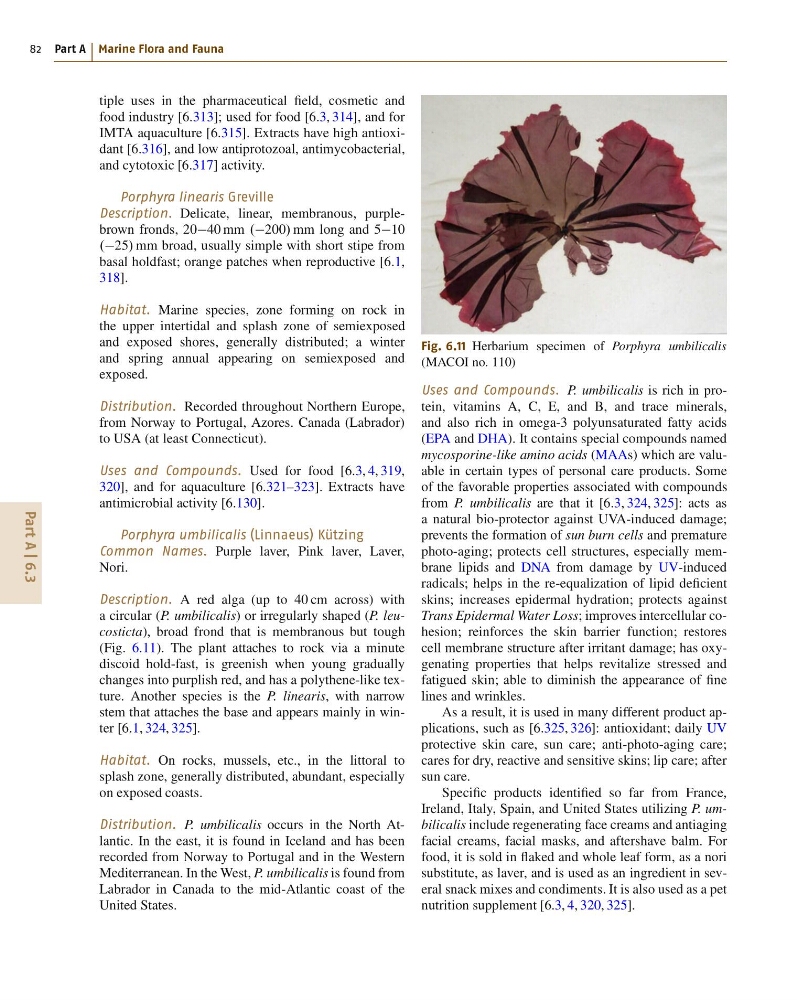
a circular (P. umbilicalis) or irregularly shaped (P. leucosticta), broad frond that is membranous but tough
(Fig. 6.11). The plant attaches to rock via a minute
discoid hold-fast, is greenish when young gradually
changes into purplish red, and has a polythene-like texture. Another species is the P. linearis, with narrow
stem that attaches the base and appears mainly in winter [6.1, 324, 325].
Habitat. On rocks, mussels, etc., in the littoral to
splash zone, generally distributed, abundant, especially
on exposed coasts.
Distribution. P. umbilicalis occurs in the North Atlantic. In the east, it is found in Iceland and has been
recorded from Norway to Portugal and in the Western
Mediterranean. In the West, P. umbilicalis is found from
Labrador in Canada to the mid-Atlantic coast of the
United States.
Fig. 6.11 Herbarium specimen of Porphyra umbilicalis
(MACOI no. 110)
Uses and Compounds. P. umbilicalis is rich in protein, vitamins A, C, E, and B, and trace minerals,
and also rich in omega-3 polyunsaturated fatty acids
(EPA and DHA). It contains special compounds named
mycosporine-like amino acids (MAAs) which are valuable in certain types of personal care products. Some
of the favorable properties associated with compounds
from P. umbilicalis are that it [6.3, 324, 325]: acts as
a natural bio-protector against UVA-induced damage;
prevents the formation of sun burn cells and premature
photo-aging; protects cell structures, especially membrane lipids and DNA from damage by UV-induced
radicals; helps in the re-equalization of lipid deficient
skins; increases epidermal hydration; protects against
Trans Epidermal Water Loss; improves intercellular cohesion; reinforces the skin barrier function; restores
cell membrane structure after irritant damage; has oxygenating properties that helps revitalize stressed and
fatigued skin; able to diminish the appearance of fine
lines and wrinkles.
As a result, it is used in many different product applications, such as [6.325, 326]: antioxidant; daily UV
protective skin care, sun care; anti-photo-aging care;
cares for dry, reactive and sensitive skins; lip care; after
sun care.
Specific products identified so far from France,
Ireland, Italy, Spain, and United States utilizing P. umbilicalis include regenerating face creams and antiaging
facial creams, facial masks, and aftershave balm. For
food, it is sold in flaked and whole leaf form, as a nori
substitute, as laver, and is used as an ingredient in several snack mixes and condiments. It is also used as a pet
nutrition supplement [6.3, 4, 320, 325].
82 Part A Marine Flora and Fauna
tiple uses in the pharmaceutical field, cosmetic and
food industry [6.313]; used for food [6.3, 314], and for
IMTA aquaculture [6.315]. Extracts have high antioxidant [6.316], and low antiprotozoal, antimycobacterial,
and cytotoxic [6.317] activity.
Porphyra linearis Greville
Description. Delicate, linear, membranous, purplebrown fronds, 2040 mm .200/ mm long and 510
.25/ mm broad, usually simple with short stipe from
basal holdfast; orange patches when reproductive [6.1,
318].
Habitat. Marine species, zone forming on rock in
the upper intertidal and splash zone of semiexposed
and exposed shores, generally distributed; a winter
and spring annual appearing on semiexposed and
exposed.
Distribution. Recorded throughout Northern Europe,
from Norway to Portugal, Azores. Canada (Labrador)
to USA (at least Connecticut).
Uses and Compounds. Used for food [6.3, 4, 319,
320], and for aquaculture [6.321–323]. Extracts have
antimicrobial activity [6.130].
Porphyra umbilicalis (Linnaeus) Kützing
Common Names. Purple laver, Pink laver, Laver,
Nori.
Description. A red alga (up to 40 cm across) with
a circular (P. umbilicalis) or irregularly shaped (P. leucosticta), broad frond that is membranous but tough
(Fig. 6.11). The plant attaches to rock via a minute
discoid hold-fast, is greenish when young gradually
changes into purplish red, and has a polythene-like texture. Another species is the P. linearis, with narrow
stem that attaches the base and appears mainly in winter [6.1, 324, 325].
Habitat. On rocks, mussels, etc., in the littoral to
splash zone, generally distributed, abundant, especially
on exposed coasts.
Distribution. P. umbilicalis occurs in the North Atlantic. In the east, it is found in Iceland and has been
recorded from Norway to Portugal and in the Western
Mediterranean. In the West, P. umbilicalis is found from
Labrador in Canada to the mid-Atlantic coast of the
United States.
Fig. 6.11 Herbarium specimen of Porphyra umbilicalis
(MACOI no. 110)
Uses and Compounds. P. umbilicalis is rich in protein, vitamins A, C, E, and B, and trace minerals,
and also rich in omega-3 polyunsaturated fatty acids
(EPA and DHA). It contains special compounds named
mycosporine-like amino acids (MAAs) which are valuable in certain types of personal care products. Some
of the favorable properties associated with compounds
from P. umbilicalis are that it [6.3, 324, 325]: acts as
a natural bio-protector against UVA-induced damage;
prevents the formation of sun burn cells and premature
photo-aging; protects cell structures, especially membrane lipids and DNA from damage by UV-induced
radicals; helps in the re-equalization of lipid deficient
skins; increases epidermal hydration; protects against
Trans Epidermal Water Loss; improves intercellular cohesion; reinforces the skin barrier function; restores
cell membrane structure after irritant damage; has oxygenating properties that helps revitalize stressed and
fatigued skin; able to diminish the appearance of fine
lines and wrinkles.
As a result, it is used in many different product applications, such as [6.325, 326]: antioxidant; daily UV
protective skin care, sun care; anti-photo-aging care;
cares for dry, reactive and sensitive skins; lip care; after
sun care.
Specific products identified so far from France,
Ireland, Italy, Spain, and United States utilizing P. umbilicalis include regenerating face creams and antiaging
facial creams, facial masks, and aftershave balm. For
food, it is sold in flaked and whole leaf form, as a nori
substitute, as laver, and is used as an ingredient in several snack mixes and condiments. It is also used as a pet
nutrition supplement [6.3, 4, 320, 325].