

19
Ferraroli et al. 2004). The sea snakes Pelamis platurus concentrate in areas of
frontal convergences, reaching hundreds or even thousands of animals in surface
slicks. Convergent flows concentrate also floating debris that in turn attracts small
fishes which are preyed upon by the snakes (Dunson and Ehlert 1971). Diving
birds like penguins also use fronts, including frontal eddies, as forage grounds
(Bost et al. 2009). Coastal birds like gulls and terns, may detect prey aggregations by using visual cues, both by direct location of prey or identifying the active
presence of other subsurface predators (large fish, seals, whales, dolphins and
even penguins) which drive preys close to the surface. Pelagic seabirds, like large
albatrosses and petrels, may travel thousands of kilometers during their foraging
flights and may use olfactory cues to detect remote sources of food like zooplankton, fishes or squids which concentrate at fronts (Nevitt 1999). The occurrence of
productive and predictable fronts may also promote the establishment of breeding
colonies in their proximities (Russell 1999; Bost et al. 2009).
Some similarities and differences between terrestrial and marine systems may
be established that can help understanding of properties and importance of marine
fronts. In a forest, most of the life concentrates at the uppermost layer, because
there is where most light is available, and every organism living below depends
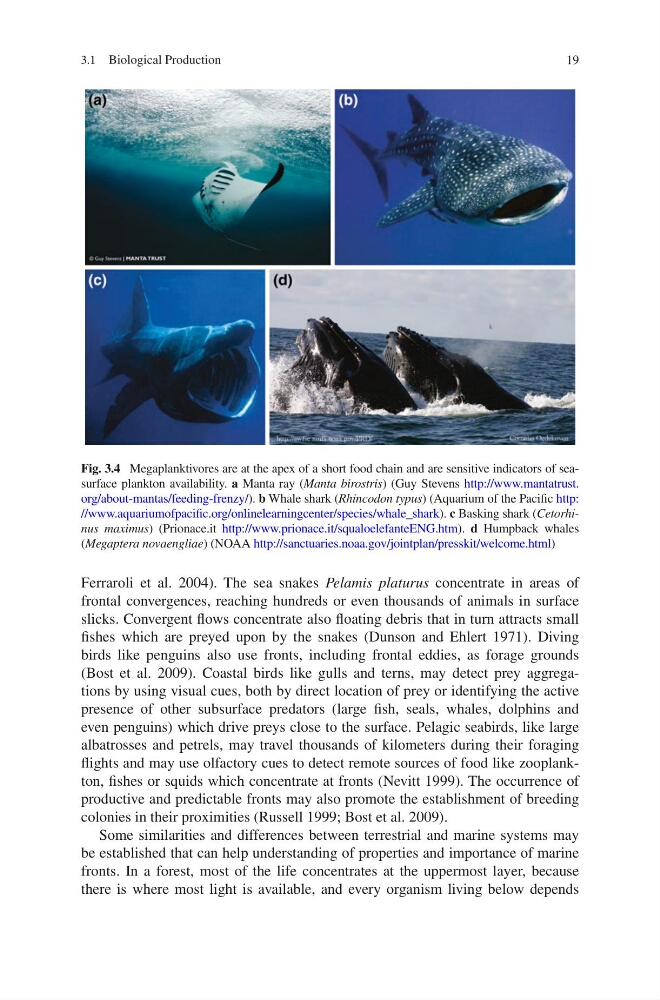
Fig. 3.4 Megaplanktivores are at the apex of a short food chain and are sensitive indicators of seasurface plankton availability. a Manta ray (Manta birostris) (Guy Stevens http://www.mantatrust.
org/about-mantas/feeding-frenzy/). b Whale shark (Rhincodon typus) (Aquarium of the Pacific http:
//www.aquariumofpacific.org/onlinelearningcenter/species/whale_shark). c Basking shark (Cetorhinus maximus) (Prionace.it http://www.prionace.it/squaloelefanteENG.htm). d Humpback whales
(Megaptera novaengliae) (NOAA http://sanctuaries.noaa.gov/jointplan/presskit/welcome.html)
3.1 Biological Production
Ferraroli et al. 2004). The sea snakes Pelamis platurus concentrate in areas of
frontal convergences, reaching hundreds or even thousands of animals in surface
slicks. Convergent flows concentrate also floating debris that in turn attracts small
fishes which are preyed upon by the snakes (Dunson and Ehlert 1971). Diving
birds like penguins also use fronts, including frontal eddies, as forage grounds
(Bost et al. 2009). Coastal birds like gulls and terns, may detect prey aggregations by using visual cues, both by direct location of prey or identifying the active
presence of other subsurface predators (large fish, seals, whales, dolphins and
even penguins) which drive preys close to the surface. Pelagic seabirds, like large
albatrosses and petrels, may travel thousands of kilometers during their foraging
flights and may use olfactory cues to detect remote sources of food like zooplankton, fishes or squids which concentrate at fronts (Nevitt 1999). The occurrence of
productive and predictable fronts may also promote the establishment of breeding
colonies in their proximities (Russell 1999; Bost et al. 2009).
Some similarities and differences between terrestrial and marine systems may
be established that can help understanding of properties and importance of marine
fronts. In a forest, most of the life concentrates at the uppermost layer, because
there is where most light is available, and every organism living below depends
Fig. 3.4 Megaplanktivores are at the apex of a short food chain and are sensitive indicators of seasurface plankton availability. a Manta ray (Manta birostris) (Guy Stevens http://www.mantatrust.
org/about-mantas/feeding-frenzy/). b Whale shark (Rhincodon typus) (Aquarium of the Pacific http:
//www.aquariumofpacific.org/onlinelearningcenter/species/whale_shark). c Basking shark (Cetorhinus maximus) (Prionace.it http://www.prionace.it/squaloelefanteENG.htm). d Humpback whales
(Megaptera novaengliae) (NOAA http://sanctuaries.noaa.gov/jointplan/presskit/welcome.html)
3.1 Biological Production