

16
3 Biology of Fronts
processes (aggregation or in situ production) can simultaneously occur at the same
front. Moreover, frontal instabilities can lead to vertical restratification, which, if
overcome turbulent mixing, can trigger frontal blooms (Taylor and Ferrari 2011).
Fronts are zones of increased lateral and vertical mixing, usually leading to
increased primary and secondary production (Olson and Backus 1985). It is well
accepted that fronts are characterized by high phytoplankton biomass and in most
cases, also enhanced activity at higher trophic levels (Le Févre 1986; Largier
1993; Acha et al. 2004). Nutrient rich waters are upwelled in fronts; and if the
frontal region is sufficiently long-lived, populations of herbivorous zooplankton
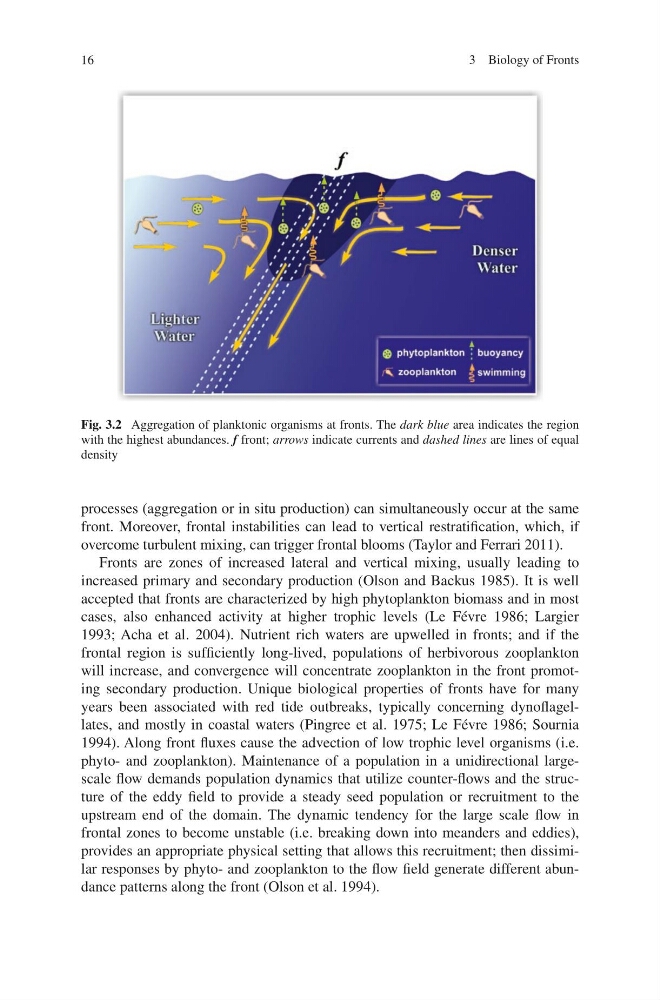
will increase, and convergence will concentrate zooplankton in the front promoting secondary production. Unique biological properties of fronts have for many
years been associated with red tide outbreaks, typically concerning dynoflagellates, and mostly in coastal waters (Pingree et al. 1975; Le Févre 1986; Sournia
1994). Along front fluxes cause the advection of low trophic level organisms (i.e.
phyto- and zooplankton). Maintenance of a population in a unidirectional largescale flow demands population dynamics that utilize counter-flows and the structure of the eddy field to provide a steady seed population or recruitment to the
upstream end of the domain. The dynamic tendency for the large scale flow in
frontal zones to become unstable (i.e. breaking down into meanders and eddies),
provides an appropriate physical setting that allows this recruitment; then dissimilar responses by phyto- and zooplankton to the flow field generate different abundance patterns along the front (Olson et al. 1994).
Fig. 3.2 Aggregation of planktonic organisms at fronts. The dark blue area indicates the region
with the highest abundances. f front; arrows indicate currents and dashed lines are lines of equal
density
3 Biology of Fronts
processes (aggregation or in situ production) can simultaneously occur at the same
front. Moreover, frontal instabilities can lead to vertical restratification, which, if
overcome turbulent mixing, can trigger frontal blooms (Taylor and Ferrari 2011).
Fronts are zones of increased lateral and vertical mixing, usually leading to
increased primary and secondary production (Olson and Backus 1985). It is well
accepted that fronts are characterized by high phytoplankton biomass and in most
cases, also enhanced activity at higher trophic levels (Le Févre 1986; Largier
1993; Acha et al. 2004). Nutrient rich waters are upwelled in fronts; and if the
frontal region is sufficiently long-lived, populations of herbivorous zooplankton
will increase, and convergence will concentrate zooplankton in the front promoting secondary production. Unique biological properties of fronts have for many
years been associated with red tide outbreaks, typically concerning dynoflagellates, and mostly in coastal waters (Pingree et al. 1975; Le Févre 1986; Sournia
1994). Along front fluxes cause the advection of low trophic level organisms (i.e.
phyto- and zooplankton). Maintenance of a population in a unidirectional largescale flow demands population dynamics that utilize counter-flows and the structure of the eddy field to provide a steady seed population or recruitment to the
upstream end of the domain. The dynamic tendency for the large scale flow in
frontal zones to become unstable (i.e. breaking down into meanders and eddies),
provides an appropriate physical setting that allows this recruitment; then dissimilar responses by phyto- and zooplankton to the flow field generate different abundance patterns along the front (Olson et al. 1994).
Fig. 3.2 Aggregation of planktonic organisms at fronts. The dark blue area indicates the region
with the highest abundances. f front; arrows indicate currents and dashed lines are lines of equal
density