

6
2 Frontal types
2.1 Tidal Fronts
In temperate climates, seasonal thermoclines develop near the surface during late
spring and summer. Unless some forcing provides enough mechanical energy to
mix the water column, thermoclines stabilize the water column, becoming stronger
as the warm season progresses. Tides are one of the main forcing processes in the
ocean (Munk and Wunsch 1998), whose energy distributes heterogeneously over
the global ocean. In continental shelves where a seasonal thermocline develops
and a high rate of tidal energy dissipation occur; there are regions in which the
intensity of turbulent mixing is able to continuously overcome the barrier to mixing presented by stratification (Simpson and Hunter 1974; Pingree et al. 1975;
Le Févre 1986). As the tidal wave approaches the coast, the tidal amplitude and
its horizontal velocity gradually increase. At some critical depth, vertical turbulence produced by friction between the tidal stream and the sea bed is sufficiently
enhanced (when added to turbulence produced by wind stress at the sea surface) as
to overcome the seasonal thermal stratification of the water column, giving rise to
tidally mixed regions near shore. Thus, the tidally mixed and the stratified regions
of the shelf are separated by a frontal region (Longhurst 1998). In contrast with
the more frequently observed situation described above there are some tidal fronts
where changes in mixing efficiency lead to a more strongly stratified water column
in the onshore region, such as in the southeast coast of Japan (Takeoka et al. 1997).
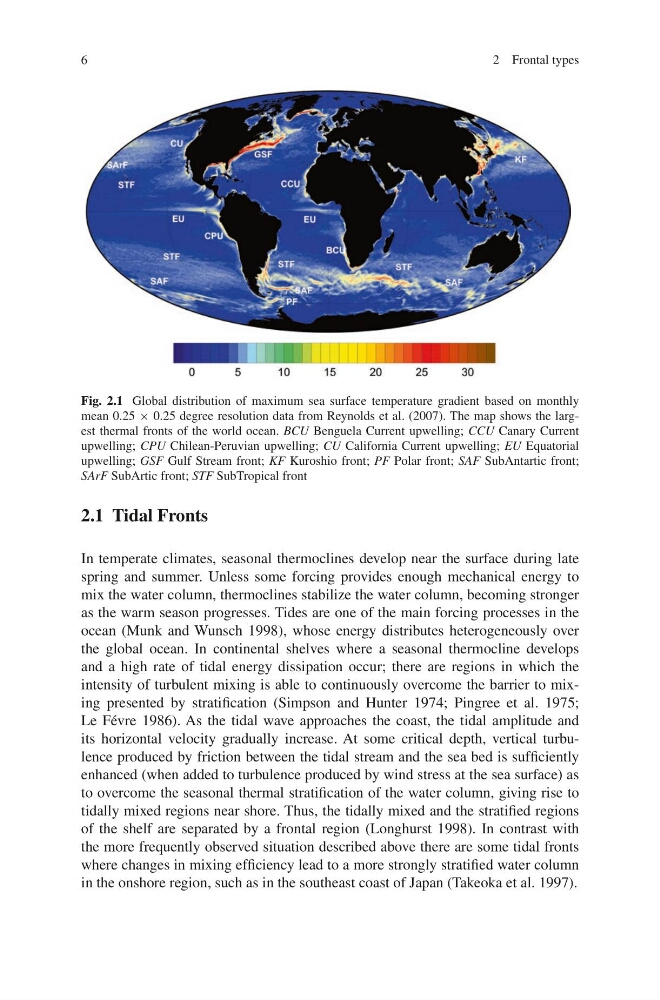
Fig. 2.1 Global distribution of maximum sea surface temperature gradient based on monthly
mean 0.25 × 0.25 degree resolution data from Reynolds et al. (2007). The map shows the largest thermal fronts of the world ocean. BCU Benguela Current upwelling; CCU Canary Current
upwelling; CPU Chilean-Peruvian upwelling; CU California Current upwelling; EU Equatorial
upwelling; GSF Gulf Stream front; KF Kuroshio front; PF Polar front; SAF SubAntartic front;
SArF SubArtic front; STF SubTropical front
2 Frontal types
2.1 Tidal Fronts
In temperate climates, seasonal thermoclines develop near the surface during late
spring and summer. Unless some forcing provides enough mechanical energy to
mix the water column, thermoclines stabilize the water column, becoming stronger
as the warm season progresses. Tides are one of the main forcing processes in the
ocean (Munk and Wunsch 1998), whose energy distributes heterogeneously over
the global ocean. In continental shelves where a seasonal thermocline develops
and a high rate of tidal energy dissipation occur; there are regions in which the
intensity of turbulent mixing is able to continuously overcome the barrier to mixing presented by stratification (Simpson and Hunter 1974; Pingree et al. 1975;
Le Févre 1986). As the tidal wave approaches the coast, the tidal amplitude and
its horizontal velocity gradually increase. At some critical depth, vertical turbulence produced by friction between the tidal stream and the sea bed is sufficiently
enhanced (when added to turbulence produced by wind stress at the sea surface) as
to overcome the seasonal thermal stratification of the water column, giving rise to
tidally mixed regions near shore. Thus, the tidally mixed and the stratified regions
of the shelf are separated by a frontal region (Longhurst 1998). In contrast with
the more frequently observed situation described above there are some tidal fronts
where changes in mixing efficiency lead to a more strongly stratified water column
in the onshore region, such as in the southeast coast of Japan (Takeoka et al. 1997).
Fig. 2.1 Global distribution of maximum sea surface temperature gradient based on monthly
mean 0.25 × 0.25 degree resolution data from Reynolds et al. (2007). The map shows the largest thermal fronts of the world ocean. BCU Benguela Current upwelling; CCU Canary Current
upwelling; CPU Chilean-Peruvian upwelling; CU California Current upwelling; EU Equatorial
upwelling; GSF Gulf Stream front; KF Kuroshio front; PF Polar front; SAF SubAntartic front;
SArF SubArtic front; STF SubTropical front