

74
carbon is released from the algae and metabolised by the animal
tissues (Muscatine and Cernichiari, 19.69 ~ smith, Muscatine and
Lewis, 1969~ Muscatine, Pool and Cernichiari, 1972~ Muscatine,
1980).
In addition, algal photosynthesis stimulates the rate of
coral calcification (Goreau, 1959; Goreau and Goreau, 1959~
Vandermeulen, Davis and Muscatine, 1972~ Vandermeulen and
Muscatine, 1974~ Chalker and Taylor, 1975).
The rela~ionship between light intensity (I) and
photosynthesis (p) can be. examined experimentally by the
construction of light-saturation (P-I) curves. All coral P-I
curves have a similar shape.
Initially, photosynthesis is directly
proportional to light intensity. Thereafter, the curve rapidly
approaches a horizontal asymptote (Pm) which is variously described
as the photosynthetic capacity, photosynthetic maximum, or
assimilation number.
It is generally assumed that the initial
slope of the curve (~) is a function of the light reactions in
photosynthesis, and that the slope of the curve declines when the
rate of cellular carbon metabolism becomes limiting (Steemann
Nielsen and J¢rgensen, 1968). The irradiance at which the initial
slope of· the curve intercepts the horizontal asymptote is defined
as Ik (TaIling, 1957). Photosynthesis as represented in P-I curves
is usually gross photosynthesis (Pg) which is defined as the sum of
net photosynthesis (pn) and the dark respiration rate (R).
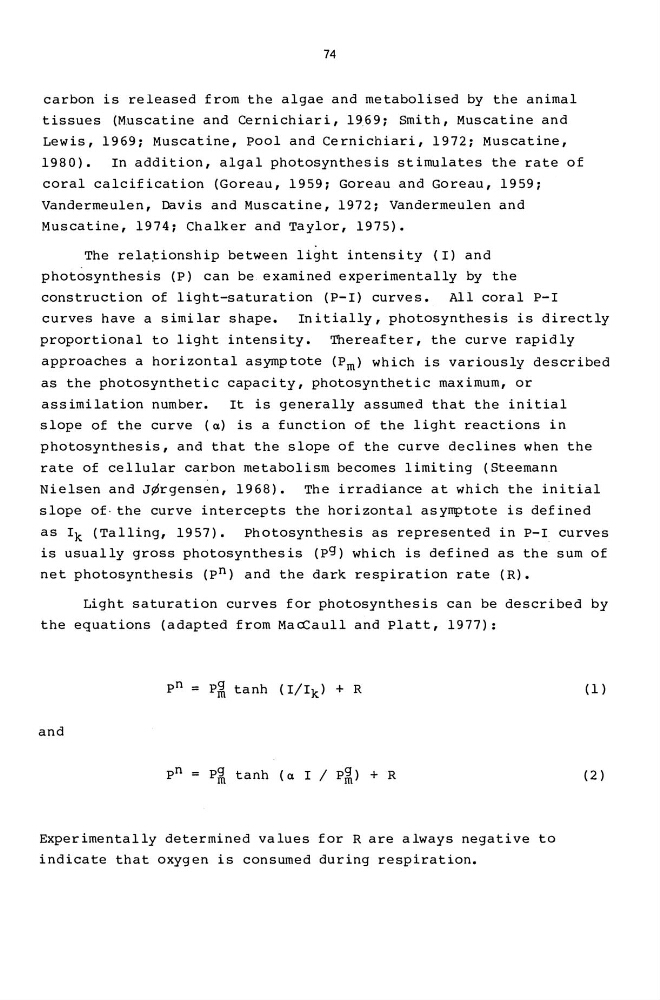
Light saturation curves for photosynthesis can be described by
the equations (adapted from MacCaull and platt, 1977):
and
P~ tanh (~ I / P~) + R
Experimentally determined values for R are always negative to
indicate that oxygen is consumed during respiration.
(1 )
(2 )
carbon is released from the algae and metabolised by the animal
tissues (Muscatine and Cernichiari, 19.69 ~ smith, Muscatine and
Lewis, 1969~ Muscatine, Pool and Cernichiari, 1972~ Muscatine,
1980).
In addition, algal photosynthesis stimulates the rate of
coral calcification (Goreau, 1959; Goreau and Goreau, 1959~
Vandermeulen, Davis and Muscatine, 1972~ Vandermeulen and
Muscatine, 1974~ Chalker and Taylor, 1975).
The rela~ionship between light intensity (I) and
photosynthesis (p) can be. examined experimentally by the
construction of light-saturation (P-I) curves. All coral P-I
curves have a similar shape.
Initially, photosynthesis is directly
proportional to light intensity. Thereafter, the curve rapidly
approaches a horizontal asymptote (Pm) which is variously described
as the photosynthetic capacity, photosynthetic maximum, or
assimilation number.
It is generally assumed that the initial
slope of the curve (~) is a function of the light reactions in
photosynthesis, and that the slope of the curve declines when the
rate of cellular carbon metabolism becomes limiting (Steemann
Nielsen and J¢rgensen, 1968). The irradiance at which the initial
slope of· the curve intercepts the horizontal asymptote is defined
as Ik (TaIling, 1957). Photosynthesis as represented in P-I curves
is usually gross photosynthesis (Pg) which is defined as the sum of
net photosynthesis (pn) and the dark respiration rate (R).
Light saturation curves for photosynthesis can be described by
the equations (adapted from MacCaull and platt, 1977):
and
P~ tanh (~ I / P~) + R
Experimentally determined values for R are always negative to
indicate that oxygen is consumed during respiration.
(1 )
(2 )