

PHYTOPLANKTON SOLVED THE ARSENATE-PHOSPHATE PROBLEr1
A.A. BENSON
Marine Biology Research Division, Scripps Institution of
Oceanography, La Jolla, California 92093, US.A.
Phosphate is so effectively consumed by photosynthetic activity in
surface waters of much of the ocean that its concentration diminishes to
that of the ubiquitous arsenate, 10- 8 M. Since both ions are transported into algae by the same carrier system, all algae are exposed to
the hazard of arsenic poisoning. At some early stage of evolution, however, aquatic plants developed an efficient mechanism for detoxifying
and excreting arsenic absorbed in their quest for phosphate. Only one
such process appears to have evolved. It is so rapid that only very low
arsenic levels accumulate in most algae.
The major arsenical metabolites of all phytoplankton were identified by Edmonds and Francesconi (1981) as 5-dimethylarsenosoribosides of
glycerol and glycerol sulfate. These strange arsenicals accumulate in
all aquatic plants (Nissen and Benson
,1982) in widely varying
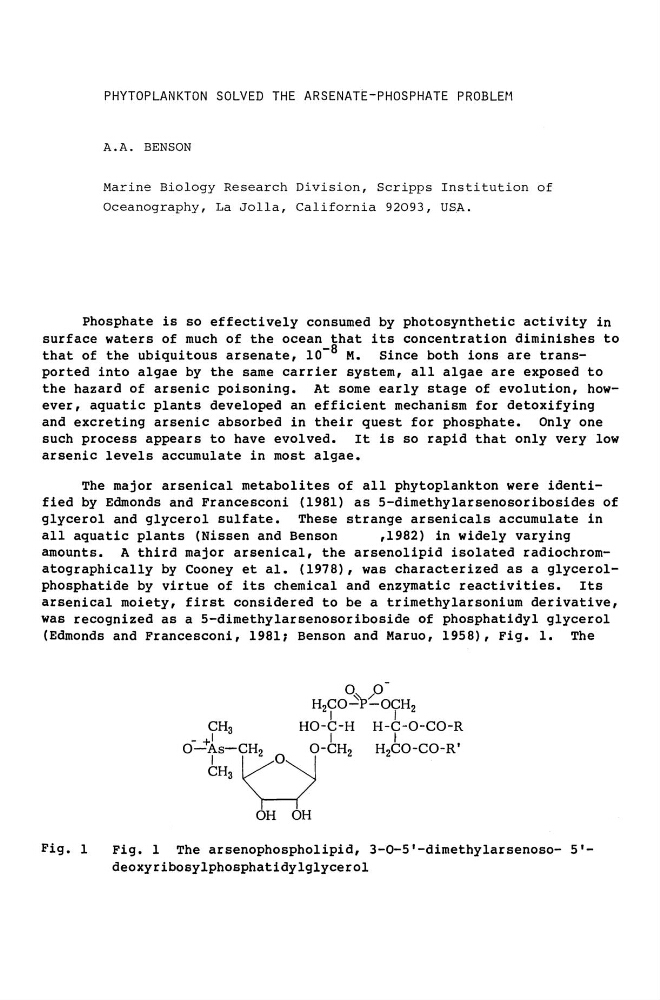
amounts. A third major arsenical, the arsenolipid isolated radiochromatographically by Cooney et ale (1978), was characterized as a glycerolphosphatide by virtue of its chemical and enzymatic reactivities. Its
arsenical moiety, first considered to be a trimethylarsonium derivative,
was recognized as a 5-dimethylarsenosoriboside of phosphatidyl glycerol
(Edmonds and Francesconi, 1981; Benson and Maruo, 1958), Fig. 1. The
Fig. 1
o 0H CO~P-:"OCH
21
1 2
CH 3
HO-C-H H-C-O-CO-R
- +1
1
I
O-ts-VO~-CH2
H 2CO-CO-R'
CH3~
OH OH
Fig. 1 The arsenophospholipid, 3-0-5'-dimethylarsenoso- 5'deoxyribosylphosphatidylglycerol
A.A. BENSON
Marine Biology Research Division, Scripps Institution of
Oceanography, La Jolla, California 92093, US.A.
Phosphate is so effectively consumed by photosynthetic activity in
surface waters of much of the ocean that its concentration diminishes to
that of the ubiquitous arsenate, 10- 8 M. Since both ions are transported into algae by the same carrier system, all algae are exposed to
the hazard of arsenic poisoning. At some early stage of evolution, however, aquatic plants developed an efficient mechanism for detoxifying
and excreting arsenic absorbed in their quest for phosphate. Only one
such process appears to have evolved. It is so rapid that only very low
arsenic levels accumulate in most algae.
The major arsenical metabolites of all phytoplankton were identified by Edmonds and Francesconi (1981) as 5-dimethylarsenosoribosides of
glycerol and glycerol sulfate. These strange arsenicals accumulate in
all aquatic plants (Nissen and Benson
,1982) in widely varying
amounts. A third major arsenical, the arsenolipid isolated radiochromatographically by Cooney et ale (1978), was characterized as a glycerolphosphatide by virtue of its chemical and enzymatic reactivities. Its
arsenical moiety, first considered to be a trimethylarsonium derivative,
was recognized as a 5-dimethylarsenosoriboside of phosphatidyl glycerol
(Edmonds and Francesconi, 1981; Benson and Maruo, 1958), Fig. 1. The
Fig. 1
o 0H CO~P-:"OCH
21
1 2
CH 3
HO-C-H H-C-O-CO-R
- +1
1
I
O-ts-VO~-CH2
H 2CO-CO-R'
CH3~
OH OH
Fig. 1 The arsenophospholipid, 3-0-5'-dimethylarsenoso- 5'deoxyribosylphosphatidylglycerol