

37
0.91
(10)
0.96
(11)
0.95
(12)
1. 00
(13)
(14)
Equation 3 describes the flux of quanta (white light) absorbed by a
thin suspension of phytoplankton cells.
J 4 , the flux of absorbed quanta,
is a function of the incident level of irradiance, J i , and the chlorophyll concentration in the suspension, ChI. The constant in equation 3
is the product of the molar absorption coefficient for cellular chlorophyll and a volume element which relates the incident level of irradiance
to a one liter suspension.
Equations 4-7 are phenomenological equations
for the two pairs of coupled reactions shown in Figure 5. J 4 is the
flux of absorbed quanta, J 3 is the rate of electron flow across reaction
centers, J 2 is the rate of photosynthetic electron flow, and J l is the
flux of electrons to carbon dioxide.
The stoichiometry of equation 2
indicates that 4.5 moles of electrons are transferred for each mole of
carbon dioxide assimilated. Al through A4 are the chemical affinities
for the four reactions.
In the case of light limited metabolism, Al
and A4 are constant, but A2 and A3 may have any value consistent with
the constraints placed upon the system. The L terms of these equations
are the phenomenological coefficients, which index the conductivity or
catalytic capacity of the metabolic pathways. Equations 8 and 9 are
conditions for cycling of reactions 2 and 3.
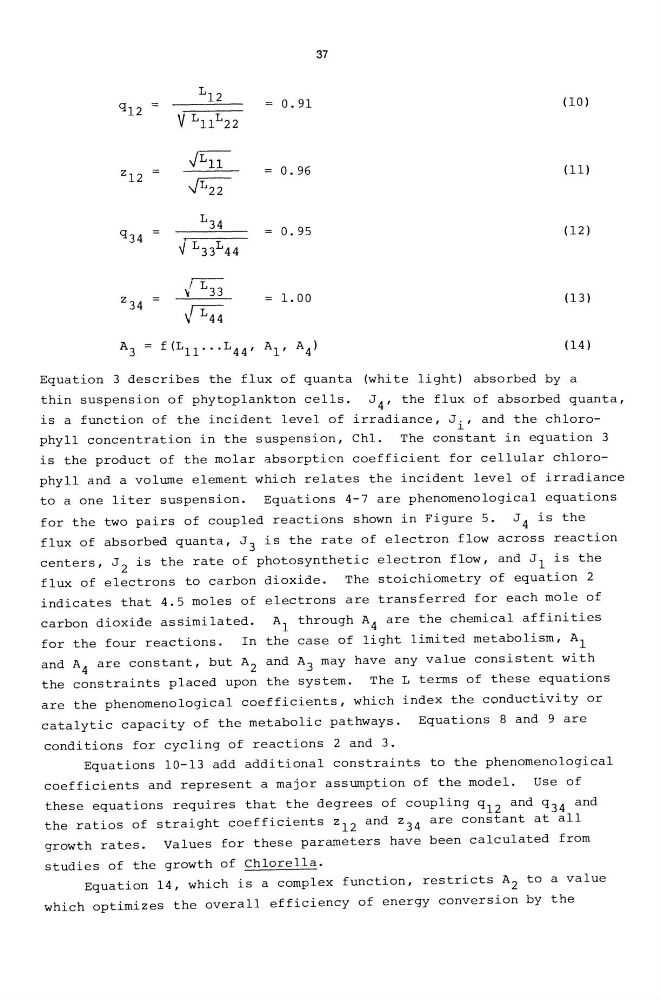
Equations 10-13 add additional constraints to the phenomenological
coefficients and represent a major assumption of the model.
Use of
these equations requires that the degrees of coupling q12 and q34 and
the ratios of straight coefficients z12 and z34 are constant at all
growth rates.
Values for these parameters have been calculated from
studies of the growth of Chlorella.
Equation 14, which is a complex function, restricts A2 to a value
which optimizes the overall efficiency of energy conversion by the
0.91
(10)
0.96
(11)
0.95
(12)
1. 00
(13)
(14)
Equation 3 describes the flux of quanta (white light) absorbed by a
thin suspension of phytoplankton cells.
J 4 , the flux of absorbed quanta,
is a function of the incident level of irradiance, J i , and the chlorophyll concentration in the suspension, ChI. The constant in equation 3
is the product of the molar absorption coefficient for cellular chlorophyll and a volume element which relates the incident level of irradiance
to a one liter suspension.
Equations 4-7 are phenomenological equations
for the two pairs of coupled reactions shown in Figure 5. J 4 is the
flux of absorbed quanta, J 3 is the rate of electron flow across reaction
centers, J 2 is the rate of photosynthetic electron flow, and J l is the
flux of electrons to carbon dioxide.
The stoichiometry of equation 2
indicates that 4.5 moles of electrons are transferred for each mole of
carbon dioxide assimilated. Al through A4 are the chemical affinities
for the four reactions.
In the case of light limited metabolism, Al
and A4 are constant, but A2 and A3 may have any value consistent with
the constraints placed upon the system. The L terms of these equations
are the phenomenological coefficients, which index the conductivity or
catalytic capacity of the metabolic pathways. Equations 8 and 9 are
conditions for cycling of reactions 2 and 3.
Equations 10-13 add additional constraints to the phenomenological
coefficients and represent a major assumption of the model.
Use of
these equations requires that the degrees of coupling q12 and q34 and
the ratios of straight coefficients z12 and z34 are constant at all
growth rates.
Values for these parameters have been calculated from
studies of the growth of Chlorella.
Equation 14, which is a complex function, restricts A2 to a value
which optimizes the overall efficiency of energy conversion by the