

22
nearly one-fourth of the total production in the water column (EI-Sayed
and Taguchi, 1981; EI-Sayed et al., 1983). However, in the Atlantic
and Indian sectors of the Antarctic, carbon fixation below the euphotic
zone did not exceed 5 to 10% of that in the entire water column (ElSayed and Weber, 1982; EI-Sayed and Jitts, 1973).
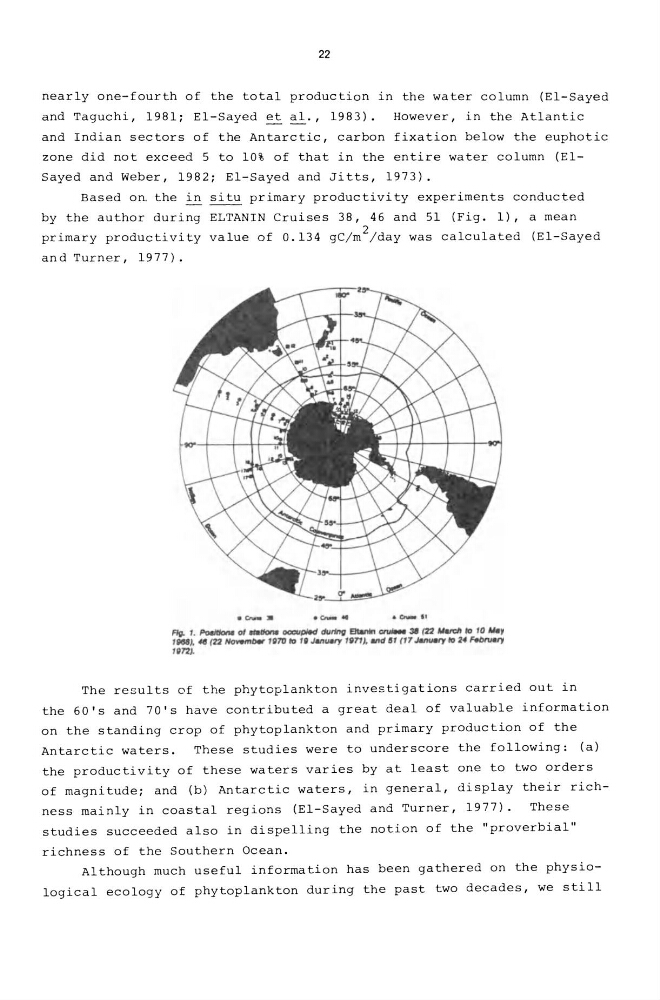
Based on. the in
by the author during
primary productivity
and Turner, 1977).
situ primary productivity experiments conducted
ELTANIN Cruises 38, 46 and 51 (Fig. 1), a mean
2
value of 0.134 gClm Iday was calculated (EI-Sayed
• c:.- ..
• c:.- ..
. 0 - . 1 .
FIQ. I . _
of _ _ oocuf'I*J tAlrIng _
=- # (22 _ to 10 """
lea~ 4fI (22 _ _ 1t70 to "JMtu.ry Ipn~ ..,11 51 (17 JMtu.ry 10 U ~
IP72~
The results of the phytoplankton investigations carried out in
the 60's and 70's have contributed a great deal of valuable information
on the standing crop of phytoplankton and primary production of the
Antarctic waters.
These studies were to underscore the following: (a)
the productivity of these waters varies by at least one to two orders
of magnitude; and (b) Antarctic waters, in general, display their richness mainly in coastal regions (EI-Sayed and Turner, 1977).
These
studies succeeded also in dispelling the notion of the "proverbial"
richness of the Southern Ocean.
Although much useful information has been gathered on the physiological ecology of phytoplankton during the past two decades, we still
nearly one-fourth of the total production in the water column (EI-Sayed
and Taguchi, 1981; EI-Sayed et al., 1983). However, in the Atlantic
and Indian sectors of the Antarctic, carbon fixation below the euphotic
zone did not exceed 5 to 10% of that in the entire water column (ElSayed and Weber, 1982; EI-Sayed and Jitts, 1973).
Based on. the in
by the author during
primary productivity
and Turner, 1977).
situ primary productivity experiments conducted
ELTANIN Cruises 38, 46 and 51 (Fig. 1), a mean
2
value of 0.134 gClm Iday was calculated (EI-Sayed
• c:.- ..
• c:.- ..
. 0 - . 1 .
FIQ. I . _
of _ _ oocuf'I*J tAlrIng _
=- # (22 _ to 10 """
lea~ 4fI (22 _ _ 1t70 to "JMtu.ry Ipn~ ..,11 51 (17 JMtu.ry 10 U ~
IP72~
The results of the phytoplankton investigations carried out in
the 60's and 70's have contributed a great deal of valuable information
on the standing crop of phytoplankton and primary production of the
Antarctic waters.
These studies were to underscore the following: (a)
the productivity of these waters varies by at least one to two orders
of magnitude; and (b) Antarctic waters, in general, display their richness mainly in coastal regions (EI-Sayed and Turner, 1977).
These
studies succeeded also in dispelling the notion of the "proverbial"
richness of the Southern Ocean.
Although much useful information has been gathered on the physiological ecology of phytoplankton during the past two decades, we still