

118
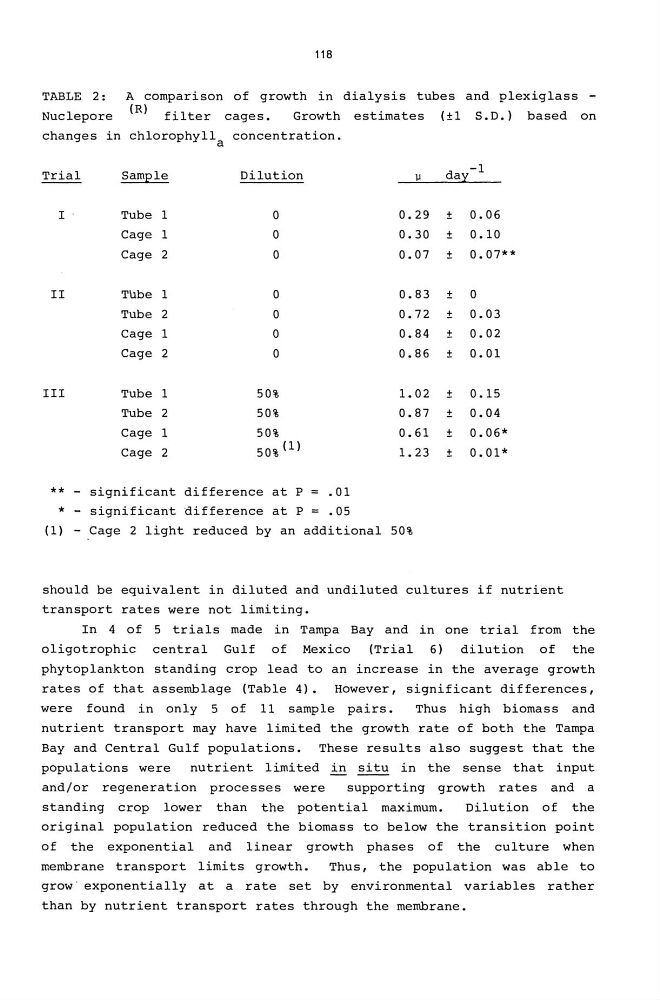
TABLE 2:
A comparison of growth in dialysis tubes and plexiglass -
Nuclepore (R) filter cages.
Growth estimates (±l S.D.) based on
changes in chlorophylla concentration.
Trial
Sample
Dilution
day -1
\J
I
Tube 1
0
0.29 ± 0.06
Cage 1
0
0.30 ± 0.10
Cage 2
0
0.07 ± 0.07**
II
Tube 1
0
0.83 ± 0
Tube 2
0
0.72 ± 0.03
Cage 1
0
0.84 ± 0.02
Cage 2
0
0.86 ± 0.01
III
Tube 1
50%
1.02 ± 0.15
Tube 2
50%
0.87 ± 0.04
Cage 1
50%
0.61 ± 0.06*
Cage 2
50%(1)
1. 23 ± 0.01*
** - significant difference at P
.01
* - significant difference at P .05
(1) - .Cage 2 light reduced by an additional 50%
should be equivalent in diluted and undiluted cultures if nutrient
transport rates were not limiting.
In 4 of 5 trials made in Tampa Bay and in one trial from the
oligotrophic central Gulf of Mexico (Trial 6) dilution of the
phytoplankton standing crop lead to an increase in the average growth
rates of that assemblage (Table 4). However, significant differences,
were found in only 5 of 11 sample pairs.
Thus high biomass and
nutrient transport may have limited the growth rate of both the Tampa
Bay and Central Gulf populations. These results also suggest that the
populations were nutrient limited in situ in the sense that input
and/or regeneration processes were
supporting growth rates and a
standing crop lower than the potential maximum.
Dilution of the
original population reduced the biomass to below the transition point
of the exponential and linear growth phases of the culture when
membrane transport limits growth.
Thus, the population was able to
grow' exponentially at a rate set by environmental variables rather
than by nutrient transport rates through the membrane.
TABLE 2:
A comparison of growth in dialysis tubes and plexiglass -
Nuclepore (R) filter cages.
Growth estimates (±l S.D.) based on
changes in chlorophylla concentration.
Trial
Sample
Dilution
day -1
\J
I
Tube 1
0
0.29 ± 0.06
Cage 1
0
0.30 ± 0.10
Cage 2
0
0.07 ± 0.07**
II
Tube 1
0
0.83 ± 0
Tube 2
0
0.72 ± 0.03
Cage 1
0
0.84 ± 0.02
Cage 2
0
0.86 ± 0.01
III
Tube 1
50%
1.02 ± 0.15
Tube 2
50%
0.87 ± 0.04
Cage 1
50%
0.61 ± 0.06*
Cage 2
50%(1)
1. 23 ± 0.01*
** - significant difference at P
.01
* - significant difference at P .05
(1) - .Cage 2 light reduced by an additional 50%
should be equivalent in diluted and undiluted cultures if nutrient
transport rates were not limiting.
In 4 of 5 trials made in Tampa Bay and in one trial from the
oligotrophic central Gulf of Mexico (Trial 6) dilution of the
phytoplankton standing crop lead to an increase in the average growth
rates of that assemblage (Table 4). However, significant differences,
were found in only 5 of 11 sample pairs.
Thus high biomass and
nutrient transport may have limited the growth rate of both the Tampa
Bay and Central Gulf populations. These results also suggest that the
populations were nutrient limited in situ in the sense that input
and/or regeneration processes were
supporting growth rates and a
standing crop lower than the potential maximum.
Dilution of the
original population reduced the biomass to below the transition point
of the exponential and linear growth phases of the culture when
membrane transport limits growth.
Thus, the population was able to
grow' exponentially at a rate set by environmental variables rather
than by nutrient transport rates through the membrane.