

65
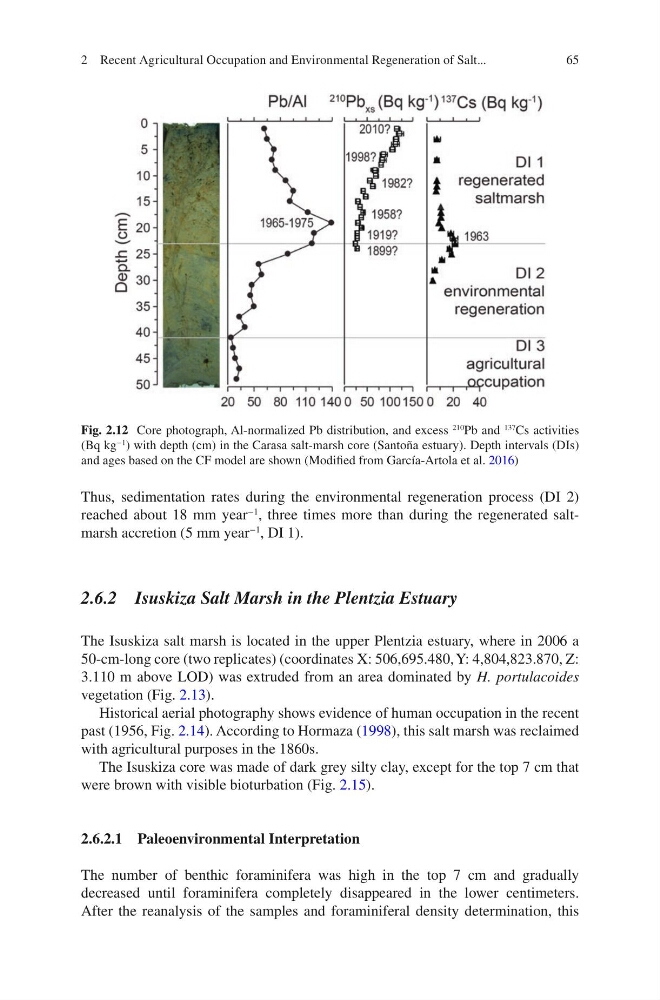
Thus, sedimentation rates during the environmental regeneration process (DI 2)
reached about 18 mm year
−1
, three times more than during the regenerated saltmarsh accretion (5 mm year
−1
, DI 1).
2.6.2 Isuskiza Salt Marsh in the Plentzia Estuary
The Isuskiza salt marsh is located in the upper Plentzia estuary, where in 2006 a
50-cm-long core (two replicates) (coordinates X: 506,695.480, Y: 4,804,823.870, Z:
3.110 m above LOD) was extruded from an area dominated by H. portulacoides
vegetation (Fig. 2.13).
Historical aerial photography shows evidence of human occupation in the recent
past (1956, Fig. 2.14). According to Hormaza (1998), this salt marsh was reclaimed
with agricultural purposes in the 1860s.
The Isuskiza core was made of dark grey silty clay, except for the top 7 cm that
were brown with visible bioturbation (Fig. 2.15).
2.6.2.1 Paleoenvironmental Interpretation
The number of benthic foraminifera was high in the top 7 cm and gradually
decreased until foraminifera completely disappeared in the lower centimeters.
After the reanalysis of the samples and foraminiferal density determination, this
Fig. 2.12 Core photograph, Al-normalized Pb distribution, and excess
210
Pb and
137
Cs activities
(Bq kg
−1 ) with depth (cm) in the Carasa salt-marsh core (Santoña estuary). Depth intervals (DIs)
and ages based on the CF model are shown (Modified from García-Artola et al. 2016)
2 Recent Agricultural Occupation and Environmental Regeneration of Salt...
Thus, sedimentation rates during the environmental regeneration process (DI 2)
reached about 18 mm year
−1
, three times more than during the regenerated saltmarsh accretion (5 mm year
−1
, DI 1).
2.6.2 Isuskiza Salt Marsh in the Plentzia Estuary
The Isuskiza salt marsh is located in the upper Plentzia estuary, where in 2006 a
50-cm-long core (two replicates) (coordinates X: 506,695.480, Y: 4,804,823.870, Z:
3.110 m above LOD) was extruded from an area dominated by H. portulacoides
vegetation (Fig. 2.13).
Historical aerial photography shows evidence of human occupation in the recent
past (1956, Fig. 2.14). According to Hormaza (1998), this salt marsh was reclaimed
with agricultural purposes in the 1860s.
The Isuskiza core was made of dark grey silty clay, except for the top 7 cm that
were brown with visible bioturbation (Fig. 2.15).
2.6.2.1 Paleoenvironmental Interpretation
The number of benthic foraminifera was high in the top 7 cm and gradually
decreased until foraminifera completely disappeared in the lower centimeters.
After the reanalysis of the samples and foraminiferal density determination, this
Fig. 2.12 Core photograph, Al-normalized Pb distribution, and excess
210
Pb and
137
Cs activities
(Bq kg
−1 ) with depth (cm) in the Carasa salt-marsh core (Santoña estuary). Depth intervals (DIs)
and ages based on the CF model are shown (Modified from García-Artola et al. 2016)
2 Recent Agricultural Occupation and Environmental Regeneration of Salt...