

59
2.5.3 Pollution Fingerprints
Metals in estuarine sediments derive both from natural (e.g. rock weathering) and
anthropogenic sources (e.g. mining operations, industrial effluents, sewage waste
discharges, and fossil-fuel burning). Unlike other pollutants, they are not biodegradable and can accumulate in the sediment over time, preserving a valuable record of
human impact. In addition, when the history of anthropogenic inputs is well known,
metal pollution signals may be used to estimate deposition dates (Irabien et al.
2008a; Marshall 2015). Lead is the most widely scattered toxic metal in the world
since ancient times (Cheng and Hu 2010). The geochemical fingerprint of Roman
mining and smelting has been detected in ice cores, peat bogs, and lacustrine deposits (Elbaz-Poulichet et al. 2011), as well as in sediments from a nearby estuary in the
northern coast of Spain (Irabien et al. 2012). However, the most dramatic increase
in Pb production occurred from the Industrial Revolution onwards, with periods of
enhanced atmospheric deposition at the turn of the 20th century and since the 1950s
(Weiss et al. 1999).
In the Urdaibai and Plentzia estuaries historical Pb/Al profiles are broadly similar, with enhanced values throughout the 20th century that peak between 1965 and
1975 in relation to the main local industrialization period (Cearreta et al. 2002;
Leorri et al. 2014b; Irabien et al. 2015). The local pollution history is in reasonable
good agreement with maximum emissions of this metal to the atmosphere in Europe
and Spain during the mid-1970s (Olendrzyński et al. 1996; Pacyna et al. 2007). This
explains the observed enrichment of Pb/Al in the upper centimeters of the sedimentary records (Fig. 2.7).
Lead concentrations were determined using Inductively Coupled Plasma-Optic
Emission Spectrometry (ICP-OES) after digestion with aqua regia. Although this
technique does not achieve the total dissolution of the sample, it has been widely
used for the analysis of recent sediments for environmental purposes (Landajo et al.
2004; Sarkar et al. 2004; Mil-Homens et al. 2006). Pollutants usually associate with
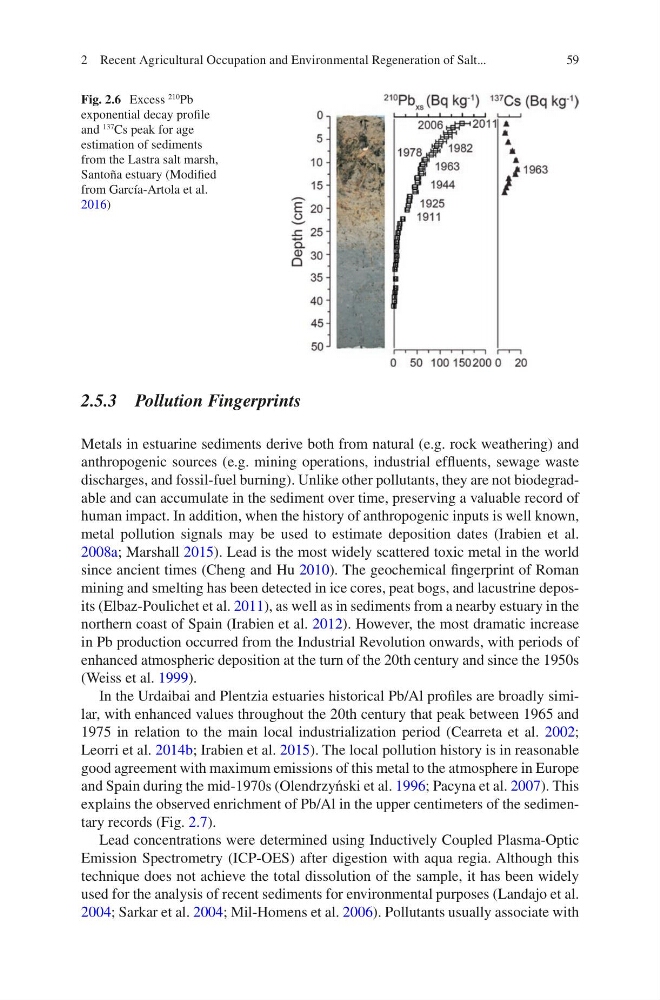
Fig. 2.6 Excess
210 Pb
exponential decay profile
and
137
Cs peak for age
estimation of sediments
from the Lastra salt marsh,
Santoña estuary (Modified
from García-Artola et al.
2016)
2 Recent Agricultural Occupation and Environmental Regeneration of Salt...
2.5.3 Pollution Fingerprints
Metals in estuarine sediments derive both from natural (e.g. rock weathering) and
anthropogenic sources (e.g. mining operations, industrial effluents, sewage waste
discharges, and fossil-fuel burning). Unlike other pollutants, they are not biodegradable and can accumulate in the sediment over time, preserving a valuable record of
human impact. In addition, when the history of anthropogenic inputs is well known,
metal pollution signals may be used to estimate deposition dates (Irabien et al.
2008a; Marshall 2015). Lead is the most widely scattered toxic metal in the world
since ancient times (Cheng and Hu 2010). The geochemical fingerprint of Roman
mining and smelting has been detected in ice cores, peat bogs, and lacustrine deposits (Elbaz-Poulichet et al. 2011), as well as in sediments from a nearby estuary in the
northern coast of Spain (Irabien et al. 2012). However, the most dramatic increase
in Pb production occurred from the Industrial Revolution onwards, with periods of
enhanced atmospheric deposition at the turn of the 20th century and since the 1950s
(Weiss et al. 1999).
In the Urdaibai and Plentzia estuaries historical Pb/Al profiles are broadly similar, with enhanced values throughout the 20th century that peak between 1965 and
1975 in relation to the main local industrialization period (Cearreta et al. 2002;
Leorri et al. 2014b; Irabien et al. 2015). The local pollution history is in reasonable
good agreement with maximum emissions of this metal to the atmosphere in Europe
and Spain during the mid-1970s (Olendrzyński et al. 1996; Pacyna et al. 2007). This
explains the observed enrichment of Pb/Al in the upper centimeters of the sedimentary records (Fig. 2.7).
Lead concentrations were determined using Inductively Coupled Plasma-Optic
Emission Spectrometry (ICP-OES) after digestion with aqua regia. Although this
technique does not achieve the total dissolution of the sample, it has been widely
used for the analysis of recent sediments for environmental purposes (Landajo et al.
2004; Sarkar et al. 2004; Mil-Homens et al. 2006). Pollutants usually associate with
Fig. 2.6 Excess
210 Pb
exponential decay profile
and
137
Cs peak for age
estimation of sediments
from the Lastra salt marsh,
Santoña estuary (Modified
from García-Artola et al.
2016)
2 Recent Agricultural Occupation and Environmental Regeneration of Salt...