

669
moves seaward down to the lower estuary and carry fishes out to coastal waters
(Barletta and Costa 2009). Estuarine fish species, such as catfishes (C. spixii, C.
agassizi and S. hertzbergii) are mainly captured for subsistence since they are highly
abundant in the estuary (Dantas et al. 2010). Commercial fisheries target different
species, such as acoupa weakfish, snooks (C. undecimalis, C. pectinatus, C. mexicanus), snappers, Brazilian mojarra, halfbeaks (Hemiramphus spp.), mullets and
cutlassfish (T. lepturus) (Fig. 20.7a–f and 20.15b, e). Estuarine fishing is common
for all communities living along its margins, however, the most important activity in
Carne de Vaca is coastal fishing (Barletta and Costa 2009; Silveira et al. 2013).
Current data on fishery landing counts on an extensive and ever growing data
bank about the Goiana Estuary (see grant n° 405818/2012-2 /COAGR/CNPq). A
report analyzed the performance of the artisanal fleet between 2013 and 2015 within
the extractive reserve Acaú-Goiana and surrounding coastal areas to determine fishery productivity related to the estuary (Table 20.2). Fishing occurs inside the estuary
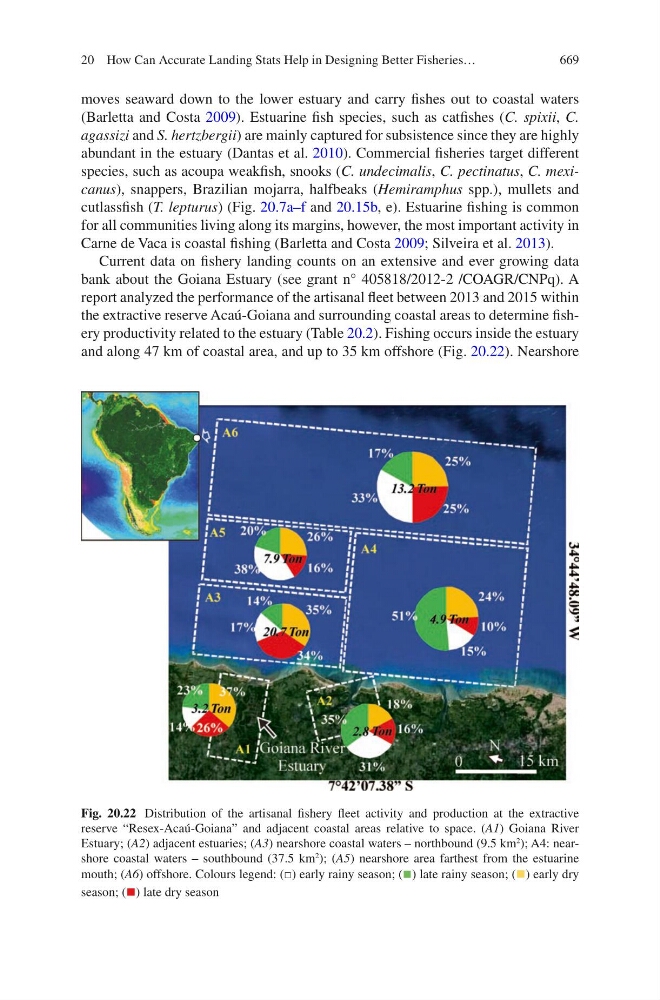
and along 47 km of coastal area, and up to 35 km offshore (Fig. 20.22). Nearshore
Fig. 20.22 Distribution of the artisanal fishery fleet activity and production at the extractive
reserve “Resex-Acaú-Goiana” and adjacent coastal areas relative to space. (A1) Goiana River
Estuary; (A2) adjacent estuaries; (A3) nearshore coastal waters – northbound (9.5 km
2 ); A4: nearshore coastal waters – southbound (37.5 km
2 ); (A5) nearshore area farthest from the estuarine
mouth; (A6) offshore. Colours legend: (□) early rainy season; (■) late rainy season; (■) early dry
season; (■) late dry season
20 How Can Accurate Landing Stats Help in Designing Better Fisheries…