

667
Mollusks are regarded as a subsistence resource by only 4.2% of the families
around the Goiana Estuary. However, a study with 360 subjects estimated that
69.7% of mussel pickers in the extractive reserve, and 88.2% in the surrounding
non-protected areas report mussel picking as their main source of subsistence and
income generation (Barletta and Costa 2009; Silva-Cavalcanti and Costa 2009).
Oysters (Crassotrea rhizophorae) are collected by men, diving or removing from
red mangrove roots (Fig. 20.10c). Charru mussel (Mytella spp.) is also collected at
sub-tidal areas by a small group of men at the lower estuary, near Acaú (Fig. 20.10d).
In total, approximately 450 families (5 person per family resulting in 2250 people)
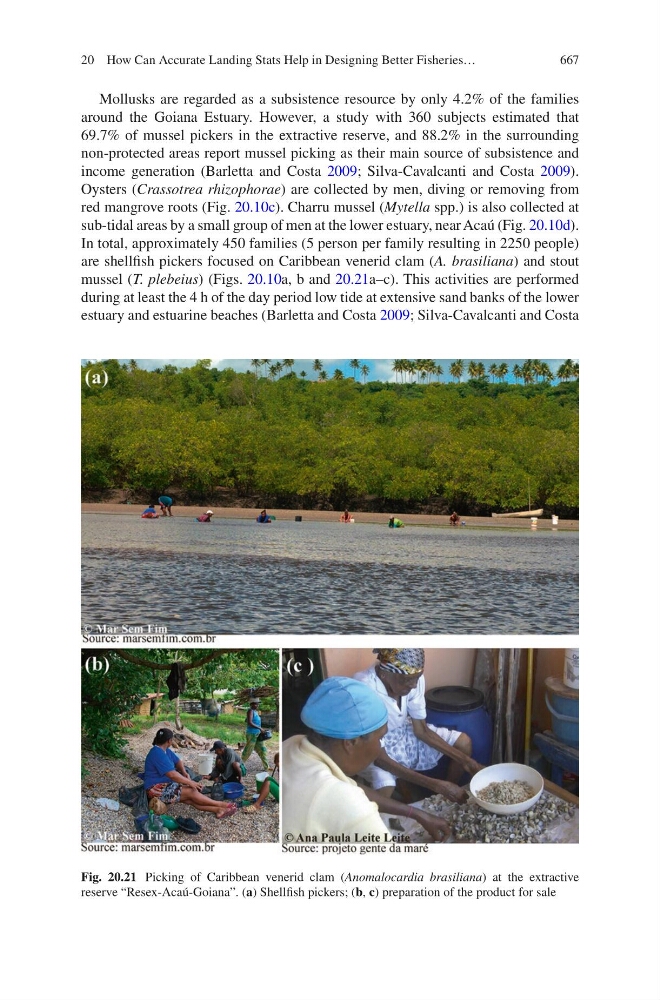
are shellfish pickers focused on Caribbean venerid clam (A. brasiliana) and stout
mussel (T. plebeius) (Figs. 20.10a, b and 20.21a–c). This activities are performed
during at least the 4 h of the day period low tide at extensive sand banks of the lower
estuary and estuarine beaches (Barletta and Costa 2009; Silva-Cavalcanti and Costa
Fig. 20.21 Picking of Caribbean venerid clam (Anomalocardia brasiliana) at the extractive
reserve “Resex-Acaú-Goiana”. (a) Shellfish pickers; (b, c) preparation of the product for sale
20 How Can Accurate Landing Stats Help in Designing Better Fisheries…