

49
the agricultural decline and migration to the cities during the 1950s, some of these
previously reclaimed lands have been naturally regenerated. The abandonment of
agricultural activities, lack of dyke maintenance, and entrance of estuarine water
has allowed recolonization by halophytic vegetation of these areas, once artificially isolated from tidal inundation. In the last three decades, local authorities
have been taking political decisions for the preservation of salt marshes due to
their ecological importance and high productivity. In this sense, the Spanish
Coastal Law passed in 1988 included these coastal environments in the public
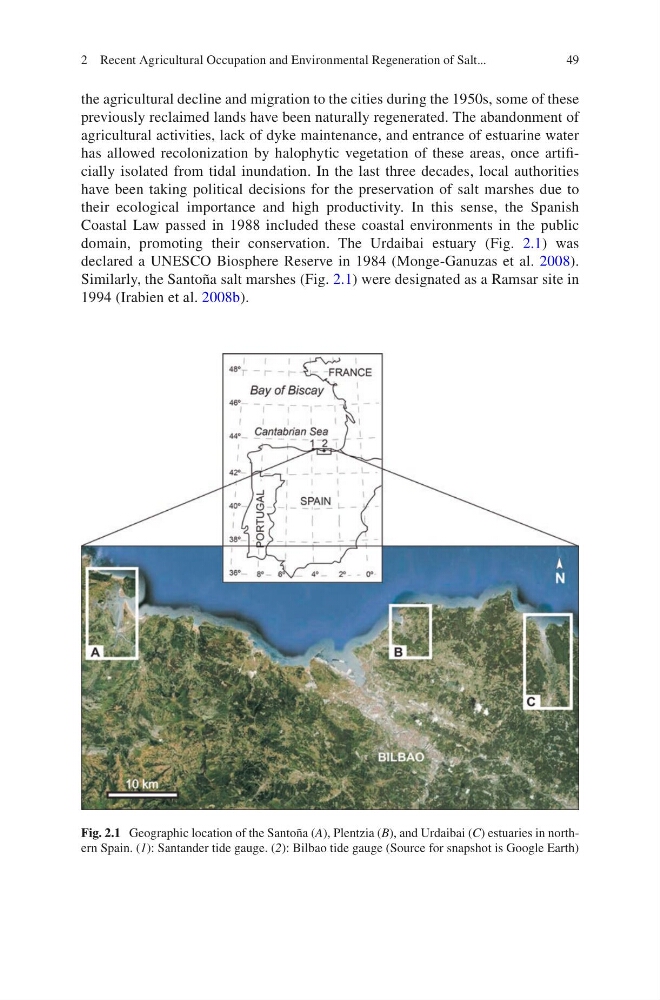
domain, promoting their conservation. The Urdaibai estuary (Fig. 2.1) was
declared a UNESCO Biosphere Reserve in 1984 (Monge- Ganuzas et al. 2008).
Similarly, the Santoña salt marshes (Fig. 2.1) were designated as a Ramsar site in
1994 (Irabien et al. 2008b).
Fig. 2.1 Geographic location of the Santoña (A), Plentzia (B), and Urdaibai (C) estuaries in northern Spain. (1): Santander tide gauge. (2): Bilbao tide gauge (Source for snapshot is Google Earth)
2 Recent Agricultural Occupation and Environmental Regeneration of Salt...
the agricultural decline and migration to the cities during the 1950s, some of these
previously reclaimed lands have been naturally regenerated. The abandonment of
agricultural activities, lack of dyke maintenance, and entrance of estuarine water
has allowed recolonization by halophytic vegetation of these areas, once artificially isolated from tidal inundation. In the last three decades, local authorities
have been taking political decisions for the preservation of salt marshes due to
their ecological importance and high productivity. In this sense, the Spanish
Coastal Law passed in 1988 included these coastal environments in the public
domain, promoting their conservation. The Urdaibai estuary (Fig. 2.1) was
declared a UNESCO Biosphere Reserve in 1984 (Monge- Ganuzas et al. 2008).
Similarly, the Santoña salt marshes (Fig. 2.1) were designated as a Ramsar site in
1994 (Irabien et al. 2008b).
Fig. 2.1 Geographic location of the Santoña (A), Plentzia (B), and Urdaibai (C) estuaries in northern Spain. (1): Santander tide gauge. (2): Bilbao tide gauge (Source for snapshot is Google Earth)
2 Recent Agricultural Occupation and Environmental Regeneration of Salt...