

600
could be seen up to 2000. The condition of the mangrove could improve only after
the year 2000. From the year 2001, the mangrove cover has been increasing
(Fig. 19.12).
19.6.2 Anthropogenic Impact on Mangrove Forest: Coringa
Wildlife Sanctuary, East Coast, India
Coringa Wildlife Sanctuary (CWS) is located in the reserved forest of Godavari
delta, in the east coast of India (Fig. 19.4). This was declared as a wild life sanctuary
in 1978. Fresh water inters the mangrove complex from the Godavari river, and its
distributaries mainly Coringa and Gaderu. The mangrove formation at Coringa covers a total area of about 333 km
2
and comprises 32 species, of which ‘true mangrove’ (major and minor components) represent 15 species. Apart from this 11
species of mangrove associates and 6 species of salt marsh are also found. Monitoring
of the Coringa mangrove reserve forest was carried out using satellite data of the
years 1977 (Landsat MSS having 80 m spatial resolution), 1998 (IRS LISS-II, 36 m
spatial resolution) and 2007 (IRS LISS-III, 23 m spatial resolution), 2011 (LISS III)
and 2016 (LISS III). Mangroves seen in the 1977 image (Fig. 19.13a) at the periphery of the southern boundary of the reserved forest (boundary seen in green colour)
have been cleared as seen in 1998 LISS II image (Fig. 19.13b). IRS LISS III image
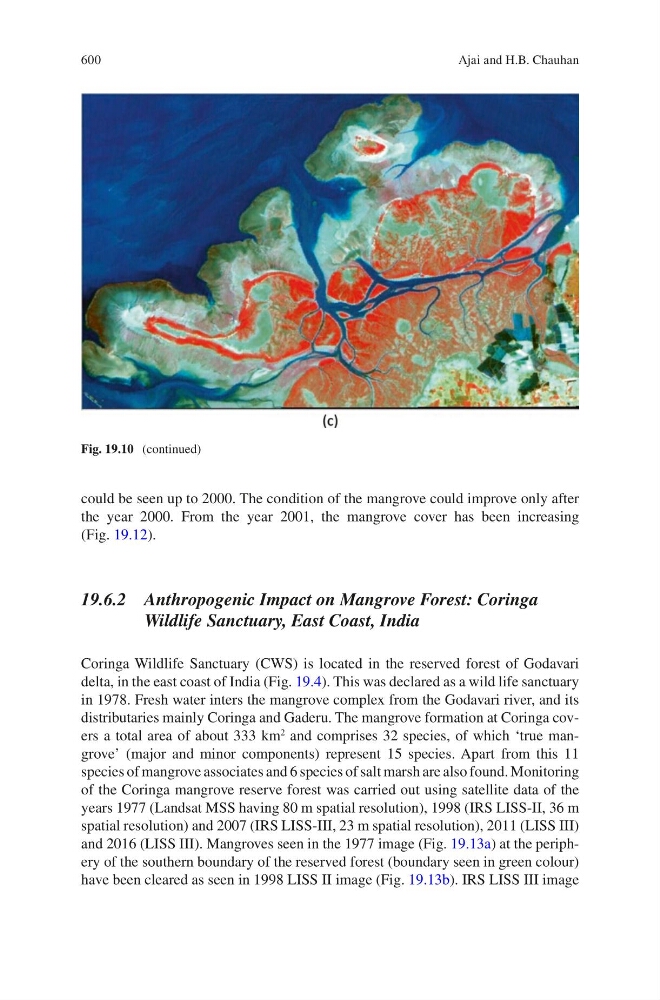
Fig. 19.10 (continued)
Ajai and H.B. Chauhan