

563
sub- products obtained from C. acutus. Thus it is possible that the ECTC would have
a better monitoring and greater control over the management of C. acutus for its
integral and sustainable use based on the specifications of Management Plans and
Planning (TMP) recently published by SEMARNAT (2014). This without forgetting the coordination with the concerned community group (as proposed by Bocco
et al. 2000) so the work does not have a bias towards a purely academic perspective,
and that it exists interest in developing alternative projects, and that it will lead them
to financial results in the short term if possible.
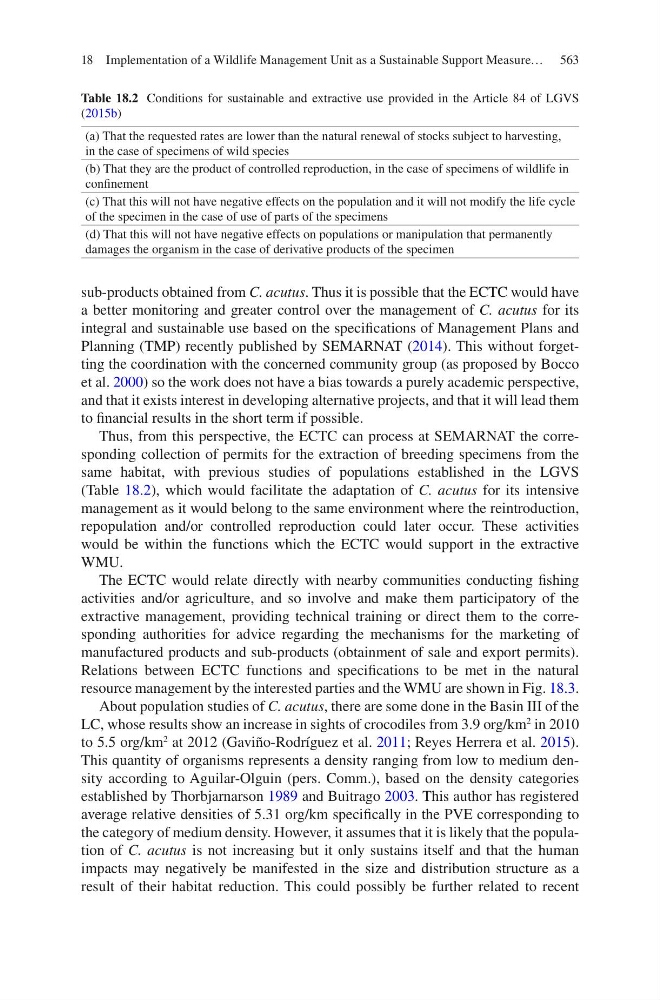
Thus, from this perspective, the ECTC can process at SEMARNAT the corresponding collection of permits for the extraction of breeding specimens from the
same habitat, with previous studies of populations established in the LGVS
(Table 18.2), which would facilitate the adaptation of C. acutus for its intensive
management as it would belong to the same environment where the reintroduction,
repopulation and/or controlled reproduction could later occur. These activities
would be within the functions which the ECTC would support in the extractive
WMU.
The ECTC would relate directly with nearby communities conducting fishing
activities and/or agriculture, and so involve and make them participatory of the
extractive management, providing technical training or direct them to the corresponding authorities for advice regarding the mechanisms for the marketing of
manufactured products and sub-products (obtainment of sale and export permits).
Relations between ECTC functions and specifications to be met in the natural
resource management by the interested parties and the WMU are shown in Fig. 18.3.
About population studies of C. acutus, there are some done in the Basin III of the
LC, whose results show an increase in sights of crocodiles from 3.9 org/km
2
in 2010
to 5.5 org/km
2
at 2012 (Gaviño-Rodríguez et al. 2011; Reyes Herrera et al. 2015).
This quantity of organisms represents a density ranging from low to medium density according to Aguilar-Olguin (pers. Comm.), based on the density categories
established by Thorbjarnarson 1989 and Buitrago 2003. This author has registered
average relative densities of 5.31 org/km specifically in the PVE corresponding to
the category of medium density. However, it assumes that it is likely that the population of C. acutus is not increasing but it only sustains itself and that the human
impacts may negatively be manifested in the size and distribution structure as a
result of their habitat reduction. This could possibly be further related to recent
Table 18.2 Conditions for sustainable and extractive use provided in the Article 84 of LGVS
(2015b)
(a) That the requested rates are lower than the natural renewal of stocks subject to harvesting,
in the case of specimens of wild species
(b) That they are the product of controlled reproduction, in the case of specimens of wildlife in
confinement
(c) That this will not have negative effects on the population and it will not modify the life cycle
of the specimen in the case of use of parts of the specimens
(d) That this will not have negative effects on populations or manipulation that permanently
damages the organism in the case of derivative products of the specimen
18 Implementation of a Wildlife Management Unit as a Sustainable Support Measure…