

498
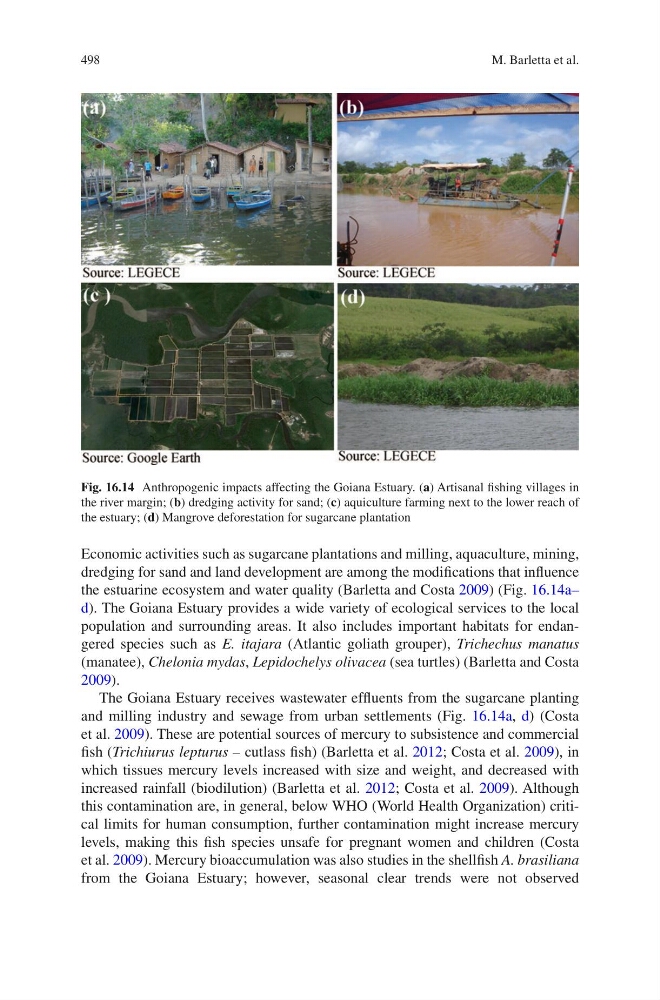
Economic activities such as sugarcane plantations and milling, aquaculture, mining,
dredging for sand and land development are among the modifications that influence
the estuarine ecosystem and water quality (Barletta and Costa 2009) (Fig. 16.14a–
d). The Goiana Estuary provides a wide variety of ecological services to the local
population and surrounding areas. It also includes important habitats for endangered species such as E. itajara (Atlantic goliath grouper), Trichechus manatus
(manatee), Chelonia mydas, Lepidochelys olivacea (sea turtles) (Barletta and Costa
2009).
The Goiana Estuary receives wastewater effluents from the sugarcane planting
and milling industry and sewage from urban settlements (Fig. 16.14a, d) (Costa
et al. 2009). These are potential sources of mercury to subsistence and commercial
fish (Trichiurus lepturus – cutlass fish) (Barletta et al. 2012; Costa et al. 2009), in
which tissues mercury levels increased with size and weight, and decreased with
increased rainfall (biodilution) (Barletta et al. 2012; Costa et al. 2009). Although
this contamination are, in general, below WHO (World Health Organization) critical limits for human consumption, further contamination might increase mercury
levels, making this fish species unsafe for pregnant women and children (Costa
et al. 2009). Mercury bioaccumulation was also studies in the shellfish A. brasiliana
from the Goiana Estuary; however, seasonal clear trends were not observed
Fig. 16.14 Anthropogenic impacts affecting the Goiana Estuary. (a) Artisanal fishing villages in
the river margin; (b) dredging activity for sand; (c) aquiculture farming next to the lower reach of
the estuary; (d) Mangrove deforestation for sugarcane plantation
M. Barletta et al.
Economic activities such as sugarcane plantations and milling, aquaculture, mining,
dredging for sand and land development are among the modifications that influence
the estuarine ecosystem and water quality (Barletta and Costa 2009) (Fig. 16.14a–
d). The Goiana Estuary provides a wide variety of ecological services to the local
population and surrounding areas. It also includes important habitats for endangered species such as E. itajara (Atlantic goliath grouper), Trichechus manatus
(manatee), Chelonia mydas, Lepidochelys olivacea (sea turtles) (Barletta and Costa
2009).
The Goiana Estuary receives wastewater effluents from the sugarcane planting
and milling industry and sewage from urban settlements (Fig. 16.14a, d) (Costa
et al. 2009). These are potential sources of mercury to subsistence and commercial
fish (Trichiurus lepturus – cutlass fish) (Barletta et al. 2012; Costa et al. 2009), in
which tissues mercury levels increased with size and weight, and decreased with
increased rainfall (biodilution) (Barletta et al. 2012; Costa et al. 2009). Although
this contamination are, in general, below WHO (World Health Organization) critical limits for human consumption, further contamination might increase mercury
levels, making this fish species unsafe for pregnant women and children (Costa
et al. 2009). Mercury bioaccumulation was also studies in the shellfish A. brasiliana
from the Goiana Estuary; however, seasonal clear trends were not observed
Fig. 16.14 Anthropogenic impacts affecting the Goiana Estuary. (a) Artisanal fishing villages in
the river margin; (b) dredging activity for sand; (c) aquiculture farming next to the lower reach of
the estuary; (d) Mangrove deforestation for sugarcane plantation
M. Barletta et al.