

490
16.3.2 Importance of Estuarine Ecocline to Predict Water
Quality Changes
Seasonal and spatial changes in environmental gradients as estuarine ecocline influence both biotic and abiotic features of an estuary (Barletta et al. 2012; Costa et al.
2009; Lima et al. 2014). The estuarine ecocline can set physico-chemical conditions
that determine the bioavailability or sinking of the amount of dissolved oxygen in
the waters along the estuary, as well as the concentration of pollutants (e.g. plastic
debris, metals, emerging pollutants) and microbiological contaminants (e.g. from
sewage, urban runoff and animal farming) throughout the transition between freshwater and marine habitats (Figs. 16.7 and 16.8). South American countries have
historically neglected basic sanitation problems in both urban and rural areas; the
same was still generally observed for industrial and agro-industrial effluents until
recently (Huang et al. 2014; Costa and Barletta 2016). Sources of industrial effluents, sewage and solid wastes are observed all along river basins, estuarine courses
and adjacent coastal and marine waters (Pereira et al. 2010). Usually, pollutants
reach critical levels near urban centers and industrial estates most of the year. When
hydrological condition changes prompted by increased rainfall and river flow, pollutant loads move together with shifting abiotic habitats to other estuarine areas
downstream, depending on the efficiency of the flushing (Figs. 16.7 and 16.8). In
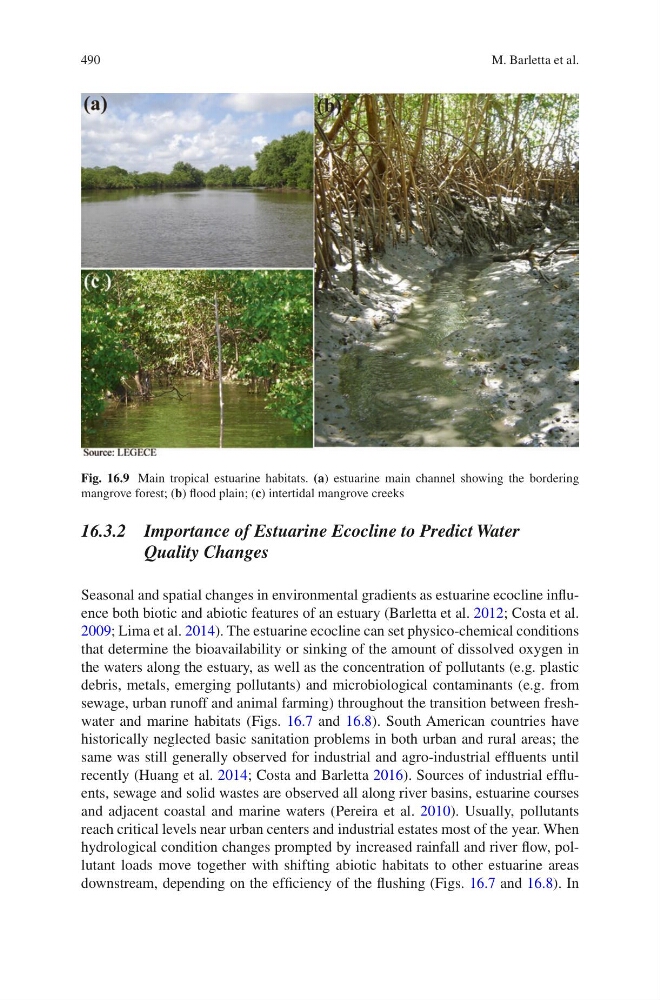
Fig. 16.9 Main tropical estuarine habitats. (a) estuarine main channel showing the bordering
mangrove forest; (b) flood plain; (c) intertidal mangrove creeks
M. Barletta et al.
16.3.2 Importance of Estuarine Ecocline to Predict Water
Quality Changes
Seasonal and spatial changes in environmental gradients as estuarine ecocline influence both biotic and abiotic features of an estuary (Barletta et al. 2012; Costa et al.
2009; Lima et al. 2014). The estuarine ecocline can set physico-chemical conditions
that determine the bioavailability or sinking of the amount of dissolved oxygen in
the waters along the estuary, as well as the concentration of pollutants (e.g. plastic
debris, metals, emerging pollutants) and microbiological contaminants (e.g. from
sewage, urban runoff and animal farming) throughout the transition between freshwater and marine habitats (Figs. 16.7 and 16.8). South American countries have
historically neglected basic sanitation problems in both urban and rural areas; the
same was still generally observed for industrial and agro-industrial effluents until
recently (Huang et al. 2014; Costa and Barletta 2016). Sources of industrial effluents, sewage and solid wastes are observed all along river basins, estuarine courses
and adjacent coastal and marine waters (Pereira et al. 2010). Usually, pollutants
reach critical levels near urban centers and industrial estates most of the year. When
hydrological condition changes prompted by increased rainfall and river flow, pollutant loads move together with shifting abiotic habitats to other estuarine areas
downstream, depending on the efficiency of the flushing (Figs. 16.7 and 16.8). In
Fig. 16.9 Main tropical estuarine habitats. (a) estuarine main channel showing the bordering
mangrove forest; (b) flood plain; (c) intertidal mangrove creeks
M. Barletta et al.