

484
16.2.2 Goiana Estuary
The Goiana Estuary (~4700 ha) represents a wide group of estuaries that border the
eastern-most portion of South America, where only a few hundred kilometres of
Atlantic Rain forest used to separate the coast from a wide expense of semi-arid
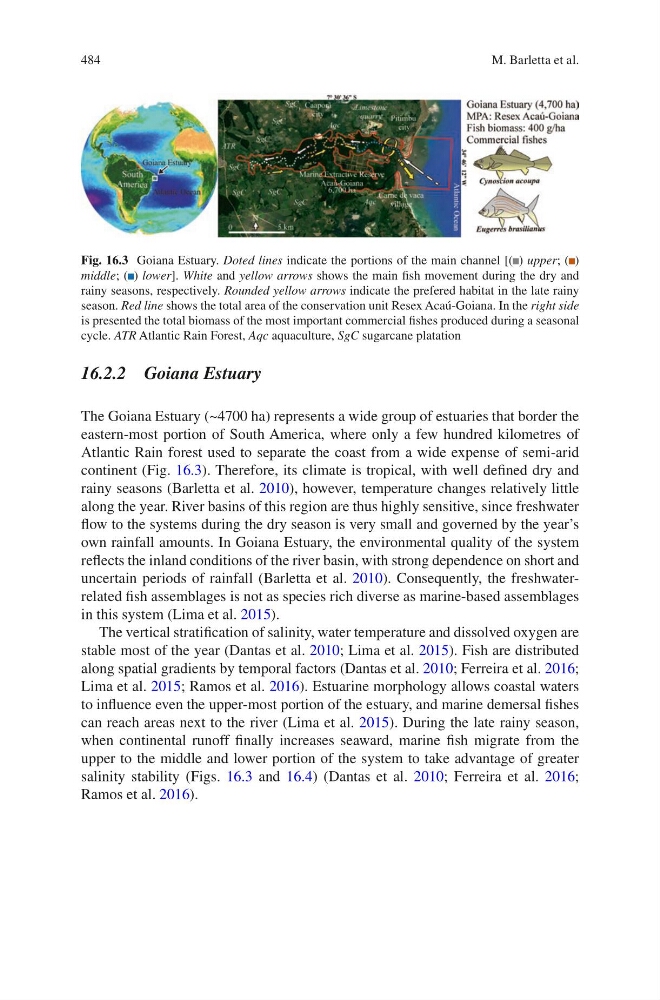
continent (Fig. 16.3). Therefore, its climate is tropical, with well defined dry and
rainy seasons (Barletta et al. 2010), however, temperature changes relatively little
along the year. River basins of this region are thus highly sensitive, since freshwater
flow to the systems during the dry season is very small and governed by the year’s
own rainfall amounts. In Goiana Estuary, the environmental quality of the system
reflects the inland conditions of the river basin, with strong dependence on short and
uncertain periods of rainfall (Barletta et al. 2010). Consequently, the freshwaterrelated fish assemblages is not as species rich diverse as marine-based assemblages
in this system (Lima et al. 2015).
The vertical stratification of salinity, water temperature and dissolved oxygen are
stable most of the year (Dantas et al. 2010; Lima et al. 2015). Fish are distributed
along spatial gradients by temporal factors (Dantas et al. 2010; Ferreira et al. 2016;
Lima et al. 2015; Ramos et al. 2016). Estuarine morphology allows coastal waters
to influence even the upper-most portion of the estuary, and marine demersal fishes
can reach areas next to the river (Lima et al. 2015). During the late rainy season,
when continental runoff finally increases seaward, marine fish migrate from the
upper to the middle and lower portion of the system to take advantage of greater
salinity stability (Figs. 16.3 and 16.4) (Dantas et al. 2010; Ferreira et al. 2016;
Ramos et al. 2016).
Fig. 16.3 Goiana Estuary. Doted lines indicate the portions of the main channel [( ) upper; ( )
middle; ( ) lower]. White and yellow arrows shows the main fish movement during the dry and
rainy seasons, respectively. Rounded yellow arrows indicate the prefered habitat in the late rainy
season. Red line shows the total area of the conservation unit Resex Acaú-Goiana. In the right side
is presented the total biomass of the most important commercial fishes produced during a seasonal
cycle. ATR Atlantic Rain Forest, Aqc aquaculture, SgC sugarcane platation
M. Barletta et al.
16.2.2 Goiana Estuary
The Goiana Estuary (~4700 ha) represents a wide group of estuaries that border the
eastern-most portion of South America, where only a few hundred kilometres of
Atlantic Rain forest used to separate the coast from a wide expense of semi-arid
continent (Fig. 16.3). Therefore, its climate is tropical, with well defined dry and
rainy seasons (Barletta et al. 2010), however, temperature changes relatively little
along the year. River basins of this region are thus highly sensitive, since freshwater
flow to the systems during the dry season is very small and governed by the year’s
own rainfall amounts. In Goiana Estuary, the environmental quality of the system
reflects the inland conditions of the river basin, with strong dependence on short and
uncertain periods of rainfall (Barletta et al. 2010). Consequently, the freshwaterrelated fish assemblages is not as species rich diverse as marine-based assemblages
in this system (Lima et al. 2015).
The vertical stratification of salinity, water temperature and dissolved oxygen are
stable most of the year (Dantas et al. 2010; Lima et al. 2015). Fish are distributed
along spatial gradients by temporal factors (Dantas et al. 2010; Ferreira et al. 2016;
Lima et al. 2015; Ramos et al. 2016). Estuarine morphology allows coastal waters
to influence even the upper-most portion of the estuary, and marine demersal fishes
can reach areas next to the river (Lima et al. 2015). During the late rainy season,
when continental runoff finally increases seaward, marine fish migrate from the
upper to the middle and lower portion of the system to take advantage of greater
salinity stability (Figs. 16.3 and 16.4) (Dantas et al. 2010; Ferreira et al. 2016;
Ramos et al. 2016).
Fig. 16.3 Goiana Estuary. Doted lines indicate the portions of the main channel [( ) upper; ( )
middle; ( ) lower]. White and yellow arrows shows the main fish movement during the dry and
rainy seasons, respectively. Rounded yellow arrows indicate the prefered habitat in the late rainy
season. Red line shows the total area of the conservation unit Resex Acaú-Goiana. In the right side
is presented the total biomass of the most important commercial fishes produced during a seasonal
cycle. ATR Atlantic Rain Forest, Aqc aquaculture, SgC sugarcane platation
M. Barletta et al.