

482
and Costa 2009; ICMbio 1995, 2012). However, the inefficient communication
between academy and institutions responsible for structuring the fisheries conservation scenario, and the sustainable use of estuarine and marine resources are a main
concern (Barletta et al. 2010; Costa and Barletta 2016).
Here in this chapter there is suitable information on how to work in favour of
estuarine ecocline and how robust sampling designs can provide consistent ecological and statistically testable data, taking into account the overlapping of abiotic
variables and life cycles of key species for different estuarine reaches and seasons.
This generates descriptors of reference conditions and ecological information that
must be used as the basis for Western Atlantic regional coastal systems
conservation.
16.2 Study Areas and Fluctuation of the Salinity Ecocline
According to Local Rainfall Patterns
16.2.1 Caeté Estuary
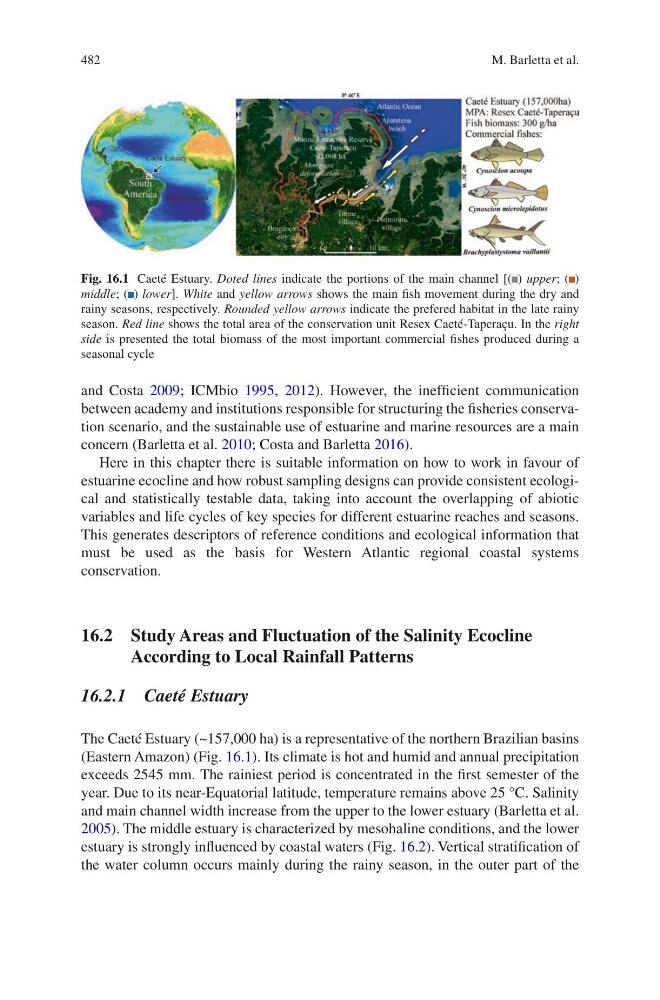
The Caeté Estuary (~157,000 ha) is a representative of the northern Brazilian basins
(Eastern Amazon) (Fig. 16.1). Its climate is hot and humid and annual precipitation
exceeds 2545 mm. The rainiest period is concentrated in the first semester of the
year. Due to its near-Equatorial latitude, temperature remains above 25 °C. Salinity
and main channel width increase from the upper to the lower estuary (Barletta et al.
2005). The middle estuary is characterized by mesohaline conditions, and the lower
estuary is strongly influenced by coastal waters (Fig. 16.2). Vertical stratification of
the water column occurs mainly during the rainy season, in the outer part of the
Fig. 16.1 Caeté Estuary. Doted lines indicate the portions of the main channel [( ) upper; ( )
middle; ( ) lower]. White and yellow arrows shows the main fish movement during the dry and
rainy seasons, respectively. Rounded yellow arrows indicate the prefered habitat in the late rainy
season. Red line shows the total area of the conservation unit Resex Caeté-Taperaçu. In the right
side is presented the total biomass of the most important commercial fishes produced during a
seasonal cycle
M. Barletta et al.
and Costa 2009; ICMbio 1995, 2012). However, the inefficient communication
between academy and institutions responsible for structuring the fisheries conservation scenario, and the sustainable use of estuarine and marine resources are a main
concern (Barletta et al. 2010; Costa and Barletta 2016).
Here in this chapter there is suitable information on how to work in favour of
estuarine ecocline and how robust sampling designs can provide consistent ecological and statistically testable data, taking into account the overlapping of abiotic
variables and life cycles of key species for different estuarine reaches and seasons.
This generates descriptors of reference conditions and ecological information that
must be used as the basis for Western Atlantic regional coastal systems
conservation.
16.2 Study Areas and Fluctuation of the Salinity Ecocline
According to Local Rainfall Patterns
16.2.1 Caeté Estuary
The Caeté Estuary (~157,000 ha) is a representative of the northern Brazilian basins
(Eastern Amazon) (Fig. 16.1). Its climate is hot and humid and annual precipitation
exceeds 2545 mm. The rainiest period is concentrated in the first semester of the
year. Due to its near-Equatorial latitude, temperature remains above 25 °C. Salinity
and main channel width increase from the upper to the lower estuary (Barletta et al.
2005). The middle estuary is characterized by mesohaline conditions, and the lower
estuary is strongly influenced by coastal waters (Fig. 16.2). Vertical stratification of
the water column occurs mainly during the rainy season, in the outer part of the
Fig. 16.1 Caeté Estuary. Doted lines indicate the portions of the main channel [( ) upper; ( )
middle; ( ) lower]. White and yellow arrows shows the main fish movement during the dry and
rainy seasons, respectively. Rounded yellow arrows indicate the prefered habitat in the late rainy
season. Red line shows the total area of the conservation unit Resex Caeté-Taperaçu. In the right
side is presented the total biomass of the most important commercial fishes produced during a
seasonal cycle
M. Barletta et al.