

29
Drainage of the wetland biomes set in motion a whole new set of conditions that
resulted in the deterioration of a healthy ecosystem to the point that ecotonal successions resulted in the replacement of prior environments (e.g., Chimney and Goforth
2001; Finkl 1995; Finkl and Charlier 2003a, b; Finkl and Makowski 2013a, b). The
new drier environments, which expanded at the sake of wetlands, created new
biomes that little resembled the pre-geoengineered landscape. Some wetlands
‘reclaimed’ (by dredge and drain practices) from the Everglades, but now residing
in the urban sprawl zone, are still subject to flooding in spite of land drainage (e.g.,
Finkl 2000; Finkl and Myers 1995, 1996, 1997). Subsequent encroachment by
farming, as in the Kissimmee River Valley and by sugar cane plantations in Broward
County (Everglades Agricultural Area, EAA), polluted waters through the use of
fertilizers (e.g., nitrogen and phosphorus macroelements, microelements, and
amendments) and pesticides. Eutrophication of Lake Okeechobee resulted and during wet years overspill sent nutrient-rich contaminated water through the Everglades
as surface flow to Florida Bay, which in turn became polluted by nutrient-rich fresh
water flowing into the estuary (Hansen 2016).
By the time the public began to take notice of the deteriorating conditions in the
Everglades system, environmental problems were multifaceted and far-reaching.
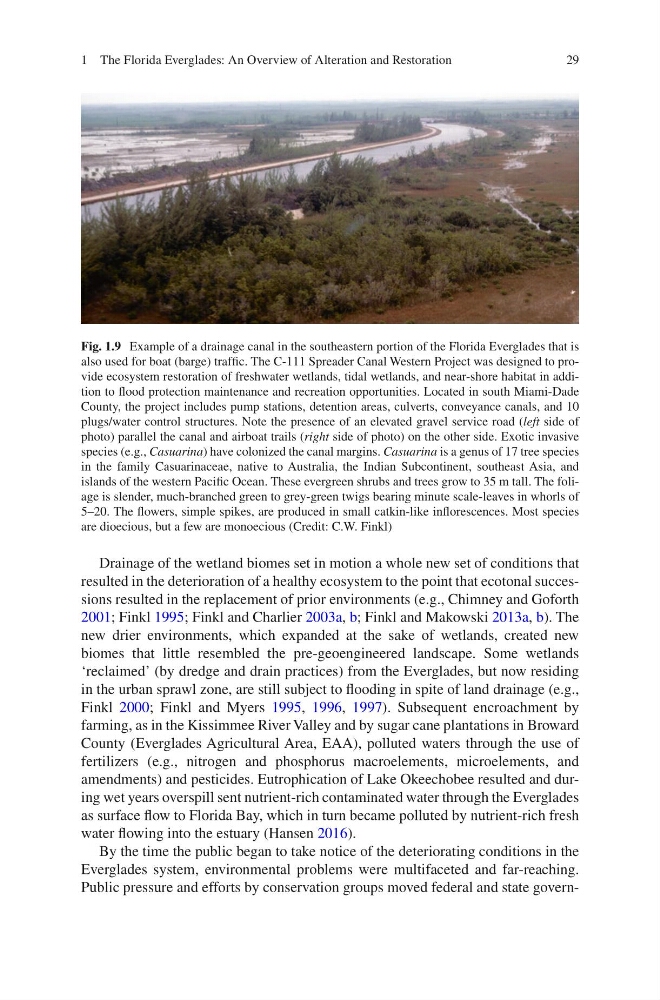
Public pressure and efforts by conservation groups moved federal and state governFig. 1.9 Example of a drainage canal in the southeastern portion of the Florida Everglades that is
also used for boat (barge) traffic. The C-111 Spreader Canal Western Project was designed to provide ecosystem restoration of freshwater wetlands, tidal wetlands, and near-shore habitat in addition to flood protection maintenance and recreation opportunities. Located in south Miami-Dade
County, the project includes pump stations, detention areas, culverts, conveyance canals, and 10
plugs/water control structures. Note the presence of an elevated gravel service road (left side of
photo) parallel the canal and airboat trails (right side of photo) on the other side. Exotic invasive
species (e.g., Casuarina) have colonized the canal margins. Casuarina is a genus of 17 tree species
in the family Casuarinaceae, native to Australia, the Indian Subcontinent, southeast Asia, and
islands of the western Pacific Ocean. These evergreen shrubs and trees grow to 35 m tall. The foliage is slender, much-branched green to grey-green twigs bearing minute scale-leaves in whorls of
5–20. The flowers, simple spikes, are produced in small catkin-like inflorescences. Most species
are dioecious, but a few are monoecious (Credit: C.W. Finkl)
1 The Florida Everglades: An Overview of Alteration and Restoration
Drainage of the wetland biomes set in motion a whole new set of conditions that
resulted in the deterioration of a healthy ecosystem to the point that ecotonal successions resulted in the replacement of prior environments (e.g., Chimney and Goforth
2001; Finkl 1995; Finkl and Charlier 2003a, b; Finkl and Makowski 2013a, b). The
new drier environments, which expanded at the sake of wetlands, created new
biomes that little resembled the pre-geoengineered landscape. Some wetlands
‘reclaimed’ (by dredge and drain practices) from the Everglades, but now residing
in the urban sprawl zone, are still subject to flooding in spite of land drainage (e.g.,
Finkl 2000; Finkl and Myers 1995, 1996, 1997). Subsequent encroachment by
farming, as in the Kissimmee River Valley and by sugar cane plantations in Broward
County (Everglades Agricultural Area, EAA), polluted waters through the use of
fertilizers (e.g., nitrogen and phosphorus macroelements, microelements, and
amendments) and pesticides. Eutrophication of Lake Okeechobee resulted and during wet years overspill sent nutrient-rich contaminated water through the Everglades
as surface flow to Florida Bay, which in turn became polluted by nutrient-rich fresh
water flowing into the estuary (Hansen 2016).
By the time the public began to take notice of the deteriorating conditions in the
Everglades system, environmental problems were multifaceted and far-reaching.
Public pressure and efforts by conservation groups moved federal and state governFig. 1.9 Example of a drainage canal in the southeastern portion of the Florida Everglades that is
also used for boat (barge) traffic. The C-111 Spreader Canal Western Project was designed to provide ecosystem restoration of freshwater wetlands, tidal wetlands, and near-shore habitat in addition to flood protection maintenance and recreation opportunities. Located in south Miami-Dade
County, the project includes pump stations, detention areas, culverts, conveyance canals, and 10
plugs/water control structures. Note the presence of an elevated gravel service road (left side of
photo) parallel the canal and airboat trails (right side of photo) on the other side. Exotic invasive
species (e.g., Casuarina) have colonized the canal margins. Casuarina is a genus of 17 tree species
in the family Casuarinaceae, native to Australia, the Indian Subcontinent, southeast Asia, and
islands of the western Pacific Ocean. These evergreen shrubs and trees grow to 35 m tall. The foliage is slender, much-branched green to grey-green twigs bearing minute scale-leaves in whorls of
5–20. The flowers, simple spikes, are produced in small catkin-like inflorescences. Most species
are dioecious, but a few are monoecious (Credit: C.W. Finkl)
1 The Florida Everglades: An Overview of Alteration and Restoration