

462
Aesthetic experiences, the outcomes of human-landscape interaction, have caused
human-influenced environments and some different aspects of these environments.
Because people so powerfully affect environmental phenomena in a way, landscape
and ecology need to be considered together, from a holistic view, with landscape and
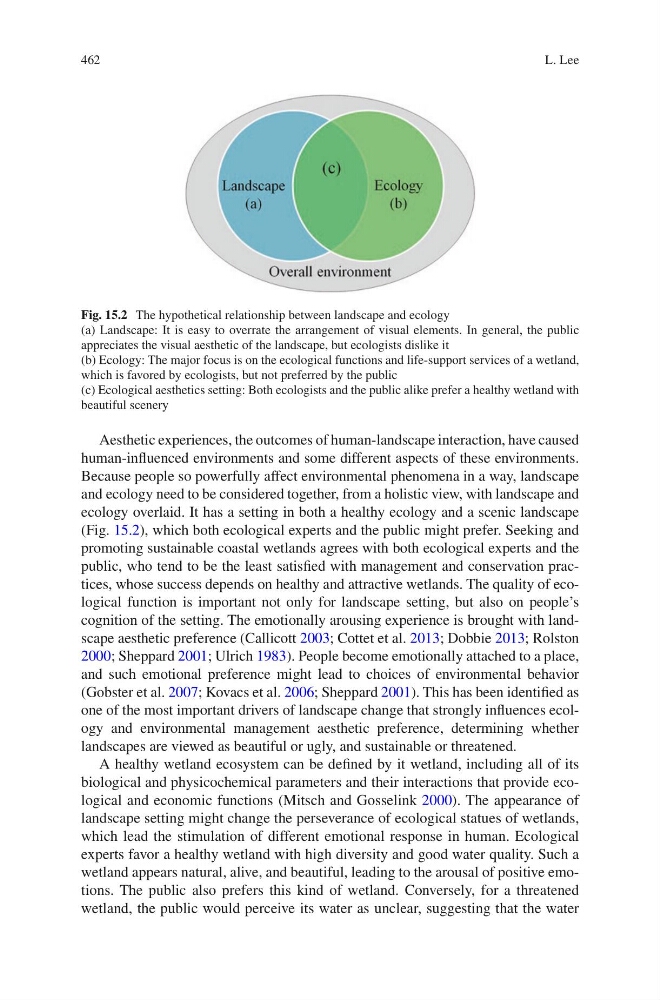
ecology overlaid. It has a setting in both a healthy ecology and a scenic landscape
(Fig. 15.2), which both ecological experts and the public might prefer. Seeking and
promoting sustainable coastal wetlands agrees with both ecological experts and the
public, who tend to be the least satisfied with management and conservation practices, whose success depends on healthy and attractive wetlands. The quality of ecological function is important not only for landscape setting, but also on people’s
cognition of the setting. The emotionally arousing experience is brought with landscape aesthetic preference (Callicott 2003; Cottet et al. 2013; Dobbie 2013; Rolston
2000; Sheppard 2001; Ulrich 1983). People become emotionally attached to a place,
and such emotional preference might lead to choices of environmental behavior
(Gobster et al. 2007; Kovacs et al. 2006; Sheppard 2001). This has been identified as
one of the most important drivers of landscape change that strongly influences ecology and environmental management aesthetic preference, determining whether
landscapes are viewed as beautiful or ugly, and sustainable or threatened.
A healthy wetland ecosystem can be defined by it wetland, including all of its
biological and physicochemical parameters and their interactions that provide ecological and economic functions (Mitsch and Gosselink 2000). The appearance of
landscape setting might change the perseverance of ecological statues of wetlands,
which lead the stimulation of different emotional response in human. Ecological
experts favor a healthy wetland with high diversity and good water quality. Such a
wetland appears natural, alive, and beautiful, leading to the arousal of positive emotions. The public also prefers this kind of wetland. Conversely, for a threatened
wetland, the public would perceive its water as unclear, suggesting that the water
Fig. 15.2 The hypothetical relationship between landscape and ecology
(a) Landscape: It is easy to overrate the arrangement of visual elements. In general, the public
appreciates the visual aesthetic of the landscape, but ecologists dislike it
(b) Ecology: The major focus is on the ecological functions and life-support services of a wetland,
which is favored by ecologists, but not preferred by the public
(c) Ecological aesthetics setting: Both ecologists and the public alike prefer a healthy wetland with
beautiful scenery
L. Lee
Aesthetic experiences, the outcomes of human-landscape interaction, have caused
human-influenced environments and some different aspects of these environments.
Because people so powerfully affect environmental phenomena in a way, landscape
and ecology need to be considered together, from a holistic view, with landscape and
ecology overlaid. It has a setting in both a healthy ecology and a scenic landscape
(Fig. 15.2), which both ecological experts and the public might prefer. Seeking and
promoting sustainable coastal wetlands agrees with both ecological experts and the
public, who tend to be the least satisfied with management and conservation practices, whose success depends on healthy and attractive wetlands. The quality of ecological function is important not only for landscape setting, but also on people’s
cognition of the setting. The emotionally arousing experience is brought with landscape aesthetic preference (Callicott 2003; Cottet et al. 2013; Dobbie 2013; Rolston
2000; Sheppard 2001; Ulrich 1983). People become emotionally attached to a place,
and such emotional preference might lead to choices of environmental behavior
(Gobster et al. 2007; Kovacs et al. 2006; Sheppard 2001). This has been identified as
one of the most important drivers of landscape change that strongly influences ecology and environmental management aesthetic preference, determining whether
landscapes are viewed as beautiful or ugly, and sustainable or threatened.
A healthy wetland ecosystem can be defined by it wetland, including all of its
biological and physicochemical parameters and their interactions that provide ecological and economic functions (Mitsch and Gosselink 2000). The appearance of
landscape setting might change the perseverance of ecological statues of wetlands,
which lead the stimulation of different emotional response in human. Ecological
experts favor a healthy wetland with high diversity and good water quality. Such a
wetland appears natural, alive, and beautiful, leading to the arousal of positive emotions. The public also prefers this kind of wetland. Conversely, for a threatened
wetland, the public would perceive its water as unclear, suggesting that the water
Fig. 15.2 The hypothetical relationship between landscape and ecology
(a) Landscape: It is easy to overrate the arrangement of visual elements. In general, the public
appreciates the visual aesthetic of the landscape, but ecologists dislike it
(b) Ecology: The major focus is on the ecological functions and life-support services of a wetland,
which is favored by ecologists, but not preferred by the public
(c) Ecological aesthetics setting: Both ecologists and the public alike prefer a healthy wetland with
beautiful scenery
L. Lee