

20
devoid of other animal life (Davis and Ogden 1994). Deer will sometimes graze in
open spots on the tender grass, Florida panthers are ever rarely seen, and an occasional wildcat will occupy one of the tree islands in order to prey upon rats and
mice. Possums and raccoons can be found along the borders of the Everglades, but
are most likely tempted to move towards urbanized areas where food sources are
more abundant. The one mammal most likely adapted to the Everglades was possibly the Florida freshwater otter (Lontra canadensis), however, relentless hunting for
their valuable pelts has all but eliminated this animal from its natural habitat
(Gleason 1984).
The delicate balance of the Everglades ecosystem allows many species of flora
and fauna to flourish. However, due to human alteration, that balance has been disrupted on a large scale. Nutrient pollution loading and overdrainage, while being
major contributors to the problem, are not the only threats the Everglades faces.
Alien species of plants and animals that have been introduced to the Everglades by
humans can be just as destructive. Exotic plants, such as Melaleuca, Brazilian pepper (Schinus terebinthifolia), and Australian pine (Casuarina spp.) (D’Antonio and
Meyerson 2002; Doren et al. 2009a, b), and invasive animals, such as Burmese
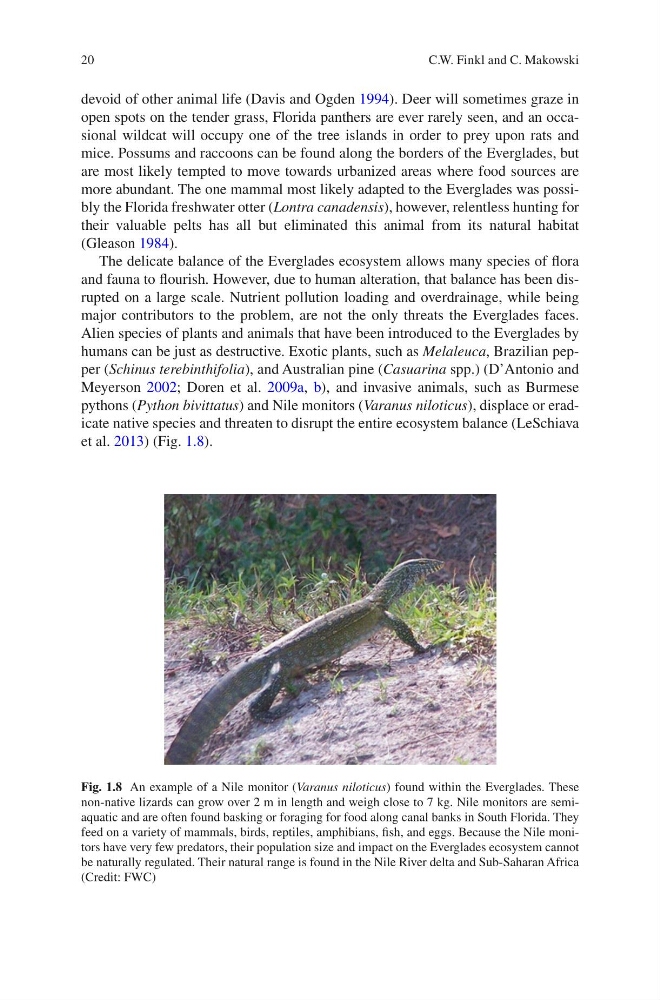
pythons (Python bivittatus) and Nile monitors (Varanus niloticus), displace or eradicate native species and threaten to disrupt the entire ecosystem balance (LeSchiava
et al. 2013) (Fig. 1.8).
Fig. 1.8 An example of a Nile monitor (Varanus niloticus) found within the Everglades. These
non-native lizards can grow over 2 m in length and weigh close to 7 kg. Nile monitors are semiaquatic and are often found basking or foraging for food along canal banks in South Florida. They
feed on a variety of mammals, birds, reptiles, amphibians, fish, and eggs. Because the Nile monitors have very few predators, their population size and impact on the Everglades ecosystem cannot
be naturally regulated. Their natural range is found in the Nile River delta and Sub-Saharan Africa
(Credit: FWC)
C.W. Finkl and C. Makowski
devoid of other animal life (Davis and Ogden 1994). Deer will sometimes graze in
open spots on the tender grass, Florida panthers are ever rarely seen, and an occasional wildcat will occupy one of the tree islands in order to prey upon rats and
mice. Possums and raccoons can be found along the borders of the Everglades, but
are most likely tempted to move towards urbanized areas where food sources are
more abundant. The one mammal most likely adapted to the Everglades was possibly the Florida freshwater otter (Lontra canadensis), however, relentless hunting for
their valuable pelts has all but eliminated this animal from its natural habitat
(Gleason 1984).
The delicate balance of the Everglades ecosystem allows many species of flora
and fauna to flourish. However, due to human alteration, that balance has been disrupted on a large scale. Nutrient pollution loading and overdrainage, while being
major contributors to the problem, are not the only threats the Everglades faces.
Alien species of plants and animals that have been introduced to the Everglades by
humans can be just as destructive. Exotic plants, such as Melaleuca, Brazilian pepper (Schinus terebinthifolia), and Australian pine (Casuarina spp.) (D’Antonio and
Meyerson 2002; Doren et al. 2009a, b), and invasive animals, such as Burmese
pythons (Python bivittatus) and Nile monitors (Varanus niloticus), displace or eradicate native species and threaten to disrupt the entire ecosystem balance (LeSchiava
et al. 2013) (Fig. 1.8).
Fig. 1.8 An example of a Nile monitor (Varanus niloticus) found within the Everglades. These
non-native lizards can grow over 2 m in length and weigh close to 7 kg. Nile monitors are semiaquatic and are often found basking or foraging for food along canal banks in South Florida. They
feed on a variety of mammals, birds, reptiles, amphibians, fish, and eggs. Because the Nile monitors have very few predators, their population size and impact on the Everglades ecosystem cannot
be naturally regulated. Their natural range is found in the Nile River delta and Sub-Saharan Africa
(Credit: FWC)
C.W. Finkl and C. Makowski