

369
forest floor from the active tidal flat may provide longer exposure to the evaporative environment that increases the salinity of soil to hinder the growth and survival of mangroves.
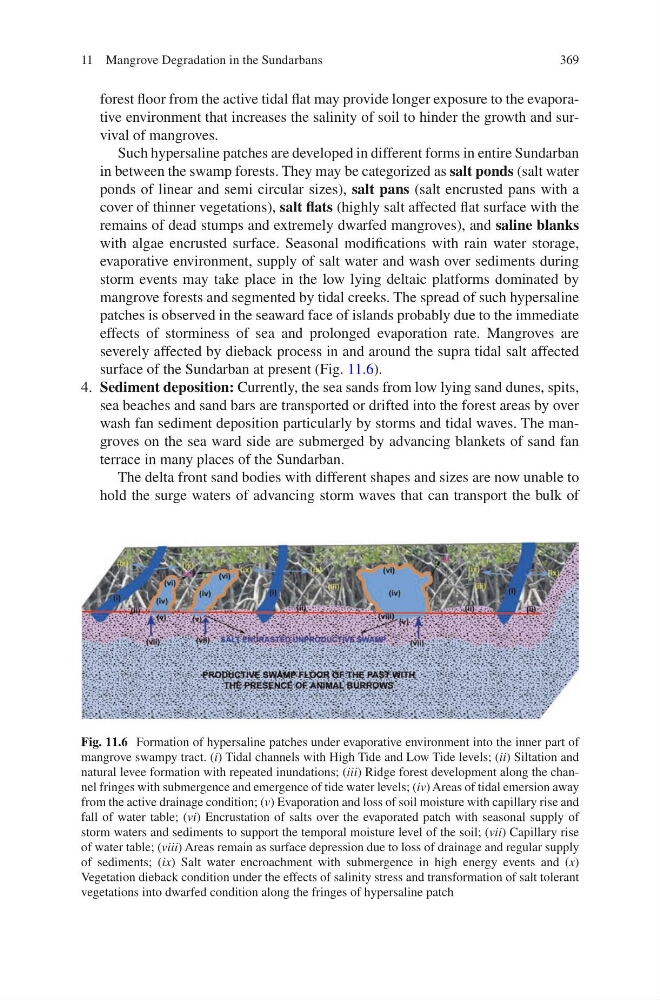
Such hypersaline patches are developed in different forms in entire Sundarban
in between the swamp forests. They may be categorized as salt ponds (salt water
ponds of linear and semi circular sizes), salt pans (salt encrusted pans with a
cover of thinner vegetations), salt flats (highly salt affected flat surface with the
remains of dead stumps and extremely dwarfed mangroves), and saline blanks
with algae encrusted surface. Seasonal modifications with rain water storage,
evaporative environment, supply of salt water and wash over sediments during
storm events may take place in the low lying deltaic platforms dominated by
mangrove forests and segmented by tidal creeks. The spread of such hypersaline
patches is observed in the seaward face of islands probably due to the immediate
effects of storminess of sea and prolonged evaporation rate. Mangroves are
severely affected by dieback process in and around the supra tidal salt affected
surface of the Sundarban at present (Fig. 11.6).
4. Sediment deposition: Currently, the sea sands from low lying sand dunes, spits,
sea beaches and sand bars are transported or drifted into the forest areas by over
wash fan sediment deposition particularly by storms and tidal waves. The mangroves on the sea ward side are submerged by advancing blankets of sand fan
terrace in many places of the Sundarban.
The delta front sand bodies with different shapes and sizes are now unable to
hold the surge waters of advancing storm waves that can transport the bulk of
Fig. 11.6 Formation of hypersaline patches under evaporative environment into the inner part of
mangrove swampy tract. (i) Tidal channels with High Tide and Low Tide levels; (ii) Siltation and
natural levee formation with repeated inundations; (iii) Ridge forest development along the channel fringes with submergence and emergence of tide water levels; (iv) Areas of tidal emersion away
from the active drainage condition; (v) Evaporation and loss of soil moisture with capillary rise and
fall of water table; (vi) Encrustation of salts over the evaporated patch with seasonal supply of
storm waters and sediments to support the temporal moisture level of the soil; (vii) Capillary rise
of water table; (viii) Areas remain as surface depression due to loss of drainage and regular supply
of sediments; (ix) Salt water encroachment with submergence in high energy events and (x)
Vegetation dieback condition under the effects of salinity stress and transformation of salt tolerant
vegetations into dwarfed condition along the fringes of hypersaline patch
11 Mangrove Degradation in the Sundarbans
forest floor from the active tidal flat may provide longer exposure to the evaporative environment that increases the salinity of soil to hinder the growth and survival of mangroves.
Such hypersaline patches are developed in different forms in entire Sundarban
in between the swamp forests. They may be categorized as salt ponds (salt water
ponds of linear and semi circular sizes), salt pans (salt encrusted pans with a
cover of thinner vegetations), salt flats (highly salt affected flat surface with the
remains of dead stumps and extremely dwarfed mangroves), and saline blanks
with algae encrusted surface. Seasonal modifications with rain water storage,
evaporative environment, supply of salt water and wash over sediments during
storm events may take place in the low lying deltaic platforms dominated by
mangrove forests and segmented by tidal creeks. The spread of such hypersaline
patches is observed in the seaward face of islands probably due to the immediate
effects of storminess of sea and prolonged evaporation rate. Mangroves are
severely affected by dieback process in and around the supra tidal salt affected
surface of the Sundarban at present (Fig. 11.6).
4. Sediment deposition: Currently, the sea sands from low lying sand dunes, spits,
sea beaches and sand bars are transported or drifted into the forest areas by over
wash fan sediment deposition particularly by storms and tidal waves. The mangroves on the sea ward side are submerged by advancing blankets of sand fan
terrace in many places of the Sundarban.
The delta front sand bodies with different shapes and sizes are now unable to
hold the surge waters of advancing storm waves that can transport the bulk of
Fig. 11.6 Formation of hypersaline patches under evaporative environment into the inner part of
mangrove swampy tract. (i) Tidal channels with High Tide and Low Tide levels; (ii) Siltation and
natural levee formation with repeated inundations; (iii) Ridge forest development along the channel fringes with submergence and emergence of tide water levels; (iv) Areas of tidal emersion away
from the active drainage condition; (v) Evaporation and loss of soil moisture with capillary rise and
fall of water table; (vi) Encrustation of salts over the evaporated patch with seasonal supply of
storm waters and sediments to support the temporal moisture level of the soil; (vii) Capillary rise
of water table; (viii) Areas remain as surface depression due to loss of drainage and regular supply
of sediments; (ix) Salt water encroachment with submergence in high energy events and (x)
Vegetation dieback condition under the effects of salinity stress and transformation of salt tolerant
vegetations into dwarfed condition along the fringes of hypersaline patch
11 Mangrove Degradation in the Sundarbans