

347
velocities and sand transporting capabilities of the tidal streams in the estuary channels, leading to their scour and to the deposition of sand on the flood tide deltas
leading into the bay as well as exporting sand onto the adjacent ocean beaches,
thereby nourishing them and adding sand to their sediment budget. The scouring
and progressive deepening of the entrance bar has increased further the effective
tidal forcing, creating a positive feedback loop which, in turn, deepens the entrance
bar, leading to more channel scour.
Interestingly, the study linking jetty construction to channel scour was initiated
by an investigation that, by happenstance, used a main road bridge across the
entrance channel as a measuring station for flow velocities and cross-sectional
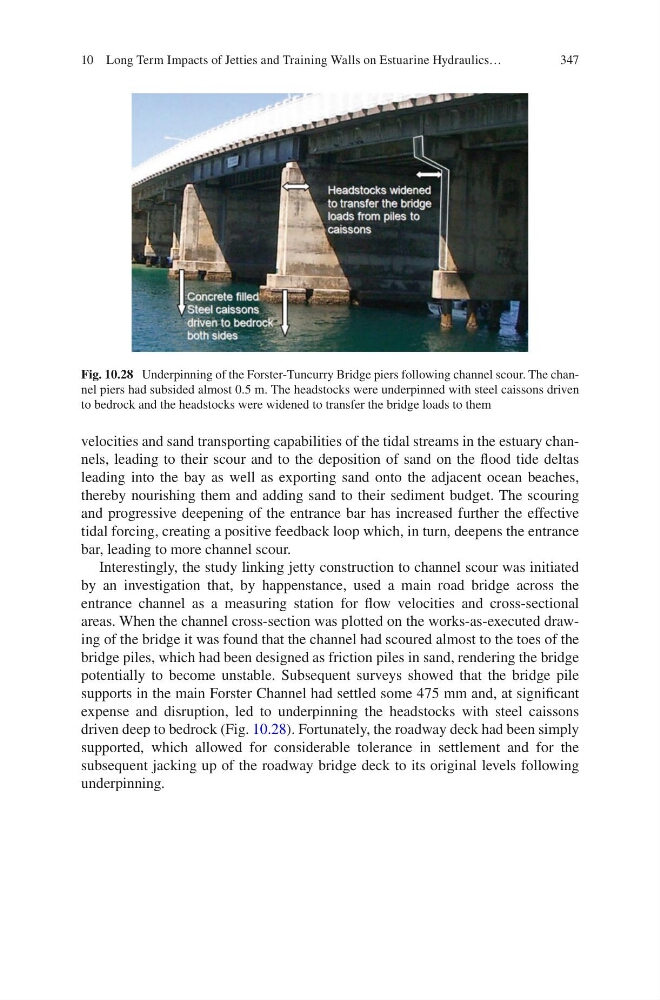
areas. When the channel cross-section was plotted on the works-as-executed drawing of the bridge it was found that the channel had scoured almost to the toes of the
bridge piles, which had been designed as friction piles in sand, rendering the bridge
potentially to become unstable. Subsequent surveys showed that the bridge pile
supports in the main Forster Channel had settled some 475 mm and, at significant
expense and disruption, led to underpinning the headstocks with steel caissons
driven deep to bedrock (Fig. 10.28). Fortunately, the roadway deck had been simply
supported, which allowed for considerable tolerance in settlement and for the
subsequent jacking up of the roadway bridge deck to its original levels following
underpinning.
Fig. 10.28 Underpinning of the Forster-Tuncurry Bridge piers following channel scour. The channel piers had subsided almost 0.5 m. The headstocks were underpinned with steel caissons driven
to bedrock and the headstocks were widened to transfer the bridge loads to them
10 Long Term Impacts of Jetties and Training Walls on Estuarine Hydraulics…
velocities and sand transporting capabilities of the tidal streams in the estuary channels, leading to their scour and to the deposition of sand on the flood tide deltas
leading into the bay as well as exporting sand onto the adjacent ocean beaches,
thereby nourishing them and adding sand to their sediment budget. The scouring
and progressive deepening of the entrance bar has increased further the effective
tidal forcing, creating a positive feedback loop which, in turn, deepens the entrance
bar, leading to more channel scour.
Interestingly, the study linking jetty construction to channel scour was initiated
by an investigation that, by happenstance, used a main road bridge across the
entrance channel as a measuring station for flow velocities and cross-sectional
areas. When the channel cross-section was plotted on the works-as-executed drawing of the bridge it was found that the channel had scoured almost to the toes of the
bridge piles, which had been designed as friction piles in sand, rendering the bridge
potentially to become unstable. Subsequent surveys showed that the bridge pile
supports in the main Forster Channel had settled some 475 mm and, at significant
expense and disruption, led to underpinning the headstocks with steel caissons
driven deep to bedrock (Fig. 10.28). Fortunately, the roadway deck had been simply
supported, which allowed for considerable tolerance in settlement and for the
subsequent jacking up of the roadway bridge deck to its original levels following
underpinning.
Fig. 10.28 Underpinning of the Forster-Tuncurry Bridge piers following channel scour. The channel piers had subsided almost 0.5 m. The headstocks were underpinned with steel caissons driven
to bedrock and the headstocks were widened to transfer the bridge loads to them
10 Long Term Impacts of Jetties and Training Walls on Estuarine Hydraulics…