

344
channels and shoals. In each case, jetty construction has occasioned scouring of
channels and changes to tidal planes, the reasons for which are exemplified in the
case study of the Wallis Lake entrance improvements (after Nielsen and Gordon
1980).
Prior to the construction of the northern (Tuncurry) jetty at Wallis Lake entrance,
the asymmetrical nature of the ebb jet expansion resulted in the development of
shallow ocean shoals. A large ebb tide separation eddy had developed on the northern side of the inlet resulting in an inlet-directed current through the northern marginal flood tide channel during ebb tide (Fig. 10.26). This opposing current carried
sediment into the entrance channel on ebb tides and induced a significant head loss
to the ebb tide flow. The effect was enhanced during the flood tides as sand, which
was entrained into the flow by wave action on the asymmetric entrance bar and
beach on the northern (Tuncurry) side of the entrance, was transported into the
entrance channel. This encouraged the southward growth of the spit on the non-jetty
side, thereby tending to close the inlet.
The construction of the northern jetty intersected the marginal flood tide channel
extending southwards along the beach. As indicated in Fig. 10.27, this eliminated
the ebb tide separation eddy and reduced significantly the rate of littoral drift transport into the entrance channel, which would have had a major impact on keeping the
inlet open (Bruun 1978). Further, this focused all of the tidal flows onto deepening
0.0
0.1
0.2
0.3
0.4
0.5
0.6
0.7
0.8
0.9
1.0
1.1
1.2
1.3
1.4
1.5
10
100
1 ,000
Maximum Channel Velocity (m/s); a
B /a
O
Channel Cross-Sectional Area (m
2 )
1997 Escoffier Curve
O'Brien P/A Relationship
Jarrett P/A twin jetties Pacific coast
aB/aO
1997 Position
2015 Position
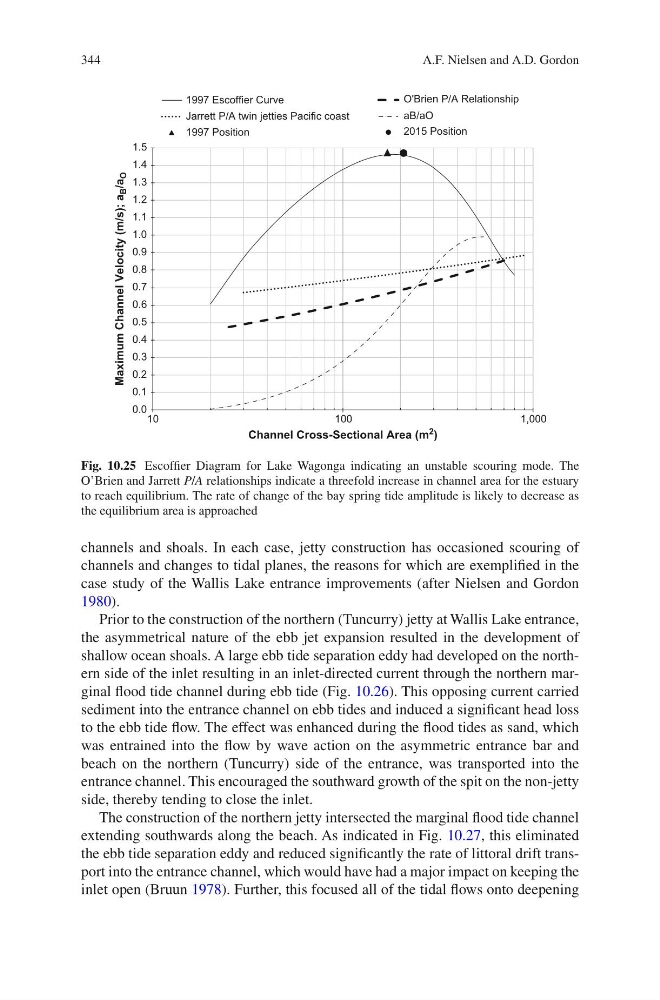
Fig. 10.25 Escoffier Diagram for Lake Wagonga indicating an unstable scouring mode. The
O’Brien and Jarrett P/A relationships indicate a threefold increase in channel area for the estuary
to reach equilibrium. The rate of change of the bay spring tide amplitude is likely to decrease as
the equilibrium area is approached
A.F. Nielsen and A.D. Gordon
channels and shoals. In each case, jetty construction has occasioned scouring of
channels and changes to tidal planes, the reasons for which are exemplified in the
case study of the Wallis Lake entrance improvements (after Nielsen and Gordon
1980).
Prior to the construction of the northern (Tuncurry) jetty at Wallis Lake entrance,
the asymmetrical nature of the ebb jet expansion resulted in the development of
shallow ocean shoals. A large ebb tide separation eddy had developed on the northern side of the inlet resulting in an inlet-directed current through the northern marginal flood tide channel during ebb tide (Fig. 10.26). This opposing current carried
sediment into the entrance channel on ebb tides and induced a significant head loss
to the ebb tide flow. The effect was enhanced during the flood tides as sand, which
was entrained into the flow by wave action on the asymmetric entrance bar and
beach on the northern (Tuncurry) side of the entrance, was transported into the
entrance channel. This encouraged the southward growth of the spit on the non-jetty
side, thereby tending to close the inlet.
The construction of the northern jetty intersected the marginal flood tide channel
extending southwards along the beach. As indicated in Fig. 10.27, this eliminated
the ebb tide separation eddy and reduced significantly the rate of littoral drift transport into the entrance channel, which would have had a major impact on keeping the
inlet open (Bruun 1978). Further, this focused all of the tidal flows onto deepening
0.0
0.1
0.2
0.3
0.4
0.5
0.6
0.7
0.8
0.9
1.0
1.1
1.2
1.3
1.4
1.5
10
100
1 ,000
Maximum Channel Velocity (m/s); a
B /a
O
Channel Cross-Sectional Area (m
2 )
1997 Escoffier Curve
O'Brien P/A Relationship
Jarrett P/A twin jetties Pacific coast
aB/aO
1997 Position
2015 Position
Fig. 10.25 Escoffier Diagram for Lake Wagonga indicating an unstable scouring mode. The
O’Brien and Jarrett P/A relationships indicate a threefold increase in channel area for the estuary
to reach equilibrium. The rate of change of the bay spring tide amplitude is likely to decrease as
the equilibrium area is approached
A.F. Nielsen and A.D. Gordon