

288
astronomical tide (if applicable), and the proximity to the continents, since they
relate directly to the sediments transport and in particular, with its main manifestation, the erosion and accretion of the beach phenomena.
9.3.1 Sediment Sampling
Along the littoral of Mallorquín Lagoon we recollected 65 sediment samples in 23
locations, following a transverse and longitudinal path throughout the bar.
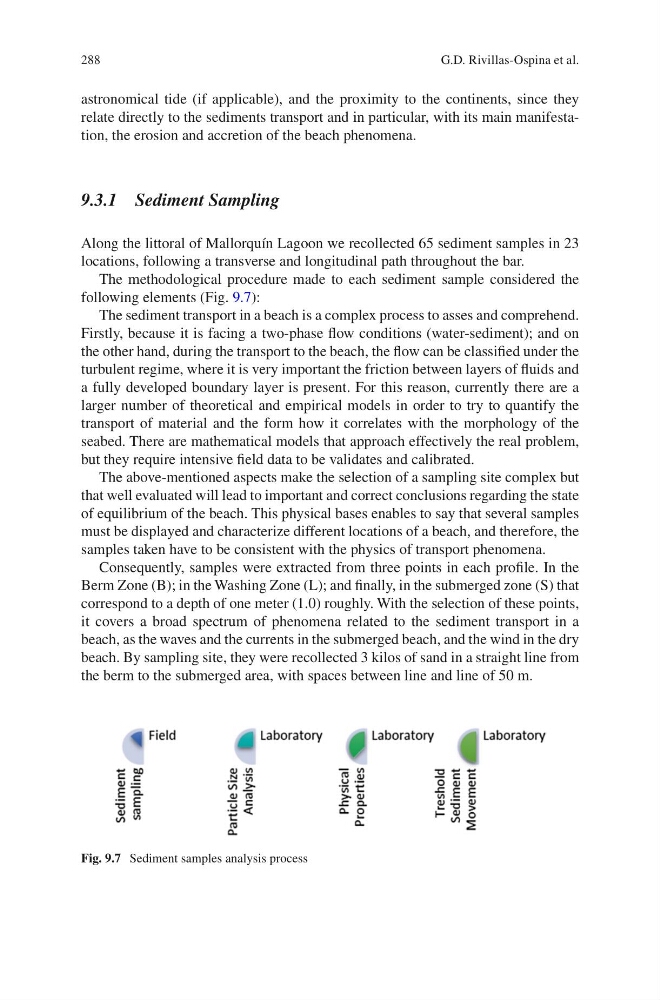
The methodological procedure made to each sediment sample considered the
following elements (Fig. 9.7):
The sediment transport in a beach is a complex process to asses and comprehend.
Firstly, because it is facing a two-phase flow conditions (water-sediment); and on
the other hand, during the transport to the beach, the flow can be classified under the
turbulent regime, where it is very important the friction between layers of fluids and
a fully developed boundary layer is present. For this reason, currently there are a
larger number of theoretical and empirical models in order to try to quantify the
transport of material and the form how it correlates with the morphology of the
seabed. There are mathematical models that approach effectively the real problem,
but they require intensive field data to be validates and calibrated.
The above-mentioned aspects make the selection of a sampling site complex but
that well evaluated will lead to important and correct conclusions regarding the state
of equilibrium of the beach. This physical bases enables to say that several samples
must be displayed and characterize different locations of a beach, and therefore, the
samples taken have to be consistent with the physics of transport phenomena.
Consequently, samples were extracted from three points in each profile. In the
Berm Zone (B); in the Washing Zone (L); and finally, in the submerged zone (S) that
correspond to a depth of one meter (1.0) roughly. With the selection of these points,
it covers a broad spectrum of phenomena related to the sediment transport in a
beach, as the waves and the currents in the submerged beach, and the wind in the dry
beach. By sampling site, they were recollected 3 kilos of sand in a straight line from
the berm to the submerged area, with spaces between line and line of 50 m.
Fig. 9.7 Sediment samples analysis process
G.D. Rivillas-Ospina et al.
astronomical tide (if applicable), and the proximity to the continents, since they
relate directly to the sediments transport and in particular, with its main manifestation, the erosion and accretion of the beach phenomena.
9.3.1 Sediment Sampling
Along the littoral of Mallorquín Lagoon we recollected 65 sediment samples in 23
locations, following a transverse and longitudinal path throughout the bar.
The methodological procedure made to each sediment sample considered the
following elements (Fig. 9.7):
The sediment transport in a beach is a complex process to asses and comprehend.
Firstly, because it is facing a two-phase flow conditions (water-sediment); and on
the other hand, during the transport to the beach, the flow can be classified under the
turbulent regime, where it is very important the friction between layers of fluids and
a fully developed boundary layer is present. For this reason, currently there are a
larger number of theoretical and empirical models in order to try to quantify the
transport of material and the form how it correlates with the morphology of the
seabed. There are mathematical models that approach effectively the real problem,
but they require intensive field data to be validates and calibrated.
The above-mentioned aspects make the selection of a sampling site complex but
that well evaluated will lead to important and correct conclusions regarding the state
of equilibrium of the beach. This physical bases enables to say that several samples
must be displayed and characterize different locations of a beach, and therefore, the
samples taken have to be consistent with the physics of transport phenomena.
Consequently, samples were extracted from three points in each profile. In the
Berm Zone (B); in the Washing Zone (L); and finally, in the submerged zone (S) that
correspond to a depth of one meter (1.0) roughly. With the selection of these points,
it covers a broad spectrum of phenomena related to the sediment transport in a
beach, as the waves and the currents in the submerged beach, and the wind in the dry
beach. By sampling site, they were recollected 3 kilos of sand in a straight line from
the berm to the submerged area, with spaces between line and line of 50 m.
Fig. 9.7 Sediment samples analysis process
G.D. Rivillas-Ospina et al.