

286
Furthermore, it is important to note as a positive element that the actual coastal
dune associated with the Mallorquín coastal wetland remains unchanged. During the
field-work, it was evident just one event of anthropic nature. It was observed that
fishermen from the adjacent communities to prepare the pass of their vessels from
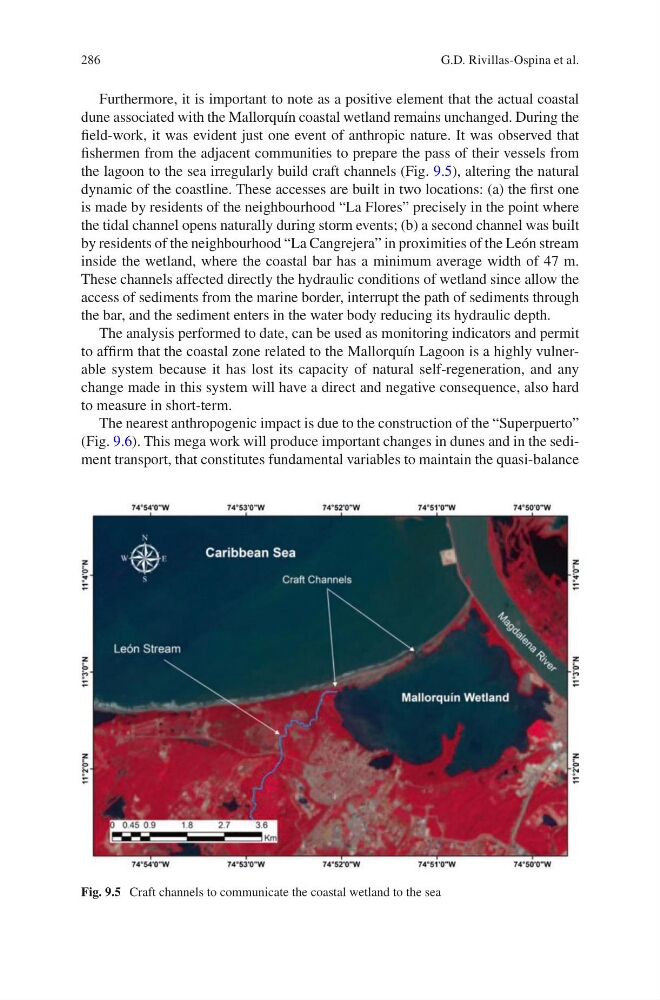
the lagoon to the sea irregularly build craft channels (Fig. 9.5), altering the natural
dynamic of the coastline. These accesses are built in two locations: (a) the first one
is made by residents of the neighbourhood “La Flores” precisely in the point where
the tidal channel opens naturally during storm events; (b) a second channel was built
by residents of the neighbourhood “La Cangrejera” in proximities of the León stream
inside the wetland, where the coastal bar has a minimum average width of 47 m.
These channels affected directly the hydraulic conditions of wetland since allow the
access of sediments from the marine border, interrupt the path of sediments through
the bar, and the sediment enters in the water body reducing its hydraulic depth.
The analysis performed to date, can be used as monitoring indicators and permit
to affirm that the coastal zone related to the Mallorquín Lagoon is a highly vulnerable system because it has lost its capacity of natural self-regeneration, and any
change made in this system will have a direct and negative consequence, also hard
to measure in short-term.
The nearest anthropogenic impact is due to the construction of the “Superpuerto”
(Fig. 9.6). This mega work will produce important changes in dunes and in the sediment transport, that constitutes fundamental variables to maintain the quasi-balance
Fig. 9.5 Craft channels to communicate the coastal wetland to the sea
G.D. Rivillas-Ospina et al.
Furthermore, it is important to note as a positive element that the actual coastal
dune associated with the Mallorquín coastal wetland remains unchanged. During the
field-work, it was evident just one event of anthropic nature. It was observed that
fishermen from the adjacent communities to prepare the pass of their vessels from
the lagoon to the sea irregularly build craft channels (Fig. 9.5), altering the natural
dynamic of the coastline. These accesses are built in two locations: (a) the first one
is made by residents of the neighbourhood “La Flores” precisely in the point where
the tidal channel opens naturally during storm events; (b) a second channel was built
by residents of the neighbourhood “La Cangrejera” in proximities of the León stream
inside the wetland, where the coastal bar has a minimum average width of 47 m.
These channels affected directly the hydraulic conditions of wetland since allow the
access of sediments from the marine border, interrupt the path of sediments through
the bar, and the sediment enters in the water body reducing its hydraulic depth.
The analysis performed to date, can be used as monitoring indicators and permit
to affirm that the coastal zone related to the Mallorquín Lagoon is a highly vulnerable system because it has lost its capacity of natural self-regeneration, and any
change made in this system will have a direct and negative consequence, also hard
to measure in short-term.
The nearest anthropogenic impact is due to the construction of the “Superpuerto”
(Fig. 9.6). This mega work will produce important changes in dunes and in the sediment transport, that constitutes fundamental variables to maintain the quasi-balance
Fig. 9.5 Craft channels to communicate the coastal wetland to the sea
G.D. Rivillas-Ospina et al.