

278
sediments. Then, a temporal evolution of the bar is made, analyzing the role that
have the structures to modify the sediments sources and the bar configuration that
protect the wetland. Finally, it is developed a plant modelling of the bar to represent
morphological changes that can generate a maritime work in long-term.
9.2 Geomorphological Aspects of Coastal Wetlands
9.2.1 Mallorquín Lagoon
Geomorphology is the science that focuses its study on the terrestrial and marine
relief present on the planet (Ruiz 2009). This science centres its interest in the
detailed analysis of beaches configuration, phenomena and processes that regulates
its evolution and physical conditions that, from present to the future, condition the
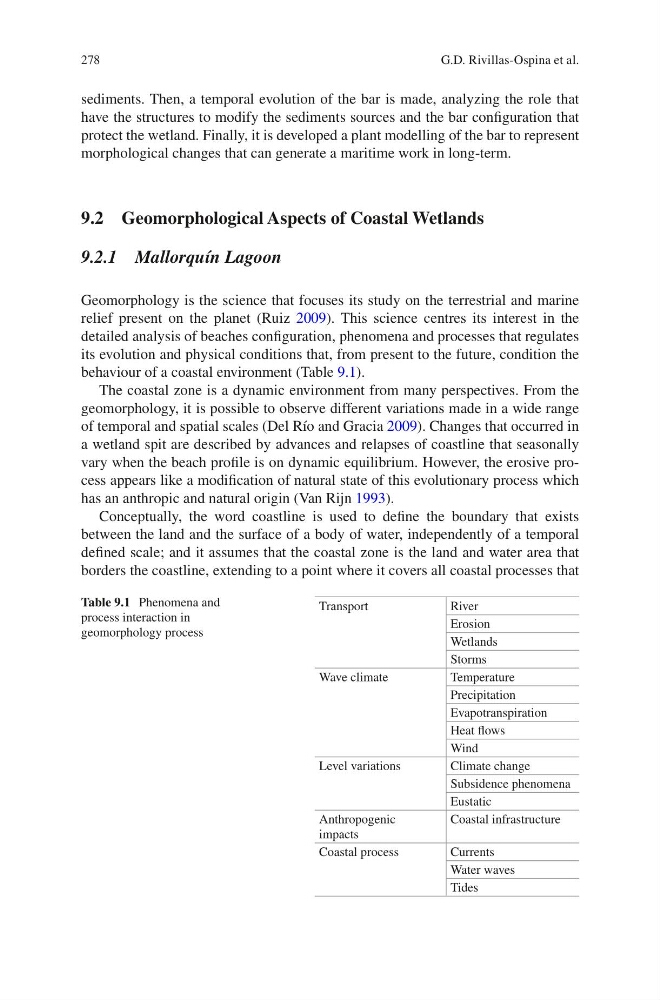
behaviour of a coastal environment (Table 9.1).
The coastal zone is a dynamic environment from many perspectives. From the
geomorphology, it is possible to observe different variations made in a wide range
of temporal and spatial scales (Del Río and Gracia 2009). Changes that occurred in
a wetland spit are described by advances and relapses of coastline that seasonally
vary when the beach profile is on dynamic equilibrium. However, the erosive process appears like a modification of natural state of this evolutionary process which
has an anthropic and natural origin (Van Rijn 1993).
Conceptually, the word coastline is used to define the boundary that exists
between the land and the surface of a body of water, independently of a temporal
defined scale; and it assumes that the coastal zone is the land and water area that
borders the coastline, extending to a point where it covers all coastal processes that
Table 9.1 Phenomena and
process interaction in
geomorphology process
Transport
River
Erosion
Wetlands
Storms
Wave climate
Temperature
Precipitation
Evapotranspiration
Heat flows
Wind
Level variations
Climate change
Subsidence phenomena
Eustatic
Anthropogenic
impacts
Coastal infrastructure
Coastal process
Currents
Water waves
Tides
G.D. Rivillas-Ospina et al.
sediments. Then, a temporal evolution of the bar is made, analyzing the role that
have the structures to modify the sediments sources and the bar configuration that
protect the wetland. Finally, it is developed a plant modelling of the bar to represent
morphological changes that can generate a maritime work in long-term.
9.2 Geomorphological Aspects of Coastal Wetlands
9.2.1 Mallorquín Lagoon
Geomorphology is the science that focuses its study on the terrestrial and marine
relief present on the planet (Ruiz 2009). This science centres its interest in the
detailed analysis of beaches configuration, phenomena and processes that regulates
its evolution and physical conditions that, from present to the future, condition the
behaviour of a coastal environment (Table 9.1).
The coastal zone is a dynamic environment from many perspectives. From the
geomorphology, it is possible to observe different variations made in a wide range
of temporal and spatial scales (Del Río and Gracia 2009). Changes that occurred in
a wetland spit are described by advances and relapses of coastline that seasonally
vary when the beach profile is on dynamic equilibrium. However, the erosive process appears like a modification of natural state of this evolutionary process which
has an anthropic and natural origin (Van Rijn 1993).
Conceptually, the word coastline is used to define the boundary that exists
between the land and the surface of a body of water, independently of a temporal
defined scale; and it assumes that the coastal zone is the land and water area that
borders the coastline, extending to a point where it covers all coastal processes that
Table 9.1 Phenomena and
process interaction in
geomorphology process
Transport
River
Erosion
Wetlands
Storms
Wave climate
Temperature
Precipitation
Evapotranspiration
Heat flows
Wind
Level variations
Climate change
Subsidence phenomena
Eustatic
Anthropogenic
impacts
Coastal infrastructure
Coastal process
Currents
Water waves
Tides
G.D. Rivillas-Ospina et al.