

204
reduction rate of mangrove areas will from 50 to 75% which would be more harmful
for coastal ecosystems in the estuaries (IPCC 2007). Besides, other environmental
problems will arise in the coastal belt such as; water pollution and scarcity, soil
degradation, deforestation, solid and hazardous wastes, loss of bio-diversity estuary
landscape damage and river bank erosion which will create a lot of new challenging
problems for human livelihood in the coastal region. In such situation it will further
create an unstable agricultural crop production, damaging fisheries and livestock
and food security in the coastal riverine islands in Bangladesh (MoWR 2005).
Therefore the climate change impacts on coastal region such as on the estuaries in
the Sundarbans will create new threats for estuaries ecosystems and landscapes.
6.6.3 Changes of Biodiversity in the Bengal Coastal Region
The salinity investigation results shows that the south west Bengal coastal regions
are carrying the highest rate of water salinity which is misbalancing the urban ecosystem and ecologies. According to salinity approximation this high rate is harmful
to for urban biodiversity as well as for urban drinking water (Fig. 6.9). The Fig. 6.9
demonstrates the water salinity intrusion pattern in the south west region of the
Ganges deltaic region, where 4 major cities and 136 small towns are located in the
coastal region in Bangladesh. All most all the towns are effected through salinity
70000
60000
50000
40000
30000
20000
10000
0
Water Discharge m3/s
Ganges
Meghna
Padma
Brahmaputra
Jan
2744
4944
370
7243 6242
4209
2336
6756
362
4786
1984
10220
1106
7752
1781 1971 4136 18324 34466
42962
11785
66980 62889
10722
38418
36699 17439 6682 3819
6980
919
10104
11137
3240
16078
24335
8008
36716
46242
10691
56466
30225
6348
29337
15280
2778
15867
264
Feb Mar
Apr
May Jun
Jul
Aug Sep
Oct
Nov Dec
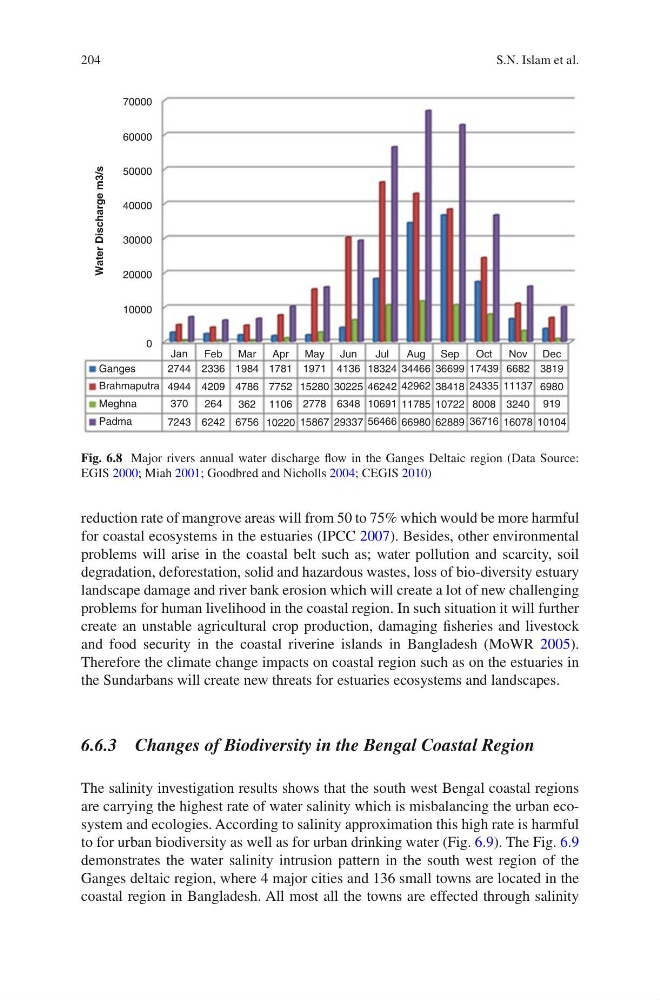
Fig. 6.8 Major rivers annual water discharge flow in the Ganges Deltaic region (Data Source:
EGIS 2000; Miah 2001; Goodbred and Nicholls 2004; CEGIS 2010)
S.N. Islam et al.
reduction rate of mangrove areas will from 50 to 75% which would be more harmful
for coastal ecosystems in the estuaries (IPCC 2007). Besides, other environmental
problems will arise in the coastal belt such as; water pollution and scarcity, soil
degradation, deforestation, solid and hazardous wastes, loss of bio-diversity estuary
landscape damage and river bank erosion which will create a lot of new challenging
problems for human livelihood in the coastal region. In such situation it will further
create an unstable agricultural crop production, damaging fisheries and livestock
and food security in the coastal riverine islands in Bangladesh (MoWR 2005).
Therefore the climate change impacts on coastal region such as on the estuaries in
the Sundarbans will create new threats for estuaries ecosystems and landscapes.
6.6.3 Changes of Biodiversity in the Bengal Coastal Region
The salinity investigation results shows that the south west Bengal coastal regions
are carrying the highest rate of water salinity which is misbalancing the urban ecosystem and ecologies. According to salinity approximation this high rate is harmful
to for urban biodiversity as well as for urban drinking water (Fig. 6.9). The Fig. 6.9
demonstrates the water salinity intrusion pattern in the south west region of the
Ganges deltaic region, where 4 major cities and 136 small towns are located in the
coastal region in Bangladesh. All most all the towns are effected through salinity
70000
60000
50000
40000
30000
20000
10000
0
Water Discharge m3/s
Ganges
Meghna
Padma
Brahmaputra
Jan
2744
4944
370
7243 6242
4209
2336
6756
362
4786
1984
10220
1106
7752
1781 1971 4136 18324 34466
42962
11785
66980 62889
10722
38418
36699 17439 6682 3819
6980
919
10104
11137
3240
16078
24335
8008
36716
46242
10691
56466
30225
6348
29337
15280
2778
15867
264
Feb Mar
Apr
May Jun
Jul
Aug Sep
Oct
Nov Dec
Fig. 6.8 Major rivers annual water discharge flow in the Ganges Deltaic region (Data Source:
EGIS 2000; Miah 2001; Goodbred and Nicholls 2004; CEGIS 2010)
S.N. Islam et al.