

188
6.1 Introduction
The coastal wetlands provide numerous ecological services to humanity. They protect the coast against erosion and guard against loss of capital infrastructure and
human lives (Wolanski et al. 2009). Coastal ecosystem also provide ecosystem services that have socioeconomic benefits to the human population, including fuel,
forage, building material, timber, fisheries, and protection of commercial, recreational, and naval vessels (Williams 1919; Wolanski et al. 2009). The tropical and
sub-tropical coastal mangrove wetlands provide another important ecosystem service to the population living in the hinterland, by sheltering it from storm winds and
capturing salt spray and improving crop production in arid coastal areas (Wolanski
2007). The coastal region of the Ganges-Brahmaputra Rivers Delta is the largest
floodplain wetland region is located in the South Asian Region (Morgan and
Mcentire 1959; Khandoker 1987; Adeel 2001; Sarker et al. 2003; Goodbred and
Nicholls 2004; Islam 2016).
Bangladesh is a land of water but water is one the most critical and major problems in country, especially the scarcity of upstream fresh water has created serious
environmental problems in the coastal region of Bangladesh (Islam et al. 2016). The
location of the landward boundary of the coastal zone is a function of three basic
geophysical processes: tidal fluctuations; salinity; and risk for cyclone and storm
surges. The coastal zone Bangladesh, affected by these processes, cover an area of
47,210 km
2
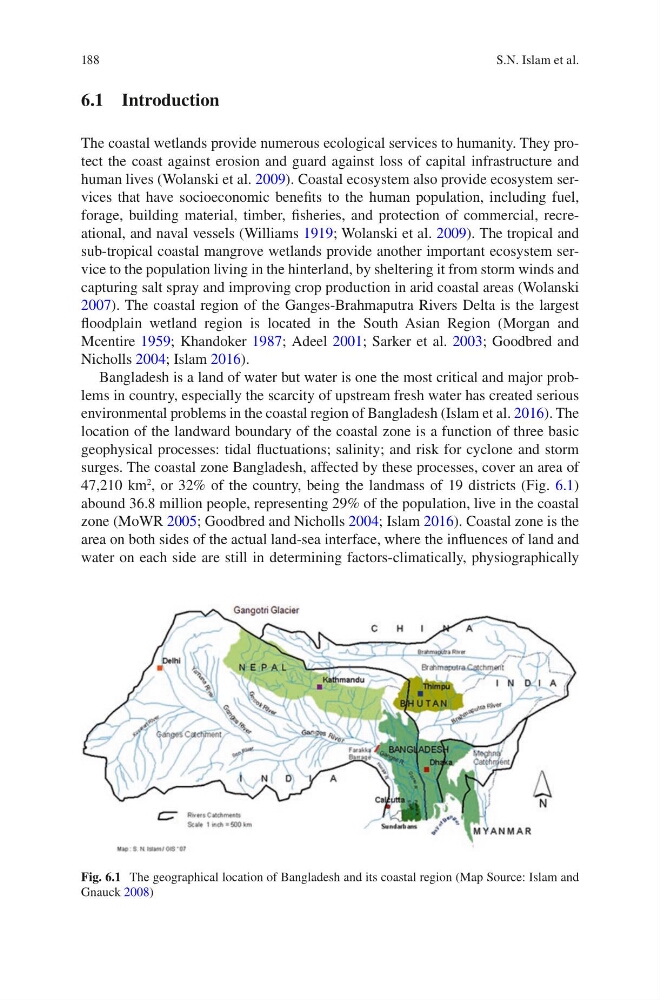
, or 32% of the country, being the landmass of 19 districts (Fig. 6.1)
abound 36.8 million people, representing 29% of the population, live in the coastal
zone (MoWR 2005; Goodbred and Nicholls 2004; Islam 2016). Coastal zone is the
area on both sides of the actual land-sea interface, where the influences of land and
water on each side are still in determining factors-climatically, physiographically
Fig. 6.1 The geographical location of Bangladesh and its coastal region (Map Source: Islam and
Gnauck 2008)
S.N. Islam et al.
6.1 Introduction
The coastal wetlands provide numerous ecological services to humanity. They protect the coast against erosion and guard against loss of capital infrastructure and
human lives (Wolanski et al. 2009). Coastal ecosystem also provide ecosystem services that have socioeconomic benefits to the human population, including fuel,
forage, building material, timber, fisheries, and protection of commercial, recreational, and naval vessels (Williams 1919; Wolanski et al. 2009). The tropical and
sub-tropical coastal mangrove wetlands provide another important ecosystem service to the population living in the hinterland, by sheltering it from storm winds and
capturing salt spray and improving crop production in arid coastal areas (Wolanski
2007). The coastal region of the Ganges-Brahmaputra Rivers Delta is the largest
floodplain wetland region is located in the South Asian Region (Morgan and
Mcentire 1959; Khandoker 1987; Adeel 2001; Sarker et al. 2003; Goodbred and
Nicholls 2004; Islam 2016).
Bangladesh is a land of water but water is one the most critical and major problems in country, especially the scarcity of upstream fresh water has created serious
environmental problems in the coastal region of Bangladesh (Islam et al. 2016). The
location of the landward boundary of the coastal zone is a function of three basic
geophysical processes: tidal fluctuations; salinity; and risk for cyclone and storm
surges. The coastal zone Bangladesh, affected by these processes, cover an area of
47,210 km
2
, or 32% of the country, being the landmass of 19 districts (Fig. 6.1)
abound 36.8 million people, representing 29% of the population, live in the coastal
zone (MoWR 2005; Goodbred and Nicholls 2004; Islam 2016). Coastal zone is the
area on both sides of the actual land-sea interface, where the influences of land and
water on each side are still in determining factors-climatically, physiographically
Fig. 6.1 The geographical location of Bangladesh and its coastal region (Map Source: Islam and
Gnauck 2008)
S.N. Islam et al.