

183
5.5 Conclusions
It is clear that occupation of Brazilian coastal tropical wetlands are linked and subordinated to external interests related to strategies between private and State interests that affect the region and the Brazilian coastline occupation. The evolution and
problems related to the regional inequalities and dynamics indicate that some cities
have been gradually losing their social and economic position.
In Bahia, as well as in Brazil, the equalization of infrastructure and welfare conditions remain therefore on the list of priorities. This equalization can create a new
regional development model that rooted in local, solid and secure foundations,
against the tendency of productive reconcentration and interstate income inequality.
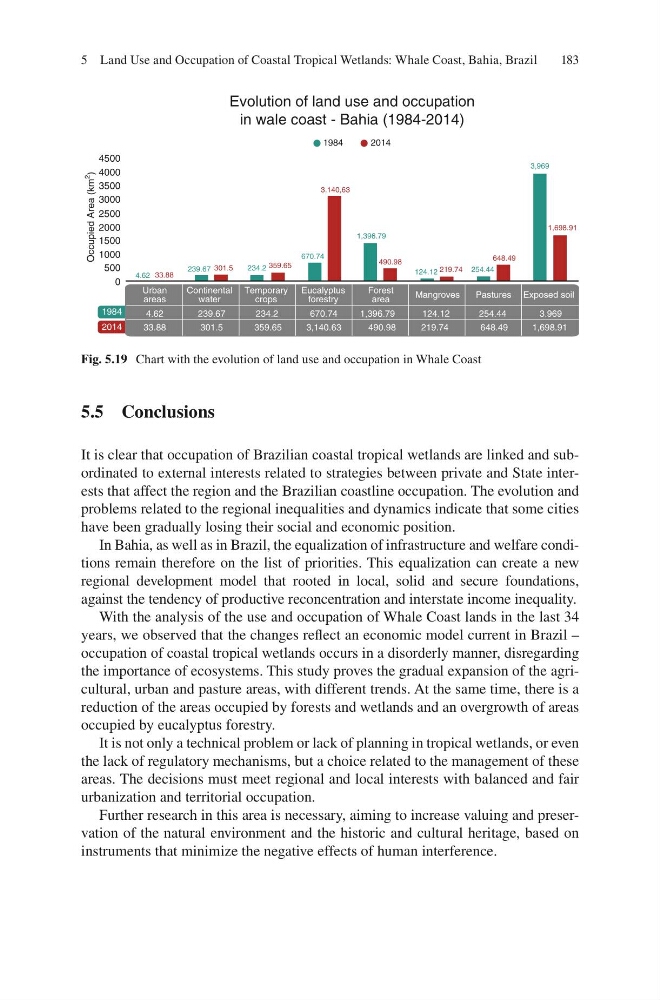
With the analysis of the use and occupation of Whale Coast lands in the last 34
years, we observed that the changes reflect an economic model current in Brazil –
occupation of coastal tropical wetlands occurs in a disorderly manner, disregarding
the importance of ecosystems. This study proves the gradual expansion of the agricultural, urban and pasture areas, with different trends. At the same time, there is a
reduction of the areas occupied by forests and wetlands and an overgrowth of areas
occupied by eucalyptus forestry.
It is not only a technical problem or lack of planning in tropical wetlands, or even
the lack of regulatory mechanisms, but a choice related to the management of these
areas. The decisions must meet regional and local interests with balanced and fair
urbanization and territorial occupation.
Further research in this area is necessary, aiming to increase valuing and preservation of the natural environment and the historic and cultural heritage, based on
instruments that minimize the negative effects of human interference.
1984
2014
Evolution of land use and occupation
in wale coast - Bahia (1984-2014)
4500
4000
3500
3000
2500
2000
1500
1000
500
0
4.62
234.2
1,396.79
124.12
254.44
3,969
670.74
239.67
33.88
301.5
359.65
490.98
219.74
648.49
1,698.91
3.140,63
Occupied Area (km
2
)
1984
2014
Urban
areas
4.62
33.88
301.5
359.65
234.2
670.74
3,140.63
1,396.79
490.98
219.74
648.49
1,698.91
3.969
254.44
124.12
239.67
Continental
water
Temporary
crops
Eucalyptus
forestry
Forest
area
Mangroves
Pastures Exposed soil
Fig. 5.19 Chart with the evolution of land use and occupation in Whale Coast
5 Land Use and Occupation of Coastal Tropical Wetlands: Whale Coast, Bahia, Brazil
5.5 Conclusions
It is clear that occupation of Brazilian coastal tropical wetlands are linked and subordinated to external interests related to strategies between private and State interests that affect the region and the Brazilian coastline occupation. The evolution and
problems related to the regional inequalities and dynamics indicate that some cities
have been gradually losing their social and economic position.
In Bahia, as well as in Brazil, the equalization of infrastructure and welfare conditions remain therefore on the list of priorities. This equalization can create a new
regional development model that rooted in local, solid and secure foundations,
against the tendency of productive reconcentration and interstate income inequality.
With the analysis of the use and occupation of Whale Coast lands in the last 34
years, we observed that the changes reflect an economic model current in Brazil –
occupation of coastal tropical wetlands occurs in a disorderly manner, disregarding
the importance of ecosystems. This study proves the gradual expansion of the agricultural, urban and pasture areas, with different trends. At the same time, there is a
reduction of the areas occupied by forests and wetlands and an overgrowth of areas
occupied by eucalyptus forestry.
It is not only a technical problem or lack of planning in tropical wetlands, or even
the lack of regulatory mechanisms, but a choice related to the management of these
areas. The decisions must meet regional and local interests with balanced and fair
urbanization and territorial occupation.
Further research in this area is necessary, aiming to increase valuing and preservation of the natural environment and the historic and cultural heritage, based on
instruments that minimize the negative effects of human interference.
1984
2014
Evolution of land use and occupation
in wale coast - Bahia (1984-2014)
4500
4000
3500
3000
2500
2000
1500
1000
500
0
4.62
234.2
1,396.79
124.12
254.44
3,969
670.74
239.67
33.88
301.5
359.65
490.98
219.74
648.49
1,698.91
3.140,63
Occupied Area (km
2
)
1984
2014
Urban
areas
4.62
33.88
301.5
359.65
234.2
670.74
3,140.63
1,396.79
490.98
219.74
648.49
1,698.91
3.969
254.44
124.12
239.67
Continental
water
Temporary
crops
Eucalyptus
forestry
Forest
area
Mangroves
Pastures Exposed soil
Fig. 5.19 Chart with the evolution of land use and occupation in Whale Coast
5 Land Use and Occupation of Coastal Tropical Wetlands: Whale Coast, Bahia, Brazil