

84
II)
E
0
(.)
as
til
c
'2
'm
E
~
(5
c
0
t:
0
a.
e
0..
II)
E
0
(.)
as
til
c
'2
'm
E
~
(5
c
0
t:
0
a.
e
0..
0,8
0,6
0,4
0,2
0 °
0,8
0,6
0,4
0,2
°
Daniel Sis cart, Victoria Diego and Francisco Lloret
Patterns of acorn removal
winter
.....
2
4
6
14
Days after sowing
spring
-
Isolated shrublands
-
0- - shrublands close to holm oak forest
..... -. shrublands close to mixed forest
(holm oak and pine)
14
Days after sowing
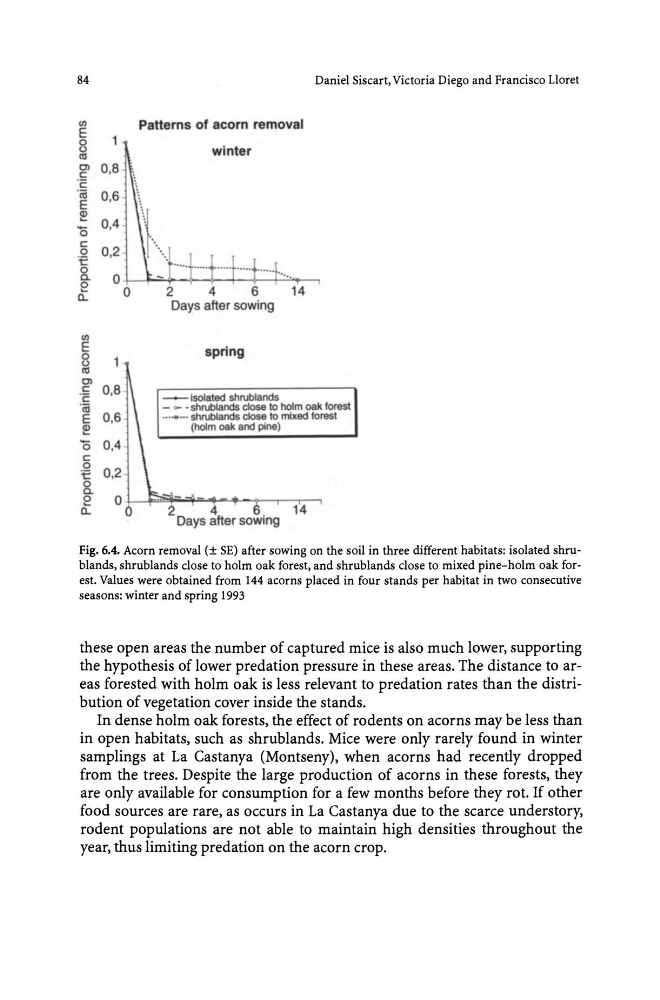
Fig. 6.4. Acorn removal (± SE) after sowing on the soil in three different habitats: isolated shrublands, shrublands close to holm oak forest, and shrublands close to mixed pine-holm oak forest. Values were obtained from 144 acorns placed in four stands per habitat in two consecutive
seasons: winter and spring 1993
these open areas the number of captured mice is also much lower, supporting
the hypothesis of lower predation pressure in these areas. The distance to areas forested with holm oak is less relevant to predation rates than the distribution of vegetation cover inside the stands.
In dense holm oak forests, the effect of rodents on acorns may be less than
in open habitats, such as shrublands. Mice were only rarely found in winter
samplings at La Castanya (Montseny), when acorns had recently dropped
from the trees. Despite the large production of acorns in these forests, they
are only available for consumption for a few months before they rot. If other
food sources are rare, as occurs in La Castanya due to the scarce understory,
rodent populations are not able to maintain high densities throughout the
year, thus limiting predation on the acorn crop.
II)
E
0
(.)
as
til
c
'2
'm
E
~
(5
c
0
t:
0
a.
e
0..
II)
E
0
(.)
as
til
c
'2
'm
E
~
(5
c
0
t:
0
a.
e
0..
0,8
0,6
0,4
0,2
0 °
0,8
0,6
0,4
0,2
°
Daniel Sis cart, Victoria Diego and Francisco Lloret
Patterns of acorn removal
winter
.....
2
4
6
14
Days after sowing
spring
-
Isolated shrublands
-
0- - shrublands close to holm oak forest
..... -. shrublands close to mixed forest
(holm oak and pine)
14
Days after sowing
Fig. 6.4. Acorn removal (± SE) after sowing on the soil in three different habitats: isolated shrublands, shrublands close to holm oak forest, and shrublands close to mixed pine-holm oak forest. Values were obtained from 144 acorns placed in four stands per habitat in two consecutive
seasons: winter and spring 1993
these open areas the number of captured mice is also much lower, supporting
the hypothesis of lower predation pressure in these areas. The distance to areas forested with holm oak is less relevant to predation rates than the distribution of vegetation cover inside the stands.
In dense holm oak forests, the effect of rodents on acorns may be less than
in open habitats, such as shrublands. Mice were only rarely found in winter
samplings at La Castanya (Montseny), when acorns had recently dropped
from the trees. Despite the large production of acorns in these forests, they
are only available for consumption for a few months before they rot. If other
food sources are rare, as occurs in La Castanya due to the scarce understory,
rodent populations are not able to maintain high densities throughout the
year, thus limiting predation on the acorn crop.