

82
Daniel Sis cart, Victoria Diego and Francisco L10ret
species. Females inoculate one to three eggs inside the young acorns from
late August to November. The larvae consume the resources stored in the
acorn.
Weevil infection stops the development of the acorns, which dry and drop
prematurely from the trees. This response of the plant to infection may have
an important effect on the larvae populations and may allow trees to decrease the resource losses from predation. The infected acorns are smaller
than healthy ones, and the amount of available food in the acorn strongly influences the weight of the larvae. Acorns smaller than approximately 0.5 g
fresh wt. normally show a complete destruction of the endosperm because of
direct consumption or digging by the larvae. The weight of the larvae living
in these small acorns is lower than 50 mg live wt., while in larger acorns larvae can weigh up to 120 mg. Larger infected acorns usually show some unaltered endosperm and germination may occur in acorns over 1.5 g if the embryo has not been damaged. The size of the acorns at the time of the inoculation would determine the size structure of weevil populations.
After dropping, infected acorns are a potential food for other consumers,
such as wood mice (Apodemus sylvaticus) (Crawley and Long 1995), which in
this way may also influence weevil populations. This effect may be particularly important because, in the absence of other food sources, prematurely
dropped acorns are expected to be more intensely predated than later ones.
TWo to four weeks after the acorn drops from the tree, larvae complete
their development, leave the acorn and bury into the soil at 10- to 30-cm
depth. The length of the complete life cycle seems variable because adults
may emerge from the soil at least 1 or 2 years after burying (Crawley and
' *
• Togores
80
0
Alresol
E
• Casamada
70
•
•
:g
I::
•
.!!!
60
•
0)
.Q
50
•
0
0
"5
~
40
• •
<3
0
o •
>.
30
.D
•
•
OJ
~
20
c:
0
10
ti
2
0
c:
0
50
100
150
200
250
Acom production (Acoms m· 2 )
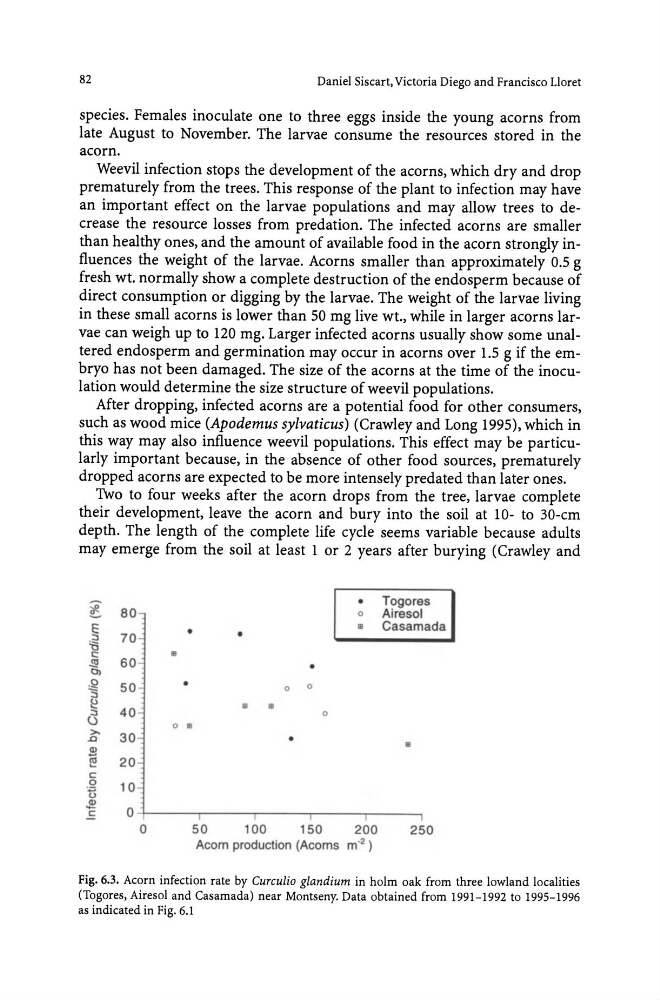
Fig. 6.3. Acorn infection rate by Curculio glandium in holm oak from three lowland localities
(Togores, Airesol and Cas am ada) near Montseny. Data obtained from 1991-1992 to 1995-1996
as indicated in Fig. 6.1
Daniel Sis cart, Victoria Diego and Francisco L10ret
species. Females inoculate one to three eggs inside the young acorns from
late August to November. The larvae consume the resources stored in the
acorn.
Weevil infection stops the development of the acorns, which dry and drop
prematurely from the trees. This response of the plant to infection may have
an important effect on the larvae populations and may allow trees to decrease the resource losses from predation. The infected acorns are smaller
than healthy ones, and the amount of available food in the acorn strongly influences the weight of the larvae. Acorns smaller than approximately 0.5 g
fresh wt. normally show a complete destruction of the endosperm because of
direct consumption or digging by the larvae. The weight of the larvae living
in these small acorns is lower than 50 mg live wt., while in larger acorns larvae can weigh up to 120 mg. Larger infected acorns usually show some unaltered endosperm and germination may occur in acorns over 1.5 g if the embryo has not been damaged. The size of the acorns at the time of the inoculation would determine the size structure of weevil populations.
After dropping, infected acorns are a potential food for other consumers,
such as wood mice (Apodemus sylvaticus) (Crawley and Long 1995), which in
this way may also influence weevil populations. This effect may be particularly important because, in the absence of other food sources, prematurely
dropped acorns are expected to be more intensely predated than later ones.
TWo to four weeks after the acorn drops from the tree, larvae complete
their development, leave the acorn and bury into the soil at 10- to 30-cm
depth. The length of the complete life cycle seems variable because adults
may emerge from the soil at least 1 or 2 years after burying (Crawley and
' *
• Togores
80
0
Alresol
E
• Casamada
70
•
•
:g
I::
•
.!!!
60
•
0)
.Q
50
•
0
0
"5
~
40
• •
<3
0
o •
>.
30
.D
•
•
OJ
~
20
c:
0
10
ti
2
0
c:
0
50
100
150
200
250
Acom production (Acoms m· 2 )
Fig. 6.3. Acorn infection rate by Curculio glandium in holm oak from three lowland localities
(Togores, Airesol and Cas am ada) near Montseny. Data obtained from 1991-1992 to 1995-1996
as indicated in Fig. 6.1