

68
b
z w
::::>
a w
a: LL
Josep Maria Espelta, Santiago Sabate and Javier Retana
~--+--- -
'"
...
BASAL DIAMETER (mm)
--- - - - -
------ -- ----I
-It)
0
aI
0
1 2
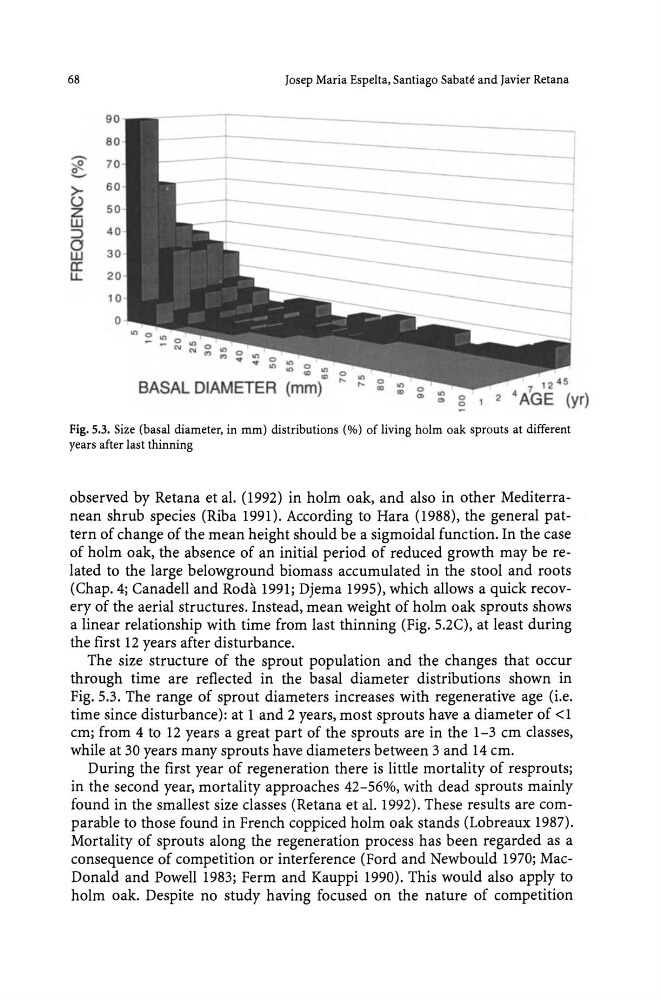
Fig. 5.3. Size (basal diameter, in mm) distributions (%) of living holm oak sprouts at different
years after last thinning
observed by Retana et al. (1992) in holm oak, and also in other Mediterranean shrub species (Riba 1991). According to Hara (1988), the general pattern of change of the mean height should be a sigmoidal function. In the case
of holm oak, the absence of an initial period of reduced growth may be related to the large belowground biomass accumulated in the stool and roots
(Chap. 4; Canadell and Roda 1991; Djema 1995), which allows a quick recovery of the aerial structures. Instead, mean weight of holm oak sprouts shows
a linear relationship with time from last thinning (Fig. 5.2C), at least during
the first 12 years after disturbance.
The size structure of the sprout population and the changes that occur
through time are reflected in the basal diameter distributions shown in
Fig. 5.3. The range of sprout diameters increases with regenerative age (i.e.
time since disturbance); at 1 and 2 years, most sprouts have a diameter of <1
cm; from 4 to 12 years a great part of the sprouts are in the 1-3 cm classes,
while at 30 years many sprouts have diameters between 3 and 14 cm.
During the first year of regeneration there is little mortality of resprouts;
in the second year, mortality approaches 42-56%, with dead sprouts mainly
found in the smallest size classes (Retana et al. 1992). These results are comparable to those found in French coppiced holm oak stands (Lobreaux 1987).
Mortality of sprouts along the regeneration process has been regarded as a
consequence of competition or interference (Ford and Newbould 1970; MacDonald and Powell 1983; Ferm and Kauppi 1990). This would also apply to
holm oak. Despite no study having focused on the nature of competition
b
z w
::::>
a w
a: LL
Josep Maria Espelta, Santiago Sabate and Javier Retana
~--+--- -
'"
...
BASAL DIAMETER (mm)
--- - - - -
------ -- ----I
-It)
0
aI
0
1 2
Fig. 5.3. Size (basal diameter, in mm) distributions (%) of living holm oak sprouts at different
years after last thinning
observed by Retana et al. (1992) in holm oak, and also in other Mediterranean shrub species (Riba 1991). According to Hara (1988), the general pattern of change of the mean height should be a sigmoidal function. In the case
of holm oak, the absence of an initial period of reduced growth may be related to the large belowground biomass accumulated in the stool and roots
(Chap. 4; Canadell and Roda 1991; Djema 1995), which allows a quick recovery of the aerial structures. Instead, mean weight of holm oak sprouts shows
a linear relationship with time from last thinning (Fig. 5.2C), at least during
the first 12 years after disturbance.
The size structure of the sprout population and the changes that occur
through time are reflected in the basal diameter distributions shown in
Fig. 5.3. The range of sprout diameters increases with regenerative age (i.e.
time since disturbance); at 1 and 2 years, most sprouts have a diameter of <1
cm; from 4 to 12 years a great part of the sprouts are in the 1-3 cm classes,
while at 30 years many sprouts have diameters between 3 and 14 cm.
During the first year of regeneration there is little mortality of resprouts;
in the second year, mortality approaches 42-56%, with dead sprouts mainly
found in the smallest size classes (Retana et al. 1992). These results are comparable to those found in French coppiced holm oak stands (Lobreaux 1987).
Mortality of sprouts along the regeneration process has been regarded as a
consequence of competition or interference (Ford and Newbould 1970; MacDonald and Powell 1983; Ferm and Kauppi 1990). This would also apply to
holm oak. Despite no study having focused on the nature of competition