

Structure and Dynamics of the Root System
49
4.3 Structure of the Root System
Taproots of holm oak usually grow quite rapidly into deep soil layers at early
stages of seedling development. However, the dominance of a vertical single
taproot in seedlings is often lost in mature trees. In the shallow soils of
north-facing slopes in Montseny, most of the trees did not have a clear central taproot, while those growing on south-facing slopes, with deeper (> 1 m)
and drier soils, frequently showed a large taproot. In Prades, where the climate is drier than in Montseny, 60% of the excavated trees had taproots.
Thus, although the data are only correlational at this point, holm oak has
taproots more often when growing in drier environments than in mesic sites.
In any case, however, holm oak has the capacity to send roots quite deep in
the soil profile when the substrate can be penetrated. Roots were observed at
3.0-m depth in a road cut on schists at Montseny and at a depth of 3.7 m in
sandstone substrate elsewhere (Canadell et al. 1996). The presence of deep
roots is thought to be orie of the mechanisms for surviving summer drought.
Maximum rooting depths of other evergreen tree species were between 2.7
and 40 m (Canadell et al. 1996) and 23 m for Quercus wislizenii in California
(Lewis and Burgy 1964). Data for holm oak from deep root excavations
(> 3 m) are not available. We have also observed plants of holm oak growing
on very shallow soils with most of the root system growing in soft rocks (e.g.
sandstone) or in-between the schistosity planes of slates with hardly any soil.
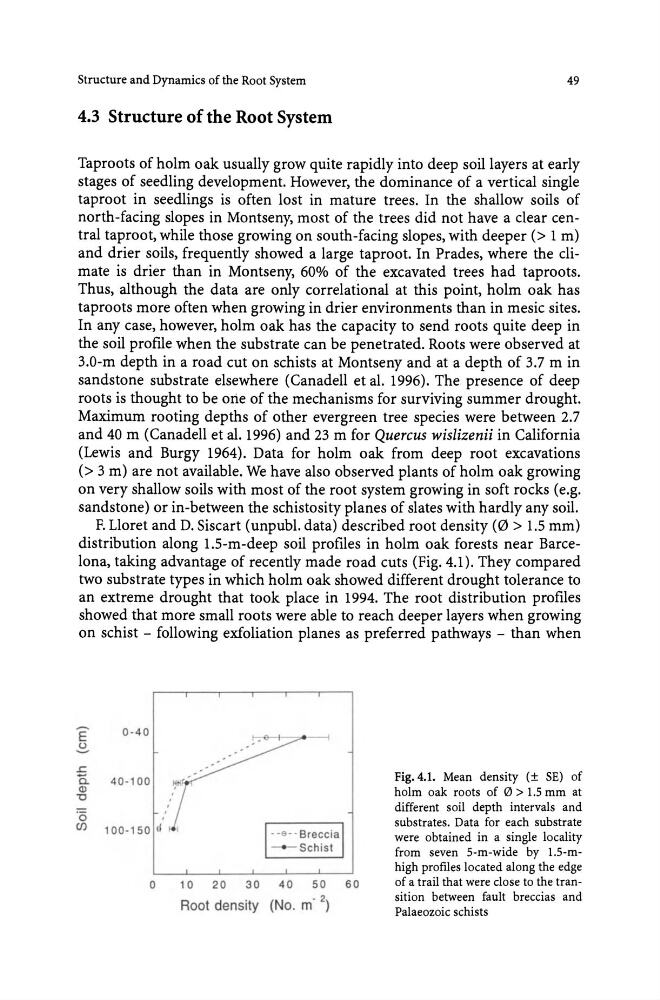
F. Lloret and D. Siscart (unpubl. data) described root density (0 > 1.5 mm)
distribution along l.5-m-deep soil profiles in holm oak forests near Barcelona, taking advantage of recently made road cuts (Fig. 4.1). They compared
two substrate types in which holm oak showed different drought tolerance to
an extreme drought that took place in 1994. The root distribution profiles
showed that more small roots were able to reach deeper layers when growing
on schist - following exfoliation planes as preferred pathways - than when
E
~
~
a.
Ql
'0
'0
(f)
0-40
40-100
o 10 20 30 40 50 60
- 2
Root density (No. m )
Fig.4.1. Mean density (± SE) of
holm oak roots of Q) > 1.5 mm at
different soil depth intervals and
substrates. Data for each substrate
were obtained in a single locality
from seven 5-m-wide by l.5-mhigh profiles located along the edge
of a trail that were close to the transition between fault breccias and
Palaeozoic schists
49
4.3 Structure of the Root System
Taproots of holm oak usually grow quite rapidly into deep soil layers at early
stages of seedling development. However, the dominance of a vertical single
taproot in seedlings is often lost in mature trees. In the shallow soils of
north-facing slopes in Montseny, most of the trees did not have a clear central taproot, while those growing on south-facing slopes, with deeper (> 1 m)
and drier soils, frequently showed a large taproot. In Prades, where the climate is drier than in Montseny, 60% of the excavated trees had taproots.
Thus, although the data are only correlational at this point, holm oak has
taproots more often when growing in drier environments than in mesic sites.
In any case, however, holm oak has the capacity to send roots quite deep in
the soil profile when the substrate can be penetrated. Roots were observed at
3.0-m depth in a road cut on schists at Montseny and at a depth of 3.7 m in
sandstone substrate elsewhere (Canadell et al. 1996). The presence of deep
roots is thought to be orie of the mechanisms for surviving summer drought.
Maximum rooting depths of other evergreen tree species were between 2.7
and 40 m (Canadell et al. 1996) and 23 m for Quercus wislizenii in California
(Lewis and Burgy 1964). Data for holm oak from deep root excavations
(> 3 m) are not available. We have also observed plants of holm oak growing
on very shallow soils with most of the root system growing in soft rocks (e.g.
sandstone) or in-between the schistosity planes of slates with hardly any soil.
F. Lloret and D. Siscart (unpubl. data) described root density (0 > 1.5 mm)
distribution along l.5-m-deep soil profiles in holm oak forests near Barcelona, taking advantage of recently made road cuts (Fig. 4.1). They compared
two substrate types in which holm oak showed different drought tolerance to
an extreme drought that took place in 1994. The root distribution profiles
showed that more small roots were able to reach deeper layers when growing
on schist - following exfoliation planes as preferred pathways - than when
E
~
~
a.
Ql
'0
'0
(f)
0-40
40-100
o 10 20 30 40 50 60
- 2
Root density (No. m )
Fig.4.1. Mean density (± SE) of
holm oak roots of Q) > 1.5 mm at
different soil depth intervals and
substrates. Data for each substrate
were obtained in a single locality
from seven 5-m-wide by l.5-mhigh profiles located along the edge
of a trail that were close to the transition between fault breccias and
Palaeozoic schists