

Soil Arthropods
345
limiting than water deficit. Above a critical threshold characteristic of each
species (pF = 4.7-5 in most Collembola or pF = 5-6 in oribatid mites; Vannier 1971), survival depends on the ability of the animals either to endure the
dry periods in an inactive state (by delaying egg hatching or by living in a
state of diapause or dormancy), to aggregate in moist microhabitats or to
migrate to the deeper soil layers (Poinsot-Balaguer 1988).
Summer drought gives rise to the minimum annual arthropod density
(10000 individuals m- 2 in Montseny; 98 580 individuals m- 2 in Prades). At
this time, oribatid mites account for 82% of the arthropods, and most of the
taxa, mainly Prostigmata and myriapods (except Diplopoda, whose density
remains similar to the annual mean), disappear from the soil. This dramatic
density fall is partly explained by mortality but is also overestimated by the
abundance of inactive forms that are not captured by Berlese-Tullgren funnels.
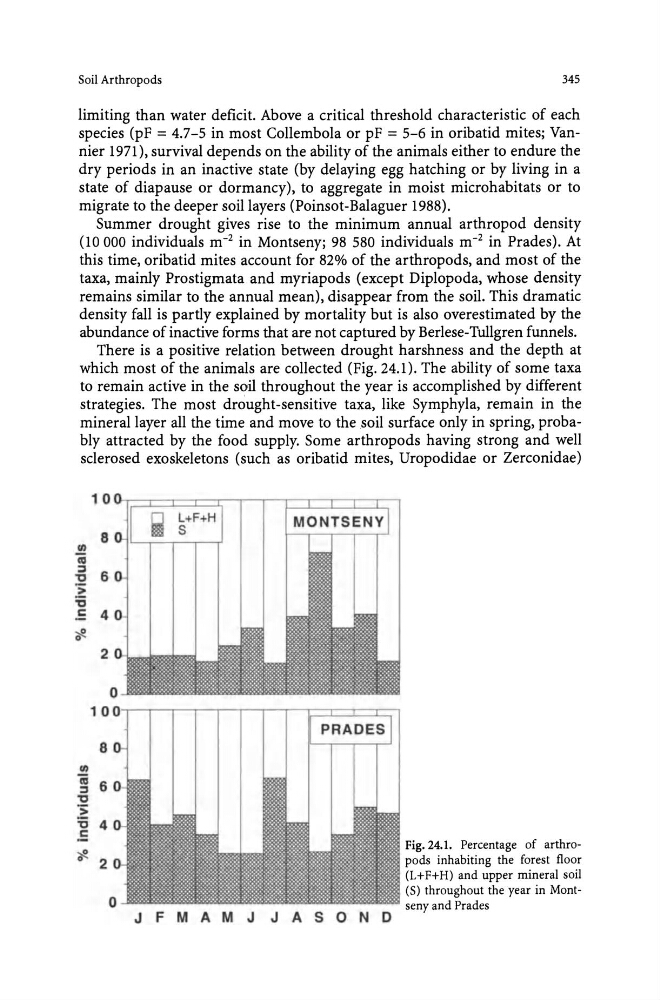
There is a positive relation between drought harshness and the depth at
which most of the animals are collected (Fig. 24.1). The ability of some taxa
to remain active in the soil throughout the year is accomplished by different
strategies. The most drought-sensitive taxa, like Symphyla, remain in the
mineral layer all the time and move to the soil surface only in spring, probably attracted by the food supply. Some arthropods having strong and well
sclerosed exoskeletons (such as oribatid mites, Uropodidae or Zerconidae)
10
8
!!2
ca
::J 6
'1:J
>
:s c 4
~
0
2
8
o
o
2
~
L+F+H
S
J F M A M J J A SON 0
Fig. 24.1. Percentage of arthropods inhabiting the forest floor
(L+F+H) and upper mineral soil
(5) throughout the year in Montseny and Prades
345
limiting than water deficit. Above a critical threshold characteristic of each
species (pF = 4.7-5 in most Collembola or pF = 5-6 in oribatid mites; Vannier 1971), survival depends on the ability of the animals either to endure the
dry periods in an inactive state (by delaying egg hatching or by living in a
state of diapause or dormancy), to aggregate in moist microhabitats or to
migrate to the deeper soil layers (Poinsot-Balaguer 1988).
Summer drought gives rise to the minimum annual arthropod density
(10000 individuals m- 2 in Montseny; 98 580 individuals m- 2 in Prades). At
this time, oribatid mites account for 82% of the arthropods, and most of the
taxa, mainly Prostigmata and myriapods (except Diplopoda, whose density
remains similar to the annual mean), disappear from the soil. This dramatic
density fall is partly explained by mortality but is also overestimated by the
abundance of inactive forms that are not captured by Berlese-Tullgren funnels.
There is a positive relation between drought harshness and the depth at
which most of the animals are collected (Fig. 24.1). The ability of some taxa
to remain active in the soil throughout the year is accomplished by different
strategies. The most drought-sensitive taxa, like Symphyla, remain in the
mineral layer all the time and move to the soil surface only in spring, probably attracted by the food supply. Some arthropods having strong and well
sclerosed exoskeletons (such as oribatid mites, Uropodidae or Zerconidae)
10
8
!!2
ca
::J 6
'1:J
>
:s c 4
~
0
2
8
o
o
2
~
L+F+H
S
J F M A M J J A SON 0
Fig. 24.1. Percentage of arthropods inhabiting the forest floor
(L+F+H) and upper mineral soil
(5) throughout the year in Montseny and Prades