

342
Pilar Andres, Eduardo Mateos and Carlos Ascaso
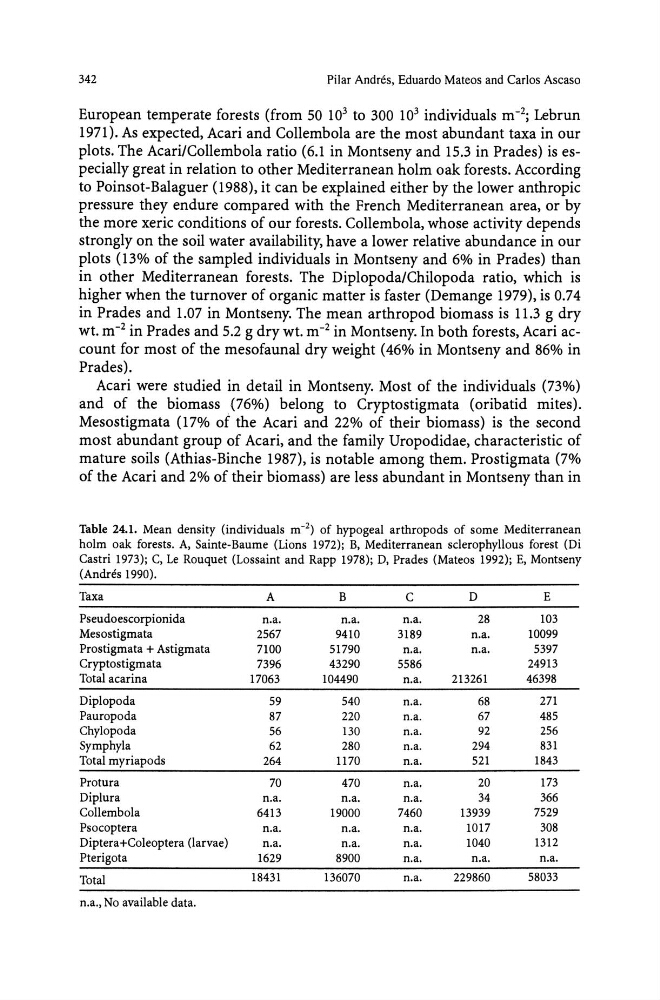
European temperate forests (from 50 10 3 to 300 10 3 individuals m- 2 j Lebrun
1971). As expected, Acari and Collembola are the most abundant taxa in our
plots. The Acari/Collembola ratio (6.1 in Montseny and 15.3 in Prades) is especially great in relation to other Mediterranean holm oak forests. According
to Poinsot-Balaguer (1988), it can be explained either by the lower anthropic
pressure they endure compared with the French Mediterranean area, or by
the more xeric conditions of our forests. Collembola, whose activity depends
strongly on the soil water availability, have a lower relative abundance in our
plots (13% of the sampled individuals in Montseny and 6% in Prades) than
in other Mediterranean forests. The Diplopoda/Chilopoda ratio, which is
higher when the turnover of organic matter is faster (Demange 1979), is 0.74
in Prades and 1.07 in Montseny. The mean arthropod biomass is 11.3 g dry
wt. m- 2 in Prades and 5.2 g dry wt. m- 2 in Montseny. In both forests, Acari account for most of the mesofaunal dry weight (46% in Montseny and 86% in
Prades).
Acari were studied in detail in Montseny. Most of the individuals (73%)
and of the biomass (76%) belong to Cryptostigmata (oribatid mites).
Mesostigmata (17% of the Acari and 22% of their biomass) is the second
most abundant group of Acari, and the family Uropodidae, characteristic of
mature soils (Athias-Binche 1987), is notable among them. Prostigmata (7%
of the Acari and 2% of their biomass) are less abundant in Montseny than in
Table 24.1. Mean density (individuals m- 2 ) of hypogeal arthropods of some Mediterranean
holm oak forests. A, Sainte-Baume (Lions 1972); B, Mediterranean sclerophyllous forest (Di
Castri 1973); C, Le Rouquet (Lossaint and Rapp 1978); D, Prades (Mateos 1992); E, Montseny
(Andres 1990).
Taxa
A
B
C
D
E
Pseudoescorpionida
n.a.
n.a.
n.a.
28
103
Mesostigmata
2567
9410
3189
n.a.
10099
Prostigmata + Astigmata
7100
51790
n.a.
n.a.
5397
Cryptostigmata
7396
43290
5586
24913
Total acarina
17063
104490
n.a.
213261
46398
Diplopoda
59
540
n.a.
68
271
Pauropoda
87
220
n.a.
67
485
Chylopoda
56
130
n.a.
92
256
Symphyla
62
280
n.a.
294
831
Total myriapods
264
1170
n.a.
521
1843
Protura
70
470
n.a.
20
173
Diplura
n.a.
n.a.
n.a.
34
366
Collembola
6413
19000
7460
13939
7529
Psocoptera
n.a.
n.a.
n.a.
1017
308
Diptera+Coleoptera (larvae)
n.a.
n.a.
n.a.
1040
1312
Pterigota
1629
8900
n.a.
n.a.
n.a.
Total
18431
136070
n.a.
229860
58033
n.a., No available data.
Pilar Andres, Eduardo Mateos and Carlos Ascaso
European temperate forests (from 50 10 3 to 300 10 3 individuals m- 2 j Lebrun
1971). As expected, Acari and Collembola are the most abundant taxa in our
plots. The Acari/Collembola ratio (6.1 in Montseny and 15.3 in Prades) is especially great in relation to other Mediterranean holm oak forests. According
to Poinsot-Balaguer (1988), it can be explained either by the lower anthropic
pressure they endure compared with the French Mediterranean area, or by
the more xeric conditions of our forests. Collembola, whose activity depends
strongly on the soil water availability, have a lower relative abundance in our
plots (13% of the sampled individuals in Montseny and 6% in Prades) than
in other Mediterranean forests. The Diplopoda/Chilopoda ratio, which is
higher when the turnover of organic matter is faster (Demange 1979), is 0.74
in Prades and 1.07 in Montseny. The mean arthropod biomass is 11.3 g dry
wt. m- 2 in Prades and 5.2 g dry wt. m- 2 in Montseny. In both forests, Acari account for most of the mesofaunal dry weight (46% in Montseny and 86% in
Prades).
Acari were studied in detail in Montseny. Most of the individuals (73%)
and of the biomass (76%) belong to Cryptostigmata (oribatid mites).
Mesostigmata (17% of the Acari and 22% of their biomass) is the second
most abundant group of Acari, and the family Uropodidae, characteristic of
mature soils (Athias-Binche 1987), is notable among them. Prostigmata (7%
of the Acari and 2% of their biomass) are less abundant in Montseny than in
Table 24.1. Mean density (individuals m- 2 ) of hypogeal arthropods of some Mediterranean
holm oak forests. A, Sainte-Baume (Lions 1972); B, Mediterranean sclerophyllous forest (Di
Castri 1973); C, Le Rouquet (Lossaint and Rapp 1978); D, Prades (Mateos 1992); E, Montseny
(Andres 1990).
Taxa
A
B
C
D
E
Pseudoescorpionida
n.a.
n.a.
n.a.
28
103
Mesostigmata
2567
9410
3189
n.a.
10099
Prostigmata + Astigmata
7100
51790
n.a.
n.a.
5397
Cryptostigmata
7396
43290
5586
24913
Total acarina
17063
104490
n.a.
213261
46398
Diplopoda
59
540
n.a.
68
271
Pauropoda
87
220
n.a.
67
485
Chylopoda
56
130
n.a.
92
256
Symphyla
62
280
n.a.
294
831
Total myriapods
264
1170
n.a.
521
1843
Protura
70
470
n.a.
20
173
Diplura
n.a.
n.a.
n.a.
34
366
Collembola
6413
19000
7460
13939
7529
Psocoptera
n.a.
n.a.
n.a.
1017
308
Diptera+Coleoptera (larvae)
n.a.
n.a.
n.a.
1040
1312
Pterigota
1629
8900
n.a.
n.a.
n.a.
Total
18431
136070
n.a.
229860
58033
n.a., No available data.