

Biogeochemical Models
301
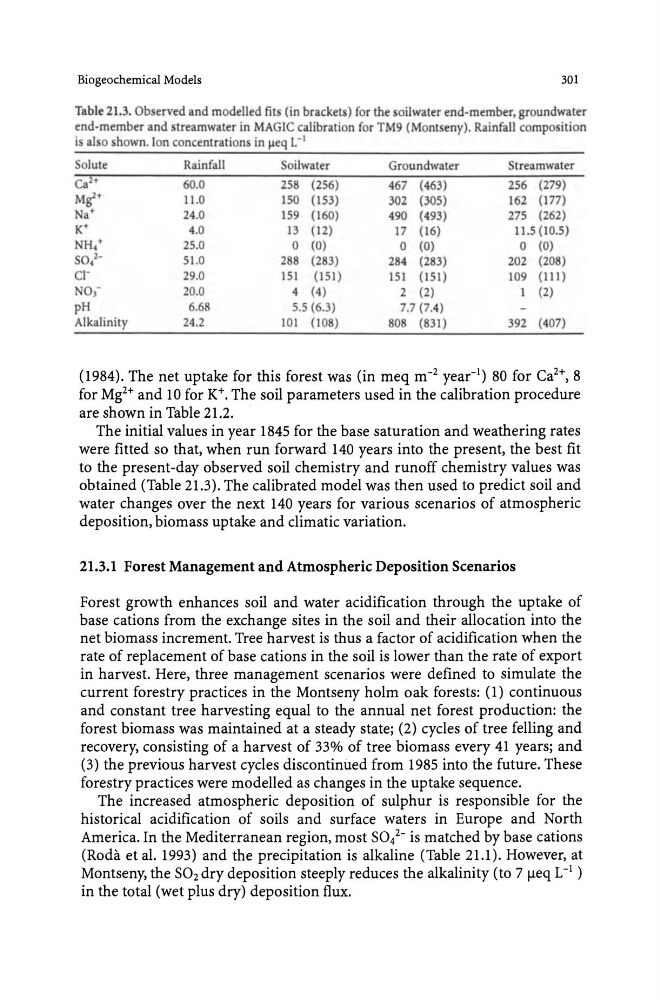
Table 21.3. Observed and modelled fits (in brackets) for the oilwater end-member, groundwater
end-member and streamwater in MAGIC calibration for TM9 (Montseny). Rainfall composition
i al 0 shown. Ion concentrations in ~eq L- 1
Solute
Rainfall
Soilwater
Groundwater
treamwater
Cal+
60.0
258 (256)
467 (463)
256 (279)
Mt+
11.0
150 (153)
302 (305)
162 (In)
Na+
24.0
159 (160)
490 (493)
275 (262)
K+
4.0
13 (l2)
17 (16)
11.5 (10.5)
NH.+
25.0
0 (0)
0 (0)
0 (0)
sol51.0
288 (283)
284 (283)
202 (208)
cr
29.0
151 (151 )
151 (151)
109 (I) 1)
O,20.0
4 (4)
2 (2)
1 (2)
pH
6.68
5.5 (6.3)
7.7 (7.4)
Alkalinity
24.2
101 (108)
808 (831)
392 (407)
(1984). The net uptake for this forest was (in meq m- 2 year-I) 80 for Ca z +, 8
for Mgz+ and 10 for K+. The soil parameters used in the calibration procedure
are shown in Table 21.2.
The initial values in year 1845 for the base saturation and weathering rates
were fitted so that, when run forward 140 years into the present, the best fit
to the present-day observed soil chemistry and runoff chemistry values was
obtained (Table 21.3). The calibrated model was then used to predict soil and
water changes over the next 140 years for various scenarios of atmospheric
deposition, biomass uptake and climatic variation.
21.3.1 Forest Management and Atmospheric Deposition Scenarios
Forest growth enhances soil and water acidification through the uptake of
base cations from the exchange sites in the soil and their allocation into the
net biomass increment. Tree harvest is thus a factor of acidification when the
rate of replacement of base cations in the soil is lower than the rate of export
in harvest. Here, three management scenarios were defined to simulate the
current forestry practices in the Montseny holm oak forests: (1) continuous
and constant tree harvesting equal to the annual net forest production: the
forest biomass was maintained at a steady state; (2) cycles of tree felling and
recovery, consisting of a harvest of 33% of tree biomass every 41 years; and
(3) the previous harvest cycles discontinued from 1985 into the future. These
forestry practices were modelled as changes in the uptake sequence.
The increased atmospheric deposition of sulphur is responsible for the
historical acidification of soils and surface waters in Europe and North
America. In the Mediterranean region, most sol- is matched by base cations
(Roda et al. 1993) and the precipitation is alkaline (Table 21.1). However, at
Montseny, the SOz dry deposition steeply reduces the alkalinity (to 7 fleq L -1 )
in the total (wet plus dry) deposition flux.
301
Table 21.3. Observed and modelled fits (in brackets) for the oilwater end-member, groundwater
end-member and streamwater in MAGIC calibration for TM9 (Montseny). Rainfall composition
i al 0 shown. Ion concentrations in ~eq L- 1
Solute
Rainfall
Soilwater
Groundwater
treamwater
Cal+
60.0
258 (256)
467 (463)
256 (279)
Mt+
11.0
150 (153)
302 (305)
162 (In)
Na+
24.0
159 (160)
490 (493)
275 (262)
K+
4.0
13 (l2)
17 (16)
11.5 (10.5)
NH.+
25.0
0 (0)
0 (0)
0 (0)
sol51.0
288 (283)
284 (283)
202 (208)
cr
29.0
151 (151 )
151 (151)
109 (I) 1)
O,20.0
4 (4)
2 (2)
1 (2)
pH
6.68
5.5 (6.3)
7.7 (7.4)
Alkalinity
24.2
101 (108)
808 (831)
392 (407)
(1984). The net uptake for this forest was (in meq m- 2 year-I) 80 for Ca z +, 8
for Mgz+ and 10 for K+. The soil parameters used in the calibration procedure
are shown in Table 21.2.
The initial values in year 1845 for the base saturation and weathering rates
were fitted so that, when run forward 140 years into the present, the best fit
to the present-day observed soil chemistry and runoff chemistry values was
obtained (Table 21.3). The calibrated model was then used to predict soil and
water changes over the next 140 years for various scenarios of atmospheric
deposition, biomass uptake and climatic variation.
21.3.1 Forest Management and Atmospheric Deposition Scenarios
Forest growth enhances soil and water acidification through the uptake of
base cations from the exchange sites in the soil and their allocation into the
net biomass increment. Tree harvest is thus a factor of acidification when the
rate of replacement of base cations in the soil is lower than the rate of export
in harvest. Here, three management scenarios were defined to simulate the
current forestry practices in the Montseny holm oak forests: (1) continuous
and constant tree harvesting equal to the annual net forest production: the
forest biomass was maintained at a steady state; (2) cycles of tree felling and
recovery, consisting of a harvest of 33% of tree biomass every 41 years; and
(3) the previous harvest cycles discontinued from 1985 into the future. These
forestry practices were modelled as changes in the uptake sequence.
The increased atmospheric deposition of sulphur is responsible for the
historical acidification of soils and surface waters in Europe and North
America. In the Mediterranean region, most sol- is matched by base cations
(Roda et al. 1993) and the precipitation is alkaline (Table 21.1). However, at
Montseny, the SOz dry deposition steeply reduces the alkalinity (to 7 fleq L -1 )
in the total (wet plus dry) deposition flux.