

298
Anna Avila
practices and varying loads of atmospheric deposition (Neal et al. 1995) and
the influence of climatic change (Avila et al. 1996) on the soil status and
streamwater chemistry. The application of MAGIC in the drier Prades catchments - an environment which is quite distinct from the cold-temperate
mid-latitude site environments usually modelled - provided a test of the
model's wider applicability (Bellot et al. 1994, 1995).
21.2 Description of MAGIC
MAGIC, developed by J. Cosby and collaborators at the University of Virginia, is one of the more widely used models for long-term prediction of
catchment response under different environmental scenarios (Cosby et al.
1985a, b). MAGIC consists of two main sets of equations:
1. Equilibria equations between the soil and the soil solution in which the
chemical composition of the soil solution is assumed to be controlled by
soil reactions involving sulphate adsorption, cation exchange, dissolution
and precipitation of aluminium and dissolution of inorganic carbon.
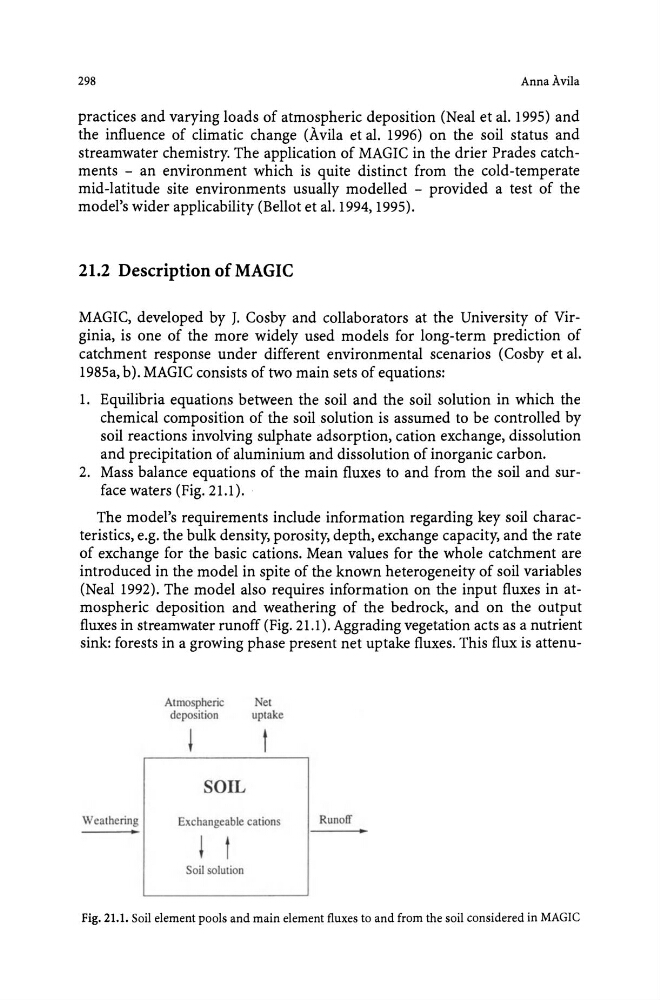
2. Mass balance equations of the main fluxes to and from the soil and surface waters (Fig. 21.1).
The model's requirements include information regarding key soil characteristics, e.g. the bulk density, porosity, depth, exchange capacity, and the rate
of exchange for the basic cations. Mean values for the whole catchment are
introduced in the model in spite of the known heterogeneity of soil variables
(Neal 1992). The model also requires information on the input fluxes in atmospheric deposition and weathering of the bedrock, and on the output
fluxes in streamwater runoff (Fig. 21.1). Aggrading vegetation acts as a nutrient
sink: forests in a growing phase present net uptake fluxes . This flux is attenuAtmospheric
et
deposition
uptake
SOIL
Weathering
Exchangeable cations
Runoff
.
Soil solution
Fig. 21.1. Soil element pools and main element fluxes to and from the soil considered in MAGIC
Anna Avila
practices and varying loads of atmospheric deposition (Neal et al. 1995) and
the influence of climatic change (Avila et al. 1996) on the soil status and
streamwater chemistry. The application of MAGIC in the drier Prades catchments - an environment which is quite distinct from the cold-temperate
mid-latitude site environments usually modelled - provided a test of the
model's wider applicability (Bellot et al. 1994, 1995).
21.2 Description of MAGIC
MAGIC, developed by J. Cosby and collaborators at the University of Virginia, is one of the more widely used models for long-term prediction of
catchment response under different environmental scenarios (Cosby et al.
1985a, b). MAGIC consists of two main sets of equations:
1. Equilibria equations between the soil and the soil solution in which the
chemical composition of the soil solution is assumed to be controlled by
soil reactions involving sulphate adsorption, cation exchange, dissolution
and precipitation of aluminium and dissolution of inorganic carbon.
2. Mass balance equations of the main fluxes to and from the soil and surface waters (Fig. 21.1).
The model's requirements include information regarding key soil characteristics, e.g. the bulk density, porosity, depth, exchange capacity, and the rate
of exchange for the basic cations. Mean values for the whole catchment are
introduced in the model in spite of the known heterogeneity of soil variables
(Neal 1992). The model also requires information on the input fluxes in atmospheric deposition and weathering of the bedrock, and on the output
fluxes in streamwater runoff (Fig. 21.1). Aggrading vegetation acts as a nutrient
sink: forests in a growing phase present net uptake fluxes . This flux is attenuAtmospheric
et
deposition
uptake
SOIL
Weathering
Exchangeable cations
Runoff
.
Soil solution
Fig. 21.1. Soil element pools and main element fluxes to and from the soil considered in MAGIC