

274
Josep Pinol, Anna Avila and Antoni Escarre
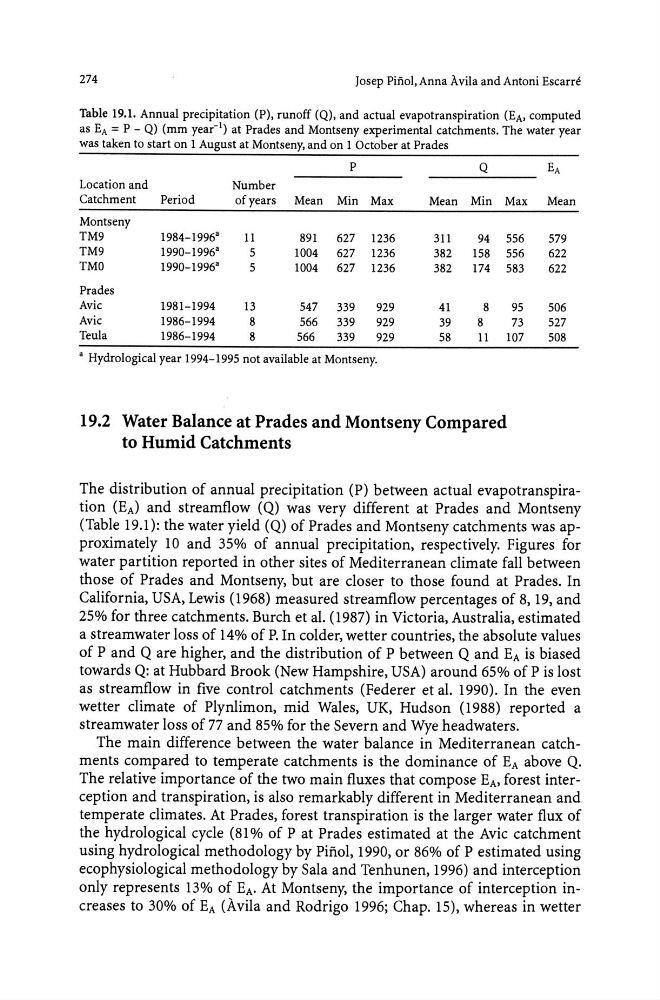
Table 19.1. Annual precipitation (P), runoff (Q), and actual evapotranspiration (EA, computed
as EA = P - Q) (mm year-I) at Prades and Montseny experimental catchments. The water year
was taken to start on 1 August at Montseny, and on 1 October at Prades
P
Q
Location and
Number
Catchment
Period
of years
Mean Min Max
Mean Min Max
Montseny
TM9
1984-1996"
11
891
627 1236
311
94 556
TM9
1990-1996"
5
1004
627 1236
382
158 556
TMO
1990-1996"
5
1004
627 1236
382
174 583
Prades
Avic
1981-1994
13
547
339
929
41
8
95
Avic
1986-1994
8
566
339
929
39
8
73
Teula
1986-1994
8
566
339
929
58
11 107
a Hydrological year 1994-1995 not available at Montseny.
19.2 Water Balance at Prades and Montseny Compared
to Humid Catchments
EA
Mean
579
622
622
506
527
508
The distribution of annual precipitation (P) between actual evapotranspiration (EA) and streamflow (Q) was very different at Prades and Montseny
(Table 19.1): the water yield (Q) of Prades and Montseny catchments was approximately 10 and 35% of annual precipitation, respectively. Figures for
water partition reported in other sites of Mediterranean climate fall between
those of Prades and Montseny, but are closer to those found at Prades. In
California, USA, Lewis (1968) measured streamflow percentages of 8, 19, and
25% for three catchments. Burch et al. (1987) in Victoria, Australia, estimated
a streamwater loss of 14% of P. In colder, wetter countries, the absolute values
of P and Q are higher, and the distribution of P between Q and EA is biased
towards Q: at Hubbard Brook (New Hampshire, USA) around 65% of P is lost
as streamflow in five control catchments (Federer et al. 1990). In the even
wetter climate of Plynlimon, mid Wales, UK, Hudson (1988) reported a
streamwater loss of 77 and 85% for the Severn and Wye headwaters.
The main difference between the water balance in Mediterranean catchments compared to temperate catchments is the dominance of EA above Q.
The relative importance of the two main fluxes that compose EA, forest interception and transpiration, is also remarkably different in Mediterranean and
temperate climates. At Prades, forest transpiration is the larger water flux of
the hydrological cycle (81 % of P at Prades estimated at the Avic catchment
using hydrological methodology by Pinol, 1990, or 86% of P estimated using
ecophysiological methodology by Sala and Tenhunen, 1996) and interception
only represents 13% of EA. At Montseny, the importance of interception increases to 30% of EA (Avila and Rodrigo 1996; Chap. 15), whereas in wetter
Josep Pinol, Anna Avila and Antoni Escarre
Table 19.1. Annual precipitation (P), runoff (Q), and actual evapotranspiration (EA, computed
as EA = P - Q) (mm year-I) at Prades and Montseny experimental catchments. The water year
was taken to start on 1 August at Montseny, and on 1 October at Prades
P
Q
Location and
Number
Catchment
Period
of years
Mean Min Max
Mean Min Max
Montseny
TM9
1984-1996"
11
891
627 1236
311
94 556
TM9
1990-1996"
5
1004
627 1236
382
158 556
TMO
1990-1996"
5
1004
627 1236
382
174 583
Prades
Avic
1981-1994
13
547
339
929
41
8
95
Avic
1986-1994
8
566
339
929
39
8
73
Teula
1986-1994
8
566
339
929
58
11 107
a Hydrological year 1994-1995 not available at Montseny.
19.2 Water Balance at Prades and Montseny Compared
to Humid Catchments
EA
Mean
579
622
622
506
527
508
The distribution of annual precipitation (P) between actual evapotranspiration (EA) and streamflow (Q) was very different at Prades and Montseny
(Table 19.1): the water yield (Q) of Prades and Montseny catchments was approximately 10 and 35% of annual precipitation, respectively. Figures for
water partition reported in other sites of Mediterranean climate fall between
those of Prades and Montseny, but are closer to those found at Prades. In
California, USA, Lewis (1968) measured streamflow percentages of 8, 19, and
25% for three catchments. Burch et al. (1987) in Victoria, Australia, estimated
a streamwater loss of 14% of P. In colder, wetter countries, the absolute values
of P and Q are higher, and the distribution of P between Q and EA is biased
towards Q: at Hubbard Brook (New Hampshire, USA) around 65% of P is lost
as streamflow in five control catchments (Federer et al. 1990). In the even
wetter climate of Plynlimon, mid Wales, UK, Hudson (1988) reported a
streamwater loss of 77 and 85% for the Severn and Wye headwaters.
The main difference between the water balance in Mediterranean catchments compared to temperate catchments is the dominance of EA above Q.
The relative importance of the two main fluxes that compose EA, forest interception and transpiration, is also remarkably different in Mediterranean and
temperate climates. At Prades, forest transpiration is the larger water flux of
the hydrological cycle (81 % of P at Prades estimated at the Avic catchment
using hydrological methodology by Pinol, 1990, or 86% of P estimated using
ecophysiological methodology by Sala and Tenhunen, 1996) and interception
only represents 13% of EA. At Montseny, the importance of interception increases to 30% of EA (Avila and Rodrigo 1996; Chap. 15), whereas in wetter